A20N, en-route, northwest Colombia, 2022
A20N, en-route, northwest Colombia, 2022
Summary
On 17 October 2022, an Airbus A320neo was unable to make an approach at either its intended destination of Riohacha or its designated alternate after those airports were both closed because of convective weather which developed over a significant part of Northern Columbia. A MAYDAY was declared due to low fuel and only 282 kg remained after the eventual landing at Santa Marta. Decision-making by both the aircraft operator and the flight crew and a lack of reliable communication between them was deemed contributory to what came very close to becoming a hull loss accident.
Flight Details
Aircraft
Type of Flight
Public Transport (Passenger)
Flight Origin
Intended Destination
Actual Destination
Take-off Commenced
Yes
Flight Airborne
Yes
Flight Completed
Yes
Phase of Flight
Cruise
General
Tag(s)
Destination Diversion,
Inadequate Aircraft Operator Procedures,
PIC less than 500 hours in Command on Type,
CVR overwritten
HF
Tag(s)
Plan Continuation Bias
LOC
Tag(s)
Environmental Factors,
Minimum Fuel Call
EPR
Tag(s)
MAYDAY declaration,
Fuel Status
Outcome
Damage or injury
No
Non-aircraft damage
No
Non-occupant Casualties
No
Off Airport Landing
No
Ditching
No
Causal Factor Group(s)
Group(s)
Aircraft Operation
Aircraft Technical
Air Traffic Management
Safety Recommendation(s)
Group(s)
Aircraft Operation
Air Traffic Management
Airport Management
Investigation Type
Type
Independent
Description
On 17 October 2022, an Airbus A320neo (HK5378) operated by Viva Air Colombia on a scheduled domestic passenger flight from Cali to Riohacha as VVC 8332 declared a MAYDAY FUEL after being unable to land at either its intended destination Riohacha, its designated alternate, or, subsequently at Rionegro due to a wide and expanding area of convective weather. The flight crew then determined that their best solution, given uncertainty in the unpredictable availability of airport weather closures in the area, was to head north to Santa Marta where better weather was more likely. They landed there with a recorded fuel remaining of only 282kg after being airborne for a total of 3 hours 40 minutes and burning 6,718 kg of fuel. The extended flight was completed in daylight.
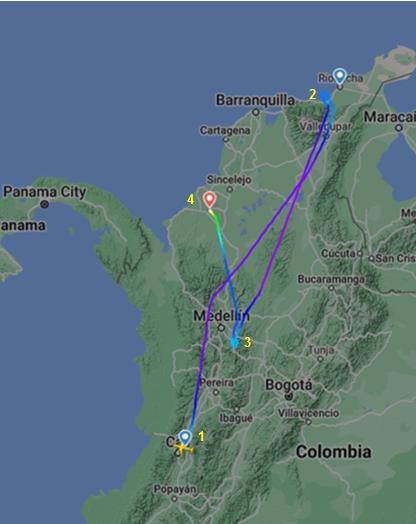
The flight track as flown: 1 Cali - 2 Riohacha - 3 Rionegro - 4 Santa Marta. [Reproduced from the Official Report]
Investigation
A Serious Incident investigation was carried out by the Colombian Technical Directorate of Accident Investigation (AIA)). Relevant data was downloaded from the digital flight data recorder (DFDR) but that from the cockpit voice recorder (CVR) was overwritten after the aircraft continued in service. Messages transmitted during the flight using the aircraft communications, addressing, and reporting system (ACARS) were also available.
The 53-year-old captain had a total of 15.000 hours flying experience, which included 330 hours on type, and was acting as pilot flying (PF) for the flight. Previous types flown included the De Havilland DHC6, the Airbus A330, the Boeing 737 and the Airbus A320. Since being unemployed for a little over a year during the Covid pandemic, he had been employed as a captain by Viva Colombia for seven months at the time of the flight. The 25-year-old first officer had a total of 1,612 hours flying experience, all but 202 hours of which had been on type. Both pilots were Colombian nationals.
What Happened
It was the crew’s third flight of the day, the earlier flights being from Cali to San Andres Island and back. Prior to departure for Riohacha, flight Despatch provided weather information which included the latest high level Significant Weather chart and destination and alternate forecasts and observations (TAFs and METARs). According to the captain’s report to the investigation, the METARs did not show anything significant, but the TAFs indicated a probable deterioration in the airports on the Colombian Caribbean coast. He noted that monitoring of conditions during the flight would be necessary to be able proceed to an appropriate alternate in place of the intended destination. The ramp fuel loaded for was 7,000 kg which consisted of planned round-trip fuel plus 679 kg which would be suffient for an additional 21 minutes airborne.
The aircraft departed Cali for Riohacha with 178 passengers on board just before 1030 Local Time (LT) with an estimated flight time of 1:45 with the captain acting as PF. The flight began its descent toward Riohacha at the usual position but when passing FL190, Air Traffic Control (ATC) advised that the destination airport had been “closed due to a storm." The captain decided to take up a holding pattern at 18,000 feet QNH in benign weather conditions whilst the options were evaluated. It was found that the three closest alternate airports along the Caribbean coast - Santa Marta, Barranquilla and Cartagena - were all subject to deteriorating weather conditions, so the captain decided to head south to the flight plan nominated alternate, Rionegro.
As Rionegro (which serves as Medellin’s International Airport) was neared after about an hour’s flight, the METAR indicated that although conditions at the time permitted normal operations, towering cumulus cloud was observed in the vicinity. Approach Control cleared the flight to descend to 16,000 feet without mentioning potential adverse weather issues at Rionegro even though such conditions were already announced on another approach frequency to which the flight was then transferred. At about this time, the flight crew received an ACARS message from their company advising that thunder and lightning was reported overhead Rionegro, and it became clear that traffic inbound to the airport was building up.
On checking in with Medellin South Approach Control, the flight clarified the delay to approach and was cleared to hold at FL150. Six minutes later, having reached 15,000 feet and joined the designated hold, the captain then queried the outlook in terms of an approach. He advised that his flight was already on diversion and “quite restricted in fuel” but would initially wait to see if an EAT (Expected Approach Time) was given. However, four minutes after this, a general broadcast on the frequency advised that the airport had just been closed altogether due to severe convective weather overhead.
Several other aircraft responded by requesting to proceed to alternate airports, and three minutes later, the flight declared ‘MINIMUM FUEL’. On the controller’s confirmation that an immediate approach to runway 01 would not be possible, the flight requested clearance to position to an alternative holding pattern used for approaches to runway 19, which appeared at that time to be more likely to become available when the adverse weather cleared.
However, on hearing the latest special weather report (SPECI), the flight requested an immediate climb to FL210 and declared a “MAYDAY FUEL” and requested permission to proceed directly to Montería, which was approved. The captain reported that when the route to Montería was programmed with FL210 and the expected speed and approach, the multifunction control and display unit (MCDU) indicated that 400 kg of fuel would remain on arrival there.
A few minutes later, the transponder was selected to 7700 and thereafter, the diversion was completed without further developments. The aircraft landed on runway 32 at Monteria 36 minutes after the emergency had been declared and continued taxiing to the terminal apron under its own power. The crew and passengers then disembarked normally. The investigation considered from the evidence available that “despite the circumstances," throughout the flight, including the emergency declaration and diversion thereafter, the flight crew had “maintained a calm, professional and assertive disposition in their actions and in communications with ATC."
Why It Happened
The investigation found that an undesirable situation developed when weather conditions over northern Colombia were unstable and when a lot of convective activity was likely to develop rapidly during the course of the day, particularly in the afternoon and early evening. It was noted that the month of October invariably involves the area being “widely influenced by the interaction of the ITCZ (intertropical convergence zone) and by Tropical Waves." This situation requires that the operational risk management focus must be enhanced in the afternoon hours when high atmospheric humidity leads to significant convective activity.
In such circumstances, it was to be expected that aerodrome forecasts would need almost continuous updating and become a key consideration when making operational decisions. Proactive identification of adverse tropical weather situations should have led to mitigation of negative impacts but there was insufficient recognition of likely changes. A more diligent analysis of the synoptic situation could have predicted areas of high convective activity and if observed by or communicated to an aircraft in flight their consequences could have been more effectively mitigated.
It was found that it was not clear whether the criteria for the selection of destination alternates included in Volume 1 of the operations manual (OM) were intended to be mandatory or discretionary when applied predeparture or en route. The failure to specify a second alternate in the flight plan as standard was noted - its absence in this event resulted in the captain having to make complex en route decisions on his own as the fuel reduced to dangerously low levels.
The captain was asked why he had chosen not to follow a suggestion made by the company operations control centre (OCC) whilst in the hold at Riohacha to divert to Santa Marta.. He responded that his assessment of the four available destination weather reports led to the decision to head south to Rionegro as the planned diversion. Under further questioning, he noted that at the time Santa Marta “was ruled out because the weather conditions at the time would not have permitted a landing” but also due to consideration of crew duty time regulations and the reduced inconvenience to passengers eventually reaching their intended destination from Rionegro, the nominated alternate, which was a major flight hub.
However, it was noted that although adverse weather was widespread across the whole of northern Columbia throughout much of the day, it was not continuously affecting specific locations for very long. This meant that, subject to having plenty of fuel on board, it would have made more sense to divert to Santa Marta originally even if a temporary closure had occurred there. The possibility of a temporary closure of the more distant and much busier airport at Rionegro, which had the potential to diminish fuel endurance significantly, could not be eliminated even though it was evident that the issued TAFs had not presented the probability and duration of adverse weather episodes at individual airports very well.
It was found that there was no visual presentation of meteorological satellite images in real time (such as those included in the investigation report like the one illustrated below for the time when the MAYDAY was declared) for controllers at the Medillin (Rionegro-SKRG) Area Control Centre (ACC) and concluded that this absence should be rectified to improve air traffic management in the presence of adverse convective weather.
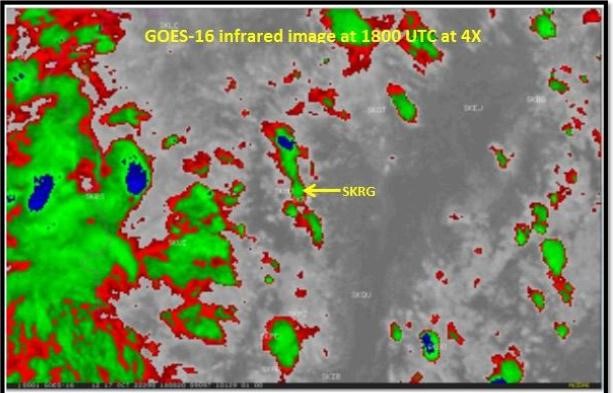
One of the satellite images obtained during the Investigation. [Reproduced from the Official Report]
It was noted that it had been impossible to properly assess the effectiveness of crew resource management (CRM) on the flight deck due to the aircraft operator’s failure to ensure the CVR was secured on arrival at Montería.
The suboptimal role of the OCC/Despatch function at the operator indicated it would be appropriate to share the findings of the investigation with their operations officers “to reinforce the consultation of meteorological information sources and the obtaining of meteorological products such as surface analysis charts, which give a general overview of synoptic phenomena that affect the country and that can provide elements of judgment for decision making” both directly by them and by the captains of already-airborne aircraft.
Finally, it was noted that traffic congestion caused by adverse weather at Rionegro which had rendered it unsuitable for unlimited nomination as an alternate was directly associated with the fact that only one end of the 3,400 metre-long runway (01) could be used for instrument approaches. It was therefore considered that an evaluation of how the only approach to runway 19 - a visual circling approach - could be replaced by one or more instrument approaches with or without changing the threshold of runway 01.
It was observed that at the time, Company OM Volume 1 Chapter 4 on diversion decision-making had only advisory status but were it upgraded to policy, flight crew would regard its table of alternate considerations as policy rather than guidance and in such circumstances, “the Captain would probably have proceeded to Santa Marta instead of Rionegro”.
The Probable Cause of the serious incident was determined to have been dynamic development of adverse weather conditions causing the closure of the destination airport (Riohacha) and the closure of the aerodrome preselected as the only alternate aerodrome (Rionegra).
Three Contributory Factors were also identified as follows:
- The lack of more up-to-date information in the meteorological information sources that considered and provided a thorough analysis of the convective evolution in real time.
- The dynamic development of adverse weather conditions affecting other aerodromes close to the flight that could have been considered as possible alternate aerodromes.
- Difficulties in immediate decision-making by both the crew and the despatch - the ACARS communications system performed intermittently for communication between the flight crew and the operator with some messages transmitted in both directions disconcertingly blocked in the system and not received in a timely manner.
A total of 8 Safety Recommendations were made as a result of this Investigation as follows: - that Viva Air Colombia should disseminate and make known the results of this investigation to their operations and dispatch officers, in order to reinforce the sources of meteorological information and the obtaining and distribution of meteorological products, such as surface analysis charts, in the planning and monitoring of flights, which provide a general overview of synoptic phenomena that affect the country and that can be a source of information to carry out a better analysis that benefits operations. [REC 01-202272-2]
- that Viva Air Colombia should carry out a reinforcement review with the operator's flight crew about the procedures and duties to follow for the preservation of the CVR records when an event occurs during the flight. It should be emphasised that the records are provided to help determine the causes of accidents or incidents within an investigation. [REC 02-202272-2]
- that Viva Air Colombia should conduct a reinforcement review with their flight crew, regarding the integral concepts of CRM. Emphasis should be placed on the optimal use of all available resources - human resources, communications and teamwork among others - in order to achieve efficiency and increase safety in air operations. [REC 03-202272-2]
- that Viva Air Colombia should review their criteria for the selection of alternate airports clarifying whether the options stipulated in Table 4.1 of the Operations Manual Volume 1 Chapter 4 are or are not binding for Dispatch and/or in decision-making for flight crew. In addition, the inclusion of a second alternate aerodrome in the Operational Flight Plan should be evaluated as a standard company procedure, when destination airports do not have weather forecasts at the time of flight dispatch. [REC 04-202272-2]
- that Viva Air Colombia should review their airport classification criteria by risk in relation to Santa Marta Airport and review its classification according to the corresponding parameters in Operations Manual Volume XII section 4.1.1.1 versus those in Operations Manual Volume XII section 4.1.4.14 according to the sum of the risks described - Runway Length, Runway Width, Topography, Meteorology, and Navigation Procedures since it should probably be considered a “HIGH RISK Special Airport”. [REC 05-202272-2]
- that The Civil Aeronautics Secretariat of Air Navigation Services (SSNA) should perform an inspection at the Medellin ACC in order to ensure that necessary actions to provide the tools that facilitate the visual presentation of meteorological satellite images in real time in the radar room and/or on the radar screens at each controller working position are in hand. [REC 06-202272-2]
- that The Civil Aeronautics Secretariat of Air Navigation Services (SSNA) require that a Study is conducted to evaluate the feasibility of designing and publishing an instrument approach procedure (IAC) for Runway 19 for Rionegro Airport. This Study should, if necessary, include an evaluation of moving the threshold of Runway 19, which currently has a 3,400 metre LDA. [REC 07-202272-2]
- that The Secretariat of the Aeronautical Authority of Colombia should ensure that this Investigation Report is made known to operators of commercial passenger air transport and to the ATS service provider, so that they apply the recommendations as appropriate and that, in addition, the Report be taken into account to improve Operational Safety Management Systems. [REC 08-202272-2]
The Final Report of the Investigation was completed on 16 September 2023 in the Spanish Language only and subsequently published. This summary is based upon an unofficial direct translation of this report.
Related Articles
- Fuel Emergencies: Guidance for Controllers
- Fuel - Regulations
- Fuel - Diversion to Weather Alternate
- Alternate Aerodrome
- Weather Forecast
- Weather Observations at Aerodromes
- Meteorological Aerodrome Report (METAR)
- Inter Tropical Convergence Zone (ITCZ)
- Aircraft Communications, Addressing and Reporting System
- Crew Resource Management (CRM)
- Decision Making