A306, Leipzig, Germany, 2024
A306, Leipzig, Germany, 2024
Summary
On 9 February 2024, an Airbus A300-600F bounced four times during an attempted landing at Leipzig with a significant tail strike occurring during the second bounce. This resulted in structural damage to the aircraft. A go-around and a second approach to a successful landing on an alternate runway followed, thus avoiding the damaged runway surface and debris from fuselage-runway contact. Having experienced several similar events in the same month, the aircraft operator significantly increased its pilot training focus on Hard Landing Avoidance, Bounce Recovery, Go-around Technique, and Tail Strike Avoidance in all three aircraft types operated.
Flight Details
Aircraft
Type of Flight
Public Transport (Cargo)
Flight Origin
Intended Destination
Take-off Commenced
Yes
Flight Airborne
Yes
Flight Completed
Yes
Phase of Flight
Missed Approach
Location - Airport
Airport
General
Tag(s)
Copilot less than 500 hours on Type,
Deficient Crew Knowledge-handling,
Landing Flare Difficulty,
Unplanned PF Change less than 1000ft agl
HF
Tag(s)
Inappropriate crew response - skills deficiency,
Manual Handling,
Ineffective Monitoring - SIC as PF
LOC
Tag(s)
Aircraft Flight Path Control Error,
Hard landing
Outcome
Damage or injury
Yes
Aircraft damage
Major
Non-aircraft damage
Yes
Non-occupant Casualties
No
Off Airport Landing
No
Ditching
No
Causal Factor Group(s)
Group(s)
Aircraft Operation
Safety Recommendation(s)
Group(s)
None Made
Investigation Type
Type
Independent
Description
On 9 February 2024, an Airbus A300-600F (D-AZMO) operated by European Air Transport on an international scheduled cargo flight from Tel Aviv to Leipzig as QY995 bounced on the main gear multiple times during the first officer’s attempt to land on runway 26L at destination in night visual meteorological conditions (VMC). The captain took over and subsequently flew a go-around and positioned for and achieved a normal landing on parallel runway 26R. Runway damage was found over several metres and structural damage was found to have occurred to the aircraft with associated aircraft-source debris subsequently found both on runway 26L and inside the damaged aft lower fuselage of the aircraft.
Investigation
A Factual Investigation only was carried by the German Federal Bureau of Aircraft Accident Investigation (BFU). The flight data recorder (FDR) and cockpit voice recorder (CVR) were “seized by the BFU” and data were analysed with both “an interaction between yaw and roll movement” and "engine thrust still present” found during the initial touchdown attempt.
The 50-year-old captain had a total of 8,475 hours flying experience of which 2,399 hours and 665 landings had been acquired on type. He was accompanied by a 30-year-old first officer who had a total of 589 hours flying experience of which all but 156 hours had been acquired on type. As Leipzig was the home base of both the operator and the crew, it was likely that around half of her landings on type would have been conducted at Leipzig but it was noted that until the event, “she had not performed a go-around (at any airport) in real flight operations as pilot flying (PF)”.
What Happened
The crew duty for the day had involved a flight from Leipzig to Tel Aviv with a two-hour turnaround time at destination. On return to Leipzig, an ILS approach to runway 26L was briefed and flown with the first officer as PF. The approach was conducted with the autopilot (AP) disconnected and with manual thrust lever control. The landing checklist was completed prior to the required 1,000-foot check that the approach was stabilised.
At around 40 feet agl, several nose-up pitch commands were made and as a result, the pitch progressively increased to +6.5° and the rate of descent reduced to around 400 fpm. At the same time, an attempt was made to align the aircraft with the runway after a light crosswind component of around 10 knots at 500 feet agl during the approach had steadily decreased to 5 knots at 50 feet agl. The flare was then initiated from +6.5° with the thrust levers still between IDLE and CLIMB so that touchdown on the 45 metre-wide 3,600 metre-long runway resulted in a bounce with no throttle ‘retard’ action or, consequently, Ground Spoiler deployment.
The pitch angle was reduced to a recorded 3.5° as the aircraft rolled to the right but pitch then increased in response to approximately 75% of full control column deflection. Thrust was reduced to idle prior to a second bounce three seconds after the first. During the second bounce, continuous nose-up pitch input increased the pitch angle to 3° but this time, the ground spoilers deployed and added to the pitch up effect. This combination led to the pitch angle increasing to a maximum of +13.7°, and a tail strike occurred before the aircraft became airborne again. A third bounced touchdown followed three seconds later. At this point “both pilots almost simultaneously said 'go-around'” and the captain took control and increased thrust. A fourth shorter-duration bounce followed quickly, but when the pitch angle reached +9.5° and the speed reached 129 KCAS, a go-around was successfully commenced. Thereafter, the flight was completed without further event and landed on runway 26R, thereby avoiding debris from the tailstrike on 26L.
After landing, an examination of the aircraft found both external and internal damage to the aft lower fuselage area with the internal damage including “bent and torn structure elements - stringer, brackets, fittings, angles, sheer plates and - (a number of) loose rivet joints“ as well as various small aircraft parts recovered from Runway 26L.
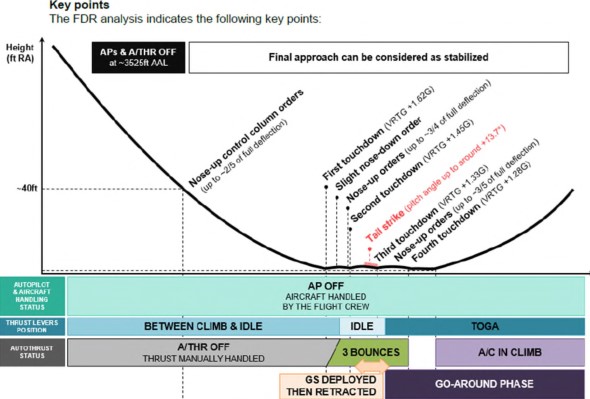
A summary of the vertical track based on Airbus analysis of FDR data. [Reproduced from the Official Report]
It was noted that the aircraft had been loaded so that the 138,294 kg Estimated Landing Weight (ELW) for the flight had been distributed so that centre of gravity was 35.6%. Therefore, although the aircraft had been tail heavy, it was within the limit of 37%. It was also noted that the aircraft operators A300-600 fleet had recorded 28,905 landings in the preceding calendar year (2023) with 257 go-arounds conducted - just under 1% of the landings made. The aircraft operations manual (OM) Part ‘B’ (type) was found to include a comprehensive section on “Bounce Recovery - Rejected Landing” which included the observation that bouncing at landing is usually the result of one or a combination of the following factors:
- Windshear
- Thermal activity
- Excessive sink rate
- Late flare initiation
- Incorrect flare technique
- Excessive airspeed
- Power-on touchdown
A number of these factors were present during one or more of the successive bounces which preceded the successful landing performed by the captain after taking control and going around. The investigation found that the OM Part ‘B’ content “essentially corresponded to the content of both the 2005 Airbus Safety Briefing Note “Bounce Recovery - Rejected Landing” and to the 2007 Airbus Safety Briefing Note “Preventing Tailstrikes at Landing”.
Safety Action taken by European Air Transport as a result of this tailstrike and several others which occurred during the same month was noted to have included (but not been limited to) the following and covered pilots on all fleets (A300-600, A330 and B757):
- The issue of an ‘Internal Safety Alert’ on ‘Tail Strike Avoidance’ which included the following guidance:
- Ensure that all thrust levers are set to IDLE at the latest at touchdown to activate ground spoiler extension at touchdown.
- In the event of a low bounce, maintain pitch and continue landing but in the event of a high bounce, maintain pitch and perform a go-around.
- Be aware of different go-around procedures before or after main gear touchdown and the Flight Director command with pitch above 11° (tail strike limit).
- The pilot monitoring (PM) is responsible for closely monitoring the pitch attitude during flare and landing, during which it is of utmost importance to precisely follow the standard operating procedures (SOP) in case of pitch values of 9 degrees or more when it is mandatory to make the call “pitch, pitch”.
- All pilots must review the correct handling of the thrust levers and their individual “muscle memory”.
- The Issue of a second ‘Internal Safety Alert’ on ‘Hard Landings’ which included the following guidance:
- The PM should promptly respond in case of high sink rates or unusual pitch
- The PM shall monitor the attitude during landing in accordance with fleet SOP (A300-600 and B757 limit: 9°, A330 limit: 7,5°) and must announce the calls according to SOP (“PITCH, PITCH” for all Airbus types or “CHECK PITCH” for the B757)
- A new CBT (Computer-based Training) system was “established and activated” with modules on ‘Hard Landing Avoidance’, ‘Bounce Recovery’, ‘Go-around Technique’ and ‘Tail Strike Avoidance’.
- An additional simulator training detail for flight crews and trainers identified as ‘Special Landing Training’ was added to the OM Part ‘D’ under the section on use of FTSDs (Flight Simulation Training Devices).
The Final factual-only Report was completed on 29 August 2024.
Related Articles
Further Reading
- Safety Briefing Note “Bounce Recovery - Rejected Landing”, Airbus, 2005
- Safety Briefing Note “Preventing Tailstrikes at Landing”, Airbus, 2007