A320, Corfu, Greece, 2024
A320, Corfu, Greece, 2024
Summary
On 19 June 2024, an Airbus A320 first officer made a longer than expected night touchdown at Corfu. Without recognising that reverse thrust had been engaged, the captain took control and applied full thrust to initiate a go-around, which is prohibited. On recognising his error, hesitation and uncertainty led to him cycling the thrust levers between full thrust and maximum reverse multiple times before eventually deciding to stop on the runway. This was achieved with 340 metres of runway remaining after both pilots had simultaneously called stop and both then simultaneously applied maximum braking.
Flight Details
Aircraft
Operator
Type of Flight
Public Transport (Passenger)
Flight Origin
Intended Destination
Take-off Commenced
Yes
Flight Airborne
Yes
Flight Completed
Yes
Phase of Flight
Landing
Location - Airport
Airport
General
Tag(s)
Unplanned PF Change less than 1000ft agl,
CVR overwritten
HF
Tag(s)
Procedural non compliance,
Dual Sidestick Input
RE
Tag(s)
Late Touchdown
Outcome
Damage or injury
No
Non-aircraft damage
No
Non-occupant Casualties
No
Off Airport Landing
No
Ditching
No
Causal Factor Group(s)
Group(s)
Aircraft Operation
Safety Recommendation(s)
Group(s)
None Made
Investigation Type
Type
Independent
Description
On 19 June 2024, an Airbus A320 (G-EZGY) operated by easyJet on a scheduled passenger service from London Gatwick to Corfu as U2 8213 touched down at destination farther along the runway than expected in night visual meteorological conditions (VMC) after an early and protracted flare by the first officer. The captain took control and set takeoff/go-around (TO/GA) thrust for a go-around before recognising that the thrust reversers had been deployed. He then became indecisive as to whether to go around or complete the landing but after multiple cycling of the thrust levers between TOGA and REV MAX eventually decided to complete the landing. The aircraft stopped with 340 metres of the end of the runway.
Investigation
The Hellenic State Investigation Authority (HARSIA) eventually delegated the serious incident investigation to the UK Air Accident Investigation Branch as the State of Registration. Relevant data on both the cockpit voice recorder (CVR) and the flight data recorder (FDR) were overwritten when the aircraft was subsequently released to service but relevant data were obtained from both the quick-access recorder (QAR) and the digital ACMS recorder (DAR). The DAR was configured to record when either of the sidestick priority buttons were pressed and which had priority. However, only the “recollections” of the two pilots were available as to their communications with each other were concerned.
It was noted that the captain had a total of 5,303 hours flying experience of which all but 256 hours were on type. No information was provided as to the experience of the first officer.
What Happened
After a stable approach flown by the first officer, the flare was commenced too early and as it continued, the aircraft was allowed to drift high and, according to the captain, went beyond the end of the touchdown zone (TDZ). The first officer’s recollection was that the touchdown had been just within the TDZ. After main gear touchdown the first officer selected REV IDLE. The captain did not notice that reverse thrust had been selected. Given that the aircraft operator requires a go-around if touchdown occurs beyond the TDZ, the captain began to do so. He called “I have control” and selected TOGA thrust without realising he had advanced the thrust levers from REV IDLE rather than IDLE.
The captain was aware of the flight crew training manual (FCTM) prohibition on going around once reverse thrust has been selected and aware of the brief loss of control event when another operator’s A320 had attempted to go around after selection of reverse thrust. According to the report, "this led to hesitation in deciding whether to continue or reject the go-around." His thinking was further disturbed by a concurrent and continuing master warning activation because he had selected TOGA with full flaps set. He briefly cycled the thrust levers from TOGA to REV IDLE and then back to TOGA before making another thrust reduction without reaching zero thrust before yet another increase to TOGA prior to a final return to REV MAX which brought the aircraft to a stop with 15% of the landing distance available (LDA) remaining.
The first officer stated that he “became rapidly and increasingly concerned that there was insufficient runway remaining to take off and had called ‘stop’." He added that he had then independently applied maximum manual braking and although he did not remember doing so, FDR data showed he had also applied a nose-down side stick at the same time. This input was void because the captain had kept his sidestick priority button pressed continuously after taking control. A “stop” call from the first officer was reported to have been made at approximately the same time as one made by the captain as he made a final selection of REV MAX thrust and applied maximum manual braking. A brake overheat warning was annunciated three minutes after the aircraft stopped, and the brake temperature peaked at just under 500°. The maximum recorded normal load during the landing was just under 1.7g with full flap remaining set throughout the landing roll. The master warning remained active continuously beyond the full stop point.
Following an external inspection of the aircraft by the emergency service, it was taxied to stand under its own power. After an “engineering check procedure for a possible heavy landing," the aircraft was released to service, and the same crew were then authorised to operate the delayed return flight back to the UK.
Why It Happened
The first officer was likely to have been surprised at the captain's immediate response to a normal touchdown, albeit aware that he believed that it had occurred right at the end of the TDZ. The captain’s initial response was to advance the thrust levers from REV IDLE to TOGA contrary to a prohibition of such action because he did not recognise that he was advancing them from REV IDLE rather than IDLE. His state of mind could have been further confused by the master warning which began and continued because he had advanced the thrust levers with the intention of going around with flaps set to full. It was noted that his awareness of the A320 Serious Incident at Copenhagen in 2022, involving an attempt to go around after selection of reverse thrust, could have played a role in his reaction.
Regarding where the aircraft had actually touched down, FDR data analysis allowed Airbus to prepare the illustration below which shows that main gear runway contact had occurred just beyond the end of the TDZ rather than just within it. Regarding what obstacle clearance might have been achieved on climbout had the go-around not been cancelled, Airbus modelled the outcome from the point at which maximum braking was applied and assumed that rotation occurred at approach speed and with flaps 3 selected once safely airborne. The result indicated that the aircraft would have become airborne approximately 600 metres before the end of the runway and would have then “cleared the first relevant obstacles on the go-around flight path by approximately 250 feet."
The Airbus FCTM text on commencing a go-around from the runway noted that:
- A go-around must not be initiated after selection of the thrust reversers.
- If a go-around is initiated by the PF, the flight crew must complete the go-around manoeuvre.
- Any transient CONFIG warnings which occur when TOGA thrust is applied with the aircraft on the ground should be disregarded.
- Only when an aircraft is safely airborne should one stage of flap be retracted.
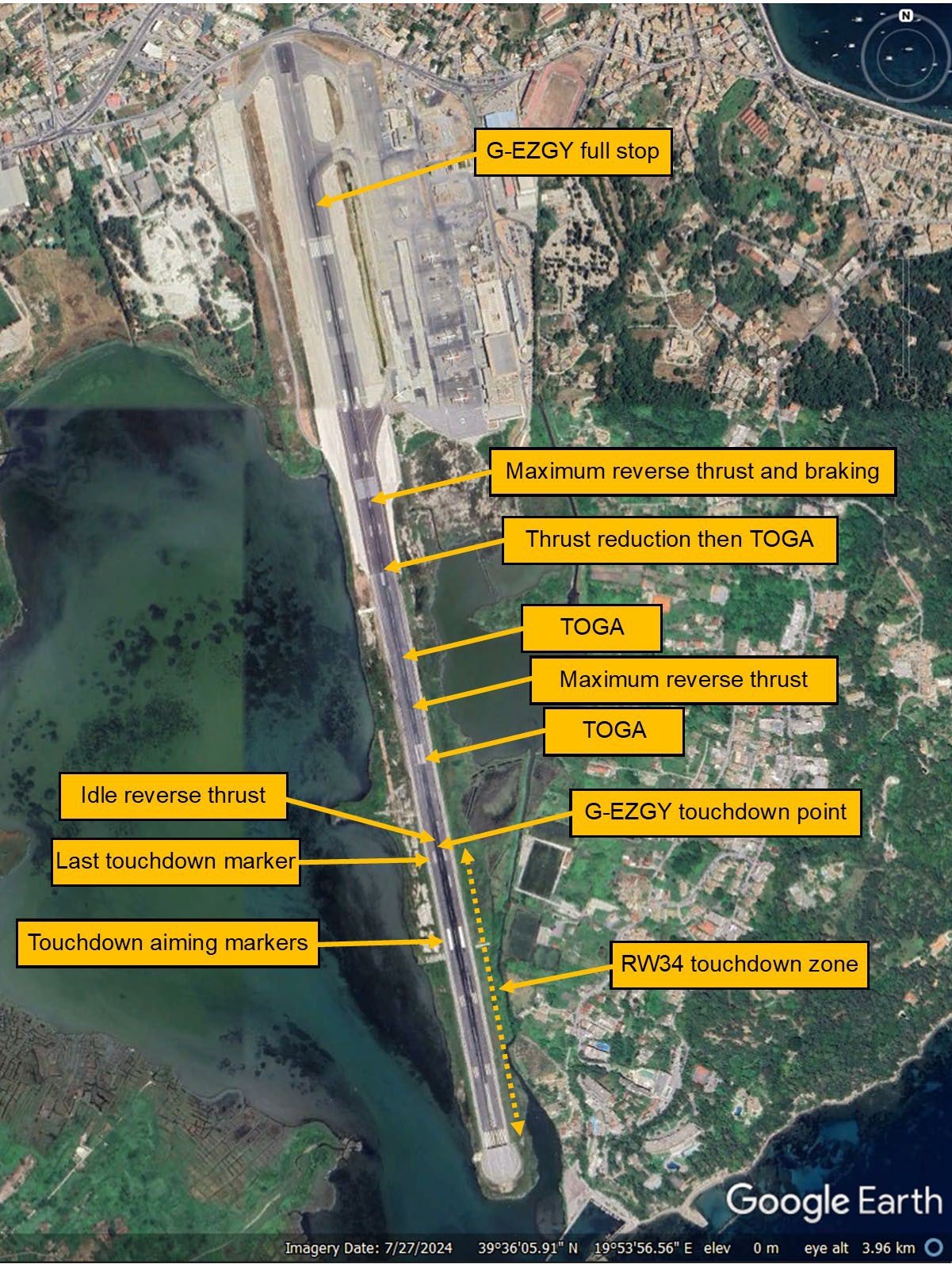
An Airbus-created annotated ground track of the key “stop-go” events during the landing roll.
[Reproduced from the Official Report]
The narrative Conclusion of the Investigation was as follows:
After a stabilised approach, a protracted flare resulted in the aircraft touching down around the end of the TDZ. Each pilot had a different appreciation of where the touchdown occurred, leading to startle and surprise for both parties when the other’s actions were not as expected. While this confusion introduced hesitation and uncertainty into the decision-making process, the pilots’ mental models re-aligned when the lack of perceivable acceleration caused them each to question the viability of continuing with the go-around. Almost contemporaneously, both pilots called “stop” while initiating maximum braking and the aircraft came to a full stop within the runway length remaining ahead.
Editor’s Note: The Investigation Report referred to “startle and surprise” having affected both pilots once abnormal circumstances occurred. Whilst there is little doubt that surprise would have probably affected both pilots, no evidence was provided that either pilot’s actions were a result of a Startle Reflex.
The Final Report was published on 10 April 2025. No Safety recommendations were made.
Related Articles
- Low Level Go Around
- Surprise
- Startle Reflex
- Landing Flare
- Decision-Making
- Flight Crew Training/Techniques Manual (FCTM)
- A320, Copenhagen Denmark, 2022