A320, en-route, southeast of Karimunjawa Indonesia, 2024
A320, en-route, southeast of Karimunjawa Indonesia, 2024
Summary
On 25 January 2024, an Airbus A320 first officer inadvertently fell asleep while the captain was already intentionally sleeping en route. Prior approval to temporarily deviate around adverse weather had been given followed by an instruction to join a destination arrival procedure that began 125 nm away. After over 200 nm of further flight and almost half an hour out of ATC contact, the captain woke up, took control and woke up the other pilot. ATC were then contacted for instructions on regaining the arrival route after a significant unapproved deviation from clearance, and the flight was completed without further event.
Flight Details
Aircraft
Operator
Type of Flight
Public Transport (Passenger)
Flight Origin
Intended Destination
Take-off Commenced
Yes
Flight Airborne
Yes
Flight Completed
Yes
Phase of Flight
Cruise
Location
General
Tag(s)
Inadequate Aircraft Operator Procedures
HF
Tag(s)
Fatigue
LOC
Tag(s)
Flight Crew Incapacitation
Outcome
Damage or injury
No
Non-aircraft damage
No
Non-occupant Casualties
No
Off Airport Landing
No
Ditching
No
Causal Factor Group(s)
Group(s)
Aircraft Operation
Safety Recommendation(s)
Group(s)
Aircraft Operation
Investigation Type
Type
Independent
Description
On 25 January 2024, both pilots of an Airbus A320 (PK-LUV) operated by Batik Air Indonesia on a scheduled domestic passenger flight from Kendari to Jakarta Soekarno-Hatta as BTK 6723 in day visual meteorological conditions (VMC) were simultaneously asleep for almost half an hour when level at FL360. According to the report, the first officer fell asleep inadvertently after the captain had intentionally taken a sleep break. A deviation of around 80 nm from the flight-planned track occurred and was corrected only when the sleeping captain woke up. Air traffic control (ATC) provided an appropriate heading to regain the required track.
Investigation
An investigation was carried out by the Indonesian NTSC. Both the cockpit voice recorder (CVR) and the flight data recorder (FDR) were removed from the aircraft and downloaded and useful valuable data was accessed from both recorders.
It was noted that the 32-year-old captain, an Indonesian national, had a total of 6,304 hours flying experience. On 24 January, the captain was rostered for an early standby duty but was not called out. He had woken at about 0530L and had remained awake and active all day and was not called to fly. He then slept for only two hours in the evening, waking up at about 2200L and preparing to depart for the very early morning report for duty at 0125LT on 25 January. This entailed driving from home to the airport which took almost an hour. At this point, he had not operated for 35 hours.
The 28 year-old first officer, also an Indonesian national, had a total of 1,664 hours flying experience. Following a day off, he was also rostered for an early standby duty and was also not called out. He had woken at about 0800LT and after an active day had, at around 1900LT, attempted to sleep. However, he had only been able to do so intermittently due to having to help his wife with their twin one-month-old babies. He woke up around midnight and later drove to the airport to meet the same 0125L duty report time as the captain. On arrival, it was noted that he had not operated for 53 hours. He advised the captain during preparation for the flight that he had not had adequate rest.
Initial progress in the Investigation was provided in a Preliminary Report which was published on 27 February 2024 and included two Safety Recommendations:
- that Batik Air Indonesia develop detailed guidance and procedures for ensuring the IM SAFE personal checklist can be used to assess pilot physical and mental condition properly. [04.O-2024-02-01] (IM SAFE is a memory aid that covers categories of pilot impairment: Illness, Medication, Stress, Alcohol, Fatigue, and Emotion.)
- that Batik Air Indonesia develop detailed procedures for ensuring that cockpit checks every 30 minutes can be implemented properly. [04.O-2024-02-02]
Batik Air subsequently took appropriate immediate safety action in accordance with both recommendations which was assessed by the Investigation as acceptable.
What Happened
The same crew had operated the inbound flight to Kendari from Jakarta normally with the captain acting as pilot flying (PF) and had arrived there at 0711LT after a 3½ hour flight which had included a 30 minute hold awaiting a weather improvement. During the cruise, the captain offered the first officer a chance to sleep which he did for about 30 minutes.
After a 37-minute turnaround, the aircraft taxied for departure from Kendari for the return to Jakarta and was airborne 0800LT with the first officer acting as PF. Having reached the cruise altitude of FL360 and set the cabin speaker to a volume appropriate for their removal of headsets, the captain asked permission to rest and the first officer agreed. After 45 minutes asleep, the captain then woke up and asked the first officer if he wanted to sleep but received the reply that he did not need to and after “a 30 second non-related duty conversation," the Captain “continued to sleep” with the first officer’s awareness.
Almost immediately, the first officer requested a temporary heading change to avoid adverse weather which was approved with a request to report when clear. A short time later the flight was instructed to change frequency from Makassar area control center (ACC) to Jakarta ACC. On checking in the flight was instructed to report when clear from bad weather conditions and to then continue towards the beginning of the KURUS 2G STAR which at that time was about 125 nm away.
A few moments later, the first officer “inadvertently fell asleep." Twelve minutes after the previous recorded transmission from the flight, Jakarta ACC called to ask how long the flight needed to continue on the adopted (250°) weather avoidance heading but received no response. Several further calls also did not elicit any response nor did calls from other aircraft at the request of ATC.
Nearly 30 minutes after the last recorded radio transmission by the first officer, the captain woke up and having recognised that “the aircraft was not in the correct flight path” then saw that the first officer was asleep and woke him. He then responded to calls from both ATC and another aircraft and advised ATC that the flight “had experienced a radio communication problem which had now been resolved." An appropriate heading was set to regain the standard arrival route (STAR) and the remainder of the flight was completed normally.
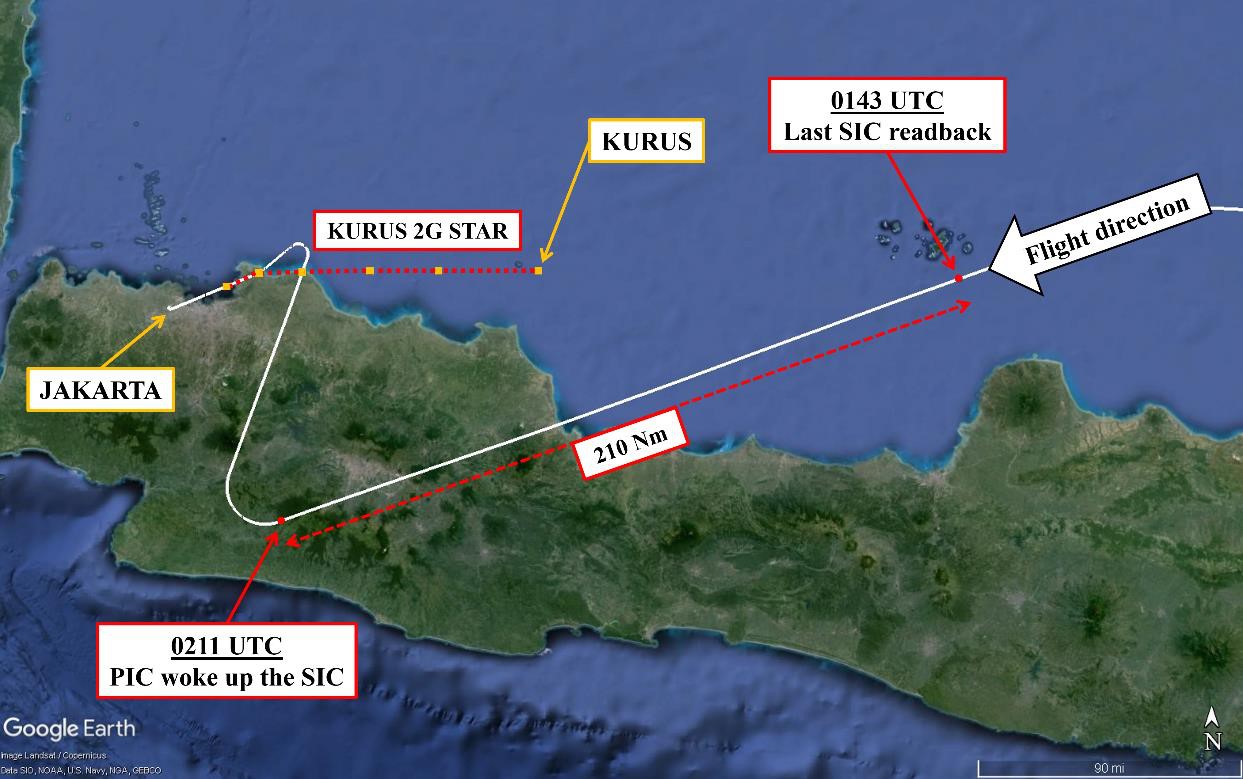
The extended weather deviation flight track following loss of communication and the recovery flown. [Reproduced from the Official Report]
Context
(1) The applicable flight time limitations for pilots as given in the airline’s operations manual (OM) Part ‘A’ and potentially relevant to the flight duty periods (FDPs) involved were noted to have included the following:
- a maximum flight duty period of 14 hours in any 24 hour period
- a maximum flight time period (FDP) of 9 hours in any 24 hour period
- a maximum of 30 hours flight time in any 7 day period
- no maximum FDP total in any 7 day period
- a minimum of 24 hours free of all duties in any 7 day period [must begin after an FDP)
- a minimum rest period of 9 hours between two FDPs after an FDP of less than 14 hours
- a minimum rest period of 11 hours between two FDPs after an FDP of up to 16 hours
- the applicable definition of an FDP for pilots reporting at and ending it at Jakarta Soekarno-Hatta was beginning 90 minutes prior to off-block time and ending 30 minutes after on block time.
- the Minimum Rest Period between two FDPs for such pilots was defined as the elapsed time between them plus 3 hours travelling time.
(2) The Operator and it pilots were “required to consider aero medical factors that may affect or be related to flying activities (and) have an obligation to remain fit for duty and to use every endeavour to maintain a level of fitness that supports safe operations”. They were “also required to inform their Chief or Manager of any medical condition that may interfere with flight safety and take responsibility prior to being assigned to duty that they will not be affected by factors that could impair human performance [including fatigue accumulated over a period of time.]"
It was noted that prior to commencing the FDP involved, the first officer did not notify the chief pilot or his deputy about his fatigue condition or complete the personal checklist (‘IM SAFE’ - see below). However, "the investigation did not find any detailed guidance or procedure anywhere in the airline’s procedural documentation which pilots could follow when using the IM SAFE checklist such as assessment guidance for each impairment category (and) the aircraft operator stated that the checklist was (merely) a means to help a pilot conduct a self-assessment."
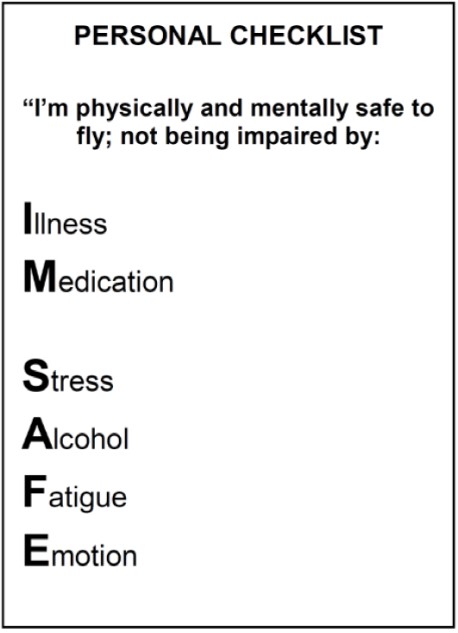
The IM-SAFE Checklist. [Reproduced from the Official Report]
It was noted that neither pilot had submitted a fatigue report related to this serious incident.
(3) The SEP (Safety & Emergency Procedures) Manual described procedures for cabin crew to perform flight deck checks every 30 minutes but did not include any detailed specification as to what such a check required.
(4) Fatigue Risk Management was covered in the OM Part ‘A’ which had text explaining the basic approach and corresponding pilot responsibilities and the purpose of fatigue reporting but no supporting practical documentation was cross-referenced. Indonesian DGCA guidance on how operators should develop and implement an FRMS was found to be available in Advisory Circular 120-08 which also documented and explained the “three main responsibilities of pilots” in respect of fatigue risk as “getting enough sleep, planning sleep ahead of time and reporting fatigue." This Circular was the DGCA’s response to the ICAO SARPs in Annex 6 Part 1. Further relevant ICAO documentation was noted as being available in the form of ICAO Doc 9966 ‘Manual for the Oversight of Fatigue Risk Management Approaches'.
Three Contributory Factors - defined as actions, omissions, events, conditions, or a combination thereof which, if eliminated, avoided or absent, would have reduced the probability of an accident or serious incident occurring or mitigated the severity of its consequences - were identified. They are presented in chronological order rather than in any rank in respect of the extent to which they were assessed to have contributed to the outcome as follows:
- The lack of detailed guidance from the aircraft operator for pilots to manage fatigue most likely resulted in the pilots not utilising their scheduled rest period appropriately which led to fatigue and led to it being managed by the improper practice of sleeping during flight.
- Both pilots elected to fly when in a fatigued condition and their altered circadian rhythm would have reduced their ability to maintain their wakefulness.
- The absence of detailed flight operating procedures resulted in the improper implementation of the flight deck check, preventing the detection of the inadvertent falling asleep of one pilot when the other was already sleeping.
One new Safety Recommendation was issued as a result of the full Findings from the completed Investigation as follows:
- that Batik Air Indonesia develop and implement fatigue management to include recommended quantity of sleep and a requirement for a pilot to plan sleep ahead of time. [04.O-2024-02-03]
The Final Report of the Investigation was approved on 8 January 2025 and subsequently published online.
Related Articles
- Fatigue
- Flight Crew In-Seat Rest
- Pilot Fatigue (SKYclip)
- Fatigue Risk Management System (FRMS)
- Circadian Rhythm Disruption
Further Reading
- Doc 9966 ‘Manual for the Oversight of Fatigue Risk Management Approaches', ICAO, 2016
- Fatigue Management Guide for Airline Operators, ICAO, IATA & IFALPA, 2015