A320, en-route, southwest Caribbean, 2023
A320, en-route, southwest Caribbean, 2023
Summary
On 25 September 2023, an Airbus A320 in cruise at FL340 entered clouds at night and encountered unexpected severe turbulence which resulted in serious injuries to four passengers and minor injuries to two other passengers and three of the four cabin crew. The scheduled flight to Fort Lauderdale was completed. The flight crew stated that they had not seen weather radar returns indicating any en route turbulence ahead. When the weather radar was removed from the aircraft and subjected to functional testing, it was found to be fully serviceable.
Flight Details
Aircraft
Operator
Type of Flight
Public Transport (Passenger)
Flight Origin
Intended Destination
Take-off Commenced
Yes
Flight Airborne
Yes
Flight Completed
Yes
Phase of Flight
Cruise
Location
Approx.
SW Carribean
General
Tag(s)
CVR overwritten
LOC
Tag(s)
Environmental Factors
WX
Tag(s)
En route In-cloud air turbulence
CS
Tag(s)
Turbulence Injury - Cabin Crew,
Pax Turbulence Injury - Seat Belt Signs on
Outcome
Damage or injury
Yes
Aircraft damage
None
Non-aircraft damage
No
Non-occupant Casualties
No
Occupant Injuries
Few occupants
Occupant Fatalities
None
Off Airport Landing
No
Ditching
No
Causal Factor Group(s)
Group(s)
Aircraft Operation
Safety Recommendation(s)
Group(s)
None Made
Investigation Type
Type
Independent
Description
On 25 September 2023, an Airbus A320 (N569JB) operated by JetBlue Airways on a scheduled international passenger flight from Guayaquil, Ecuador to Fort Lauderdale, Florida as JBU1256 was approximately 200 nm south of the western tip of Jamaica when a sudden encounter with severe convective turbulence occurred. The flight crew had not anticipated this turbulence. Four of the 162 passengers sustained serious injuries, and two others sustained minor injuries as did three of the four cabin crew. The flight was completed as scheduled and landed approximately one hour 40 minutes after the upset with no further turbulence encountered.
Investigation
An accident anvestigation was carried out by the U.S. National Transportation Safety Board (NTSB). Relevant recorded data from the aircraft flight data recorder (FDR) were available as were comprehensive meteorological data. The aircraft landed 1 hour and 42 minutes after the turbulence encounter but no action was then taken to secure relevant data on the cockpit voice recorder (CVR) and after removal and downloading, it was confirmed to have been overwritten after the accident. The 53-year-old captain who was acting as pilot monitoring (PM) for the sector had a total of 20,699 hours multi-engine flying experience, of which 13,680 hours were on type. The 33-year-old first officer had a total of 3,010 hours multi-engine flying experience, which included 722 hours on type.
What Happened
The crew reported that the flight proceeded normally prior to the encounter, and no indications of convective turbulence were detected on the weather radar or on radar images on their Jeppeson FliteDeck and Weather Services International iPad applications. The captain stated that en route immediately prior to the accident, the weather radar was not showing returns, and had been set with a 160 nm range at maximum brightness. He also said the crew did not see clouds or lightning ahead and noted that the seat belt signs had been on continuously since departure.
FDR data showed that the severe turbulence lasted 1 minute 10 seconds during which the aircraft pitch angle ranged between -1.8° and +6.3° the roll angle varied from -8.4° left wing down to 8.8° right wing down with vertical acceleration in the range -0.69G to +1.68G. During the encounter, the aircraft climbed 810 feet above its cruise level as the speed varied between M0.732 and M0.820. The autopilot (AP) disconnected 48 seconds into the encounter and “a nose down input was applied on the captain’s sidestick” to begin recovery from the excursion. Once the turbulence has ceased, the AP was re-engaged, and the aircraft returned to its cleared attitude FL 340.
The captain said once normal flight was recovered, the pilots asked for a cabin report and were informed of injuries to both the unsecured cabin crew and some passengers. The company was asked to arrange for emergency medical attendance on arrival at destination.
On arrival, the captain made an entry in the aircraft Technical Log which stated “weather radar inoperative and severe turbulence encounter." The radar was removed and sent to the manufacturer. Testing found that the unit passed all test requirements.
Why It Happened
Satellite imagery showed that the location where the turbulence was encountered coincided with a cloud pattern consistent with convective activity. The illustration below shows the the flight track passing south to north “across the cloud pattern consistent with convective activity [which shows that] the accident aircraft flew across the coldest portion of the cloud." According to U.S. National Oceanic and Atmospheric Administration (NOAA) data that the cloud top height was around 42,000 feet. Other information confirmed the reported absence of any lightning flash activity within 20 miles during the 10 minutes preceding and four minutes after the turbulence. There were also “no relevant SIGMETs issued by the Meteorological Watch Office that were active for the accident location at the accident time”.
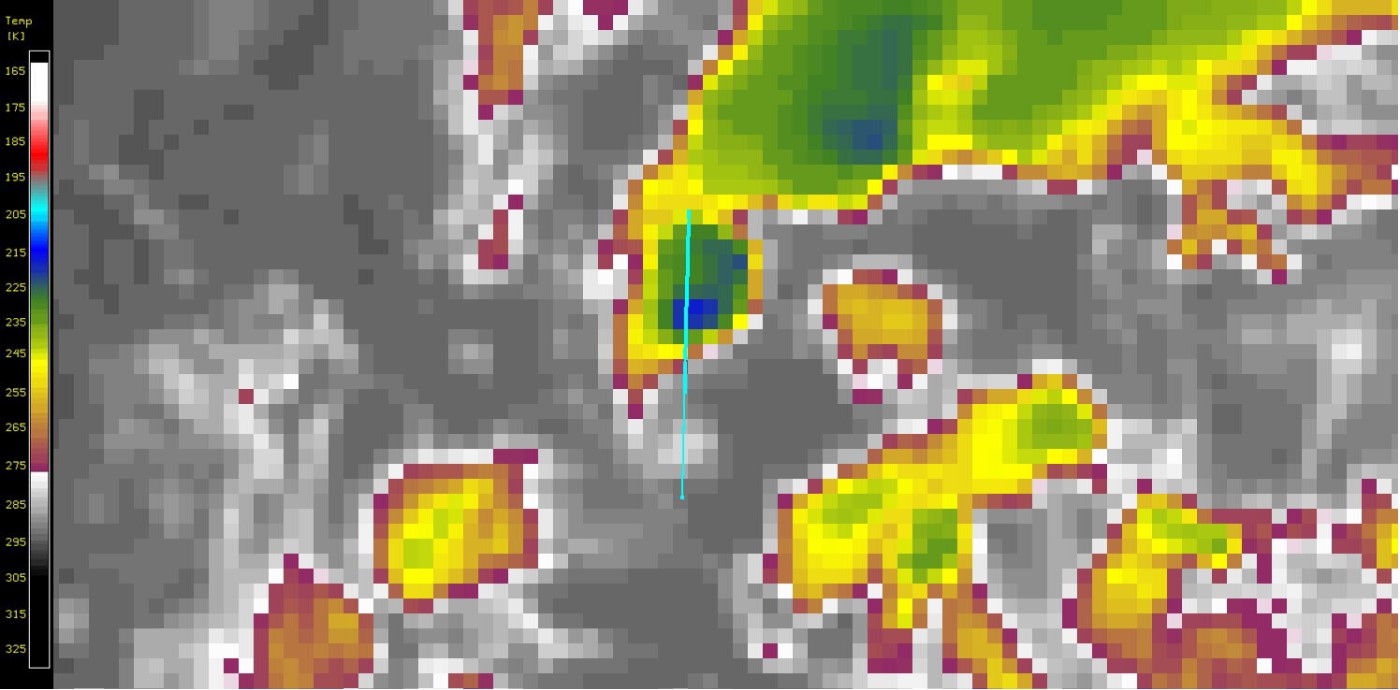
Satellite infrared imagery three minutes after the turbulence encounter with the aircraft northerly flight track at this time depicted by the light blue line. [Reproduced from the Official Report]
In response to the captain’s technical log entry stating “weather radar inoperative," the weather radar equipment was “initially electrically tested on the aircraft with no electrical shorts detected." It was then removed and sent to the original equipment manufacturer (OEM) for further testing. It was returned with a report that “manufacturer testing found that the unit passed all test requirements." It was also noted that it was in compliance with the most recent modification status for the unit.
The investigation did not record details on the injuries or the position in which those who sustained them were at that time the turbulence occurred. No mention was made of any prior communication with the cabin crew about the advisability of seat belt use or passenger toilet use.
The Probable Cause of the accident was determined to have been “an inadvertent encounter with convectively induced turbulence during cruise that was not depicted by the airplane’s weather radar system.” No reason was found why weather radar equipment which - after a rigorous post flight examination by the OEM - was found to be free of any defect had not been displaying a turbulence area.
The Final Report was published on 12 December 2024. This summary also draws on information contained in the corresponding published investigation docket. No safety recommendations were made.