A320, Toulouse France, 2023
A320, Toulouse France, 2023
Summary
On 30 July 2023, an Airbus A320 departed Toulouse from an intersection other than the one from which it was cleared to use without the flight crew or the tower controller noticing the error. The available takeoff distance was 500 metres less than required, and rotation occurred with only approximately 500 metres of runway remaining. The crew error was attributed to a combination of “high workload and expeditious mindset, limited attentional capacity, sub-optimal performance and confirmation bias." That the tower did not notice the crew error was assessed as a contributory factor which allowed the incorrect takeoff to occur.
Flight Details
Aircraft
Operator
Type of Flight
Public Transport (Passenger)
Flight Origin
Intended Destination
Take-off Commenced
Yes
Flight Airborne
Yes
Flight Completed
Yes
Phase of Flight
Take Off
Location - Airport
Airport
General
Tag(s)
Copilot less than 500 hours on Type,
CVR overwritten,
PIC aged 60 or over
AGC
Tag(s)
Read Back Clearance not followed
HF
Tag(s)
Ineffective Monitoring,
Procedural non compliance,
Ineffective Monitoring - PIC as PF
Outcome
Damage or injury
No
Non-aircraft damage
No
Non-occupant Casualties
No
Off Airport Landing
No
Ditching
No
Causal Factor Group(s)
Group(s)
Aircraft Operation
Air Traffic Management
Safety Recommendation(s)
Group(s)
None Made
Investigation Type
Type
Independent
Description
On 30 July 2023, an Airbus A320 (G-EJCI) operated by easyJet on a scheduled international passenger flight from Toulouse to London Gatwick as U2 8414 departed from runway 32R in day visual conditions (VMC) without sufficient runway distance after lining up at an intersection other than the one planned. When the crew erroneously transmitted that they were at the correct intersection, the tower did not notice the error. The aircraft then became airborne with insufficient runway ahead, on which a rejected takeoff could not have been safely performed had it been required.
Investigation
The French Civil Aviation Accident Investigation Agency, the BEA, delegated the serious incident investigation to the UK Air Accident Investigation Branch (AAIB) as the State of Registration. An analysis of the air traffic control (ATC) aspect of the event was carried out by the French air navigation service provider (ANSP) involved, and details of the findings and follow-up actions were provided to the AAIB. No data from the cockpit voice recorder (CVR) or flight data recorder (FDR) covering the event were available to the Investigation.
The 62-year-old captain, who was acting as pilot flying (PF), had a total of 16,488 hours flying experience, of which 12,992 hours were on type. He was “familiar with Toulouse but had not been there recently." The first officer had a total of 347 hours flying experience, of which 135 hours, all gained in the three months prior to the investigated event, were on type. He had completed his first line check on the A320 earlier in the month, and the investigated flight was his eighth sector following this release to line flying unsupervised by a training captain.
What Happened
The inbound flight from London Gatwick, operated by the same crew who operated the return flight, had arrived 90 minutes late. The flight crew checked runway performance data and were presented with two options for departure from runway 32R: the full runway length (N1) or the first intersection along it (N2). They agreed that N2 should be used and both completed the performance calculations for this intersection. The subsequent departure briefing covered the taxi routing to N2 and noted that “it was short and uncomplicated." They did not discuss the location of N2 and it was not visible from their stand (V10) - see the illustration below.
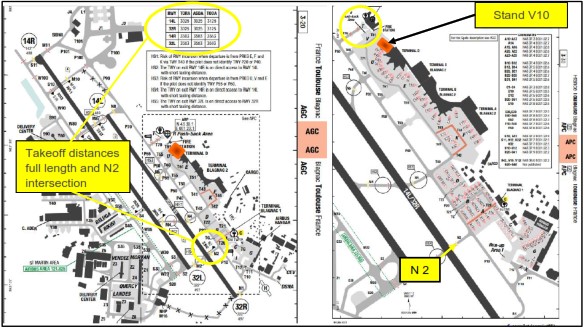
The Toulouse GND and Parking Gates Charts with N2, V10 & the N1 & N2 TORA/ASDA/TODA. [Reproduced from the Official Report]
It was noted that a ‘Threat Matrix’ was provided by the airline to assist flight crew in identifying “potential threats” but this did not include intersection departures as “an example of a potential threat."
Following a 38-minute turnaround, pushback and start clearance was received, and taxi clearance to N1 was received. Ground control were advised that departure from N2 could be accepted, and this was approved. The aircraft joined the parallel taxiway and proceeded southeastwards. Soon after joining this taxiway, the aircraft operator’s requirement for an additional brief which “normally precedes the taxi checks” was satisfied. This requires that performance, engine-out departure procedure, departure runway / routing and stop altitude / departure clearance are reviewed by pilots and is referred to as the ‘PEDS’ Brief. This review did not include any reference to “where N2 was in relation to their position on the taxiway" (see the illustration below) nor was this required. The crew could not remember whether the aerodrome chart was displayed on the captain’s electronic flight bag (EFB) but thought it likely that “in anticipation of the short and non-complex taxi routing” it was more likely that the SID chart would have been displayed instead.
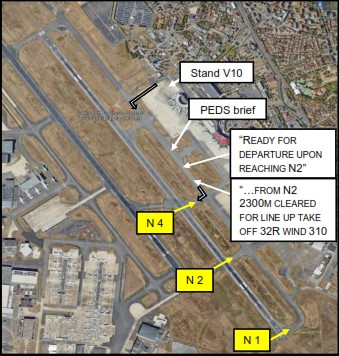
An annotated aerial view of the taxi out route. [Reproduced from the Official Report]
The first officer called tower to advise that they would be “ready for departure upon reaching N2,” and the controller responded with “bonjour from N2 2,300 metres cleared for lineup take off 32R wind 310 degrees 12 knots." As the clearance was read back, the aircraft was approaching the N4 intersection, and the captain turned right towards the N4 holding point. The crew then completed the company “mandatory flow,” part of which requires that “each pilot silently verifies (the) takeoff intersection." This was then followed by the lineup checklist as the aircraft entered the runway at N4, passing standard runway access signage and guard lights installed on both sides of the taxiway (see the illustration of the left hand side view of this signage below).
The lineup checklist required both pilots to “confirm that the lineup is performed at the intended runway intersection and [in compliance with] the ATC clearance received” but without the CVR recording, it was not possible to know what was said by both pilots at this point. However, the pilots agreed that the captain said “cleared for takeoff, runway 32R, N2, 2,300 metres” and then commenced the takeoff. Rotation was said to have occurred with approximately 500 metres of runway ahead.
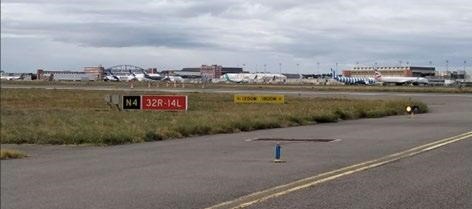
The N4 Holding Point signage as it would have been visible on both sides of the taxiway. [Reproduced from the Official Report]
The crew stated that during the climb, they had “discussed the remaining runway length observed during the takeoff and reviewed their performance calculations and taxi routing (and) concluded that the takeoff had been initiated from N4 instead of the planned and cleared N2." The available takeoff distance available (TODA) from N4 was “approximately 1,800 metres."
The aircraft operator’s analysis found that had the takeoff been rejected between V1 (134 knots) and VR (142 knots), “a runway excursion was a likely outcome." An analysis by Airbus found that the aircraft had overflown the end of the runway at “a height of approximately 180 feet” and that “had an engine failure occurred at V1, the continued takeoff profile would have ensured a clearance of at least 45 ft from obstacles." However, based on the accelerate-stop distance (ASDA) of 1,780 metres, it also found that a rejected takeoff at V1 “could have resulted in an overrun of 102 metres with all engines operative and 93 metres with one engine inoperative."
An analysis of the ATC element carried out by the French State DNSA found that although the shift was rostered with sufficient controllers to separately cover five operational positions, low traffic volumes had led to some being stood down. As a result, only three controllers were on duty. It was found that having instructed the flight to contact tower on reaching N2, the ground controller did not then visually follow the taxiing aircraft. The tower controller issued the clearance to line up and takeoff from N2 as the aircraft was approaching the N4 intersection and also did not then follow the aircraft visually. Both controllers attributed their performance to “a lack of concentration at the beginning of a shift and low traffic density rather than being fatigue-induced." The DNSA’s analysis concluded that the incident was caused by a "lack of effective verification by the crew of the lineup intersection."
Why It Happened
The investigation noted that the EFB app used to determine takeoff performance displayed only intersection options approved for use by the operator’s aircraft type - in this case only N2. It was noted that because use of the N4 intersection for takeoff was not permitted by the airport operator for jet aircraft with a weight of over 7000 kg, this option could not be displayed by the app.
The pilots reported their current perception of flying for the operator. The captain “considered the operational environment at his home base as ‘demanding,' with significant delays occurring on most duties, perceived as being due to a reduced availability of ground staff." He believed this had become accepted as the ‘new normal’ and had led to a desire to be ‘efficient’ (so as) "to keep the operation flowing where possible." The first officer described the pace of operations as "quicker than (he had) expected from training." He had operated to Toulouse once during line training and had not flown with the captain previously. It was noted by the Investigation that “neither pilot felt that the challenging operational environment had produced a culture of taking shortcuts or rushing."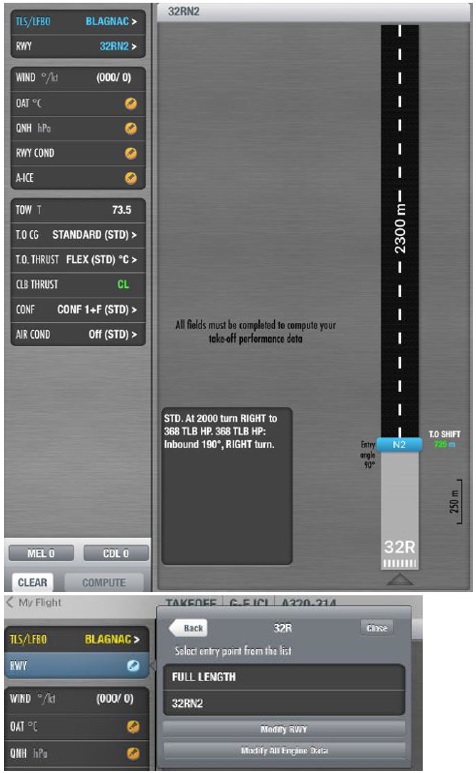
The N2 intersection takeoff option as displayed on the EFB. [Reproduced from the Official Report]
The captain added that in respect of these general views on flying for the operator, “as their pushback was late by over an hour, he was trying to be ‘efficient’ (and) believed that the conduct of the checks ‘flowed promptly’ but were not unduly rushed." He added that “the first point he was aware that the first officer might be task saturated was when he asked for the taxi checks promptly followed by the lineup checks." He also stated that he had not seen the runway sign boards possibly due to his monitoring of the first officer’s actions.
The first officer stated that “the combination of the short taxi distance and early takeoff clearance required the aircraft checks to be conducted in a compressed timescale (which) resulted in him being ‘heads down’ for much of the time, cross-checking relevant checklist items. He believed that his mental capacity was fully engaged with this task and could not recall seeing the runway sign boards as they crossed the N4 holding point." He added that “his high workload as the aircraft entered the runway meant that his response to the captain’s lineup checklist declaration was ‘disjointed’.”
The aircraft operator’s internal investigation into the event concluded that “the operational environment at the home operating base at the time of the occurrence could be considered ‘challenging’” and attributed this to “a combination of the application of calculated takeoff times (CTOTs) and a perceived shortage of ground staff adding pressure to meet scheduled departure times." However it found that “this did not result in unsafe shortcuts or inappropriate rushing but did result in an expeditious mindset for the captain."
Safety Action taken as a result of the event prior to finalisation of the report was noted as having included the following:
- easyJet updated the Ground Operations Procedures in their operations manual (OM) (A) to require all taxi intentions to be announced by the PF to the PM.
- easyJet published a ‘Safety Focus’ to all pilots to highlight the risks associated with intersection takeoffs.
- easyJet amended their company and crew information route manual entry for Toulouse to include a note that a number of intersections are not available for takeoff.
- easyJet updated its threat matrix to include the risk of using intersections for takeoff.
- Toulouse ATC published, on 25 August 2023, a ‘Safety Flash Broadcast’ which reminded their controllers that:
- they must constantly monitor manoeuvring aircraft by visual observation as per ICAO PANS-ATM (Doc 4444)
- The ground controller’s responsibility for monitoring the progress of aircraft via the correct taxiways extends to the holding points.
- The tower controller gives alignment or takeoff clearance only when the aircraft is at or nearing the runway holding point, as per EAPPRI v3 paragraph 1.5.2.h. (Editor's Note: ‘EAPPRI’ has since been superseded by GAPPRI).
The investigation’s review of all the available information and of the findings of both the easyJet and DNSA internal investigations were briefly discussed but no overall conclusion was included in the AAIB Report.
The Final Report was published on 10 April 2025.
Related Articles
- Intersection Take Off: Guidance for Flight Crew
- Intersection Take Off: Guidance for Controllers
- Global Action Plan for the Prevention of Runway Incursions (GAPPRI)
- Stopbars (SKYclip)
- Runway Holding Position
- Runway Holding Point Lighting
- Taxiway Surface Markings and Signs
- Taxiway Lighting
- Pilot Workload