A320 / UAV, vicinity Auckland, New Zealand, 2024
A320 / UAV, vicinity Auckland, New Zealand, 2024
Summary
On 2 April 2024, an Airbus A320 on an instrument approach to Auckland in controlled airspace and at 2,000 feet saw a UAV appear from the right and then pass just over the flight deck. The UAV was reported to have been “about the size of a duck” and at its closest to have partly filled the windscreen whilst passing right to left. The investigation concluded that existing UAV regulations had frequently not been followed either intentionally or because of ignorance, and such non-compliance was likely to be attributable to the lack of consequences.
Flight Details
Aircraft
Operator
Type of Flight
Public Transport (Passenger)
Flight Origin
Intended Destination
Take-off Commenced
Yes
Flight Airborne
Yes
Flight Completed
Yes
Phase of Flight
Descent
Location - Airport
Airport
General
Tag(s)
Aircraft-aircraft near miss,
Unmanned Aircraft Involved
LOS
Tag(s)
Required Separation not maintained,
Near Miss,
UAV Involved
Outcome
Damage or injury
No
Non-aircraft damage
No
Non-occupant Casualties
No
Off Airport Landing
No
Ditching
No
Causal Factor Group(s)
Group(s)
Aircraft Operation
Safety Recommendation(s)
Group(s)
Air Traffic Management
Investigation Type
Type
Independent
Description
On 2 April 2024, an Airbus A320 (ZK-OXJ) operated by Air New Zealand on a domestic passenger flight from Christchurch to Auckland as NZ562 had a very close encounter with an unmanned aerial vehicle (UAV). The Airbus was on approach to runway 23L at destination in day visual conditions (VMC) and within Auckland controlled airspace where UAV operations were not permitted. Following the immediate sighting report, the airspace segment was temporarily closed in accordance with corresponding air traffic control (ATC) procedures.
Investigation
An investigation was carried out by the New Zealand Transport Safety Investigation Commission (TAIC) and extended into a broader review of the UAV risk to commercial aviation. The captain had a total of 12,802 hours flying experience, and the first officer, who had been acting as pilot flying (PF) for the sector (leg) during which the UAV was encountered, had a total of 4,900 hours flying experience. The conflict did not involve any opportunity to increase separation.
What Happened
Within controlled airspace at an altitude of 2,000 feet on final approach to runway 23L at Auckland and in controlled airspace with about seven nm to run, the pilots observed a small UAV appear from the north and pass over the top of the flight deck. The pilots reported the UAV was “in very clear sight” below an overcast at about 2,700 feet before appearing to continue in the direction of Ardmore to the south (see the illustration below). No UAV operation within the airspace involved had been authorised, and it was not possible to identify either the UAV involved or its pilot. The Auckland-based pilots involved were based at Auckland and were about to complete the last flight of a four-sector duty.
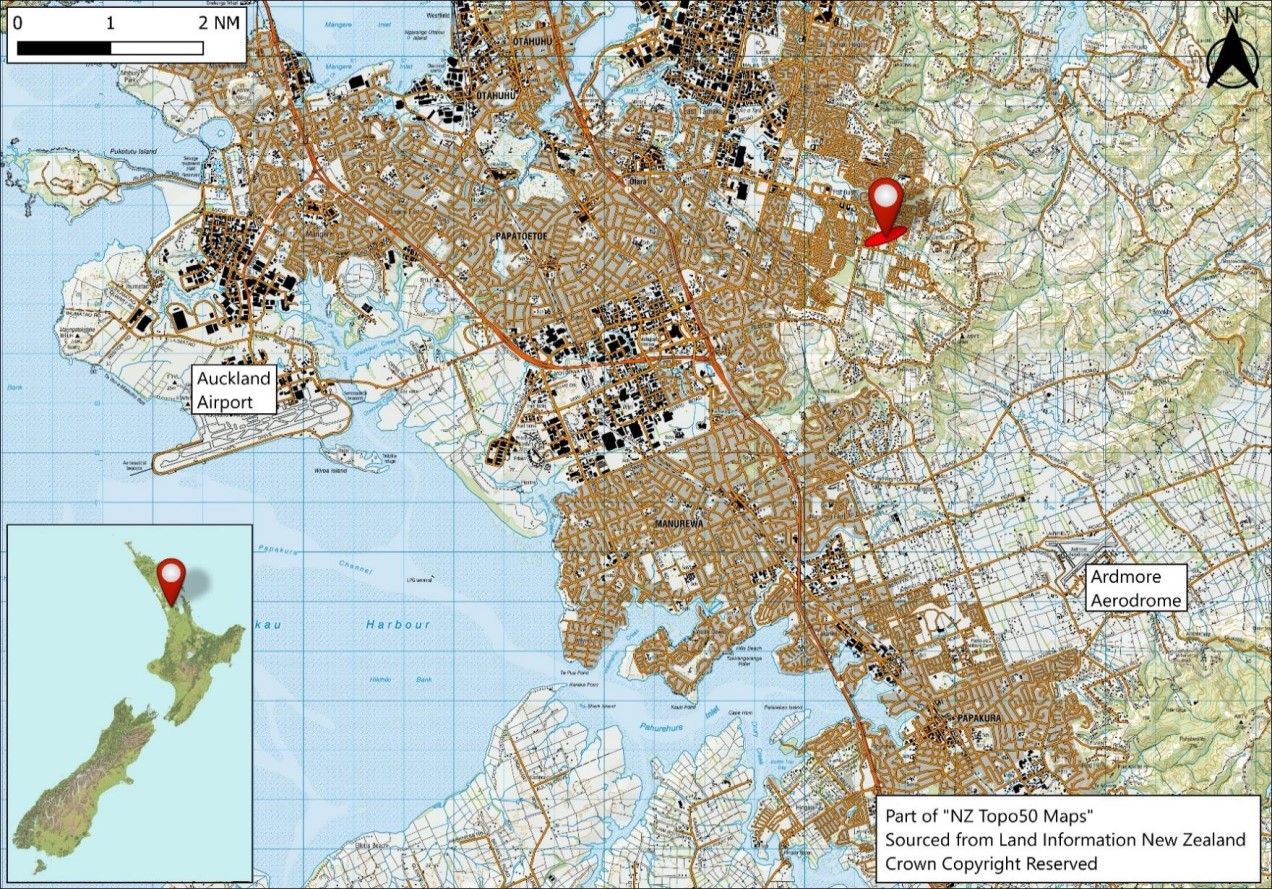
The location of the encounter in relation to Auckland Airport and Ardmore aerodrome. [Reproduced from the Official Report]
Why the Conflict Occurred
It was noted that use of a drone in controlled airspace and at the altitude involved had been contrary to relevant Civil Aviation Rules (CARs) Parts 101 and 102 and, as in other similar reported incidents, had posed a safety risk. It was further noted that the absence of any “universal and reliable physical or electronic restriction to stop a drone flying in controlled airspace” means that safety is “reliant on drone operators knowing and following the rules." It was observed that “until adequate controls are placed on the use of drones, other aircraft, including passenger-carrying aircraft, (will) continue to be at risk of disruption and collision."
It was noted that the CARs Part 101 rules require that prior permission is obtained from ATC before operating any drone in controlled airspace. However, there is one specific exception to this requirement for a “shielded operation” which is not directly relevant to achieving safe operation of aircraft involved in commercial air transport. (A shielded operation is a flight in which a drone remains within 100 m of, and below the top of, a natural or man-made object. This is because other aircraft are unlikely to be flying so low and close to structures.) Part 101 also defines “where, when and how drones can be operated, while also trying to balance the needs of private and commercial drone operators." These rules are more restrictive than those in Part 102, which apply to drone operators who have obtained an Unmanned Aircraft Operator Certificate. Such a certificate is required if operators wish to fly a UAV outside the restrictions of the Part 101 rules including, for example, an “unshielded operation,” flight at night, flight over third-party property without prior notification and/or permission or for the flight of any drone with a weight in excess of 25 kg. Part 102 certification comes with ongoing compliance requirements and associated costs.
In respect of the known extent of the existing national aircraft/drone conflict risk, it was found that ATC data for the six-year period 2019-2024 showed a total of 367 reported airspace incidents involving UAVs / drones. This total included 57 events occurring within a Control Area at a maximum reported height of 8,000 feet amsl “which resulted in a total of 36 delayed or cancelled flights and five go-arounds." Separate CAA data for “drone-related incidents” during the ten-year period 2015-2024 was found to have recorded 5,297 such incidents of which they had responded with some form of action in respect of just over a third.
The following Findings of the investigation were documented:
- The flight crew of the Airbus A320 very likely witnessed a drone in close proximity to their aeroplane while on approach to runway 23L at Auckland.
- Air traffic control had not authorised any drone operations in the airspace around Auckland at the time of the incident; there should not have been any drones operating within four km of Auckland.
- The drone pilot’s intentions are unknown as neither they nor the drone itself could be identified.
- It is almost certain that the drone did not have a functioning operating mechanism in place to restrict access to controlled and/or restricted airspace.
Three Safety Issues were identified a result of the investigation as follows:
- Some drone pilots may not be complying with the rules because there are seldom consequences for noncompliance, resulting in potential conflict with manned aircraft. Since no action had been taken to address this matter, it was decided that a corresponding safety recommendation covering this issue should be issued.
- Some drone pilots may not be complying with Civil Aviation Rules because they are unaware of those rules and how they apply to them, resulting in potential conflict with manned aircraft. It was noted that whilst the investigation was in progress, the CAA advised that they had been running a targeted social media campaign aimed at educating new drone operators and had published a new brochure to help such people to understand the rules. They, and the Department of Conservation, had also sent a notification to all existing holders of CARs Part 101 or 102 approvals to reminder them of the relevant rules and required permits.
- In the event of the loss of control of a drone, there are no mandatory controls to prevent conflict with manned aircraft. Since no action had been taken to address this matter, it was decided that a corresponding Safety Recommendation covering this issue should be issued.
One Safety Recommendation encompassing the two unaddressed Safety Issues identified above was made as a result of the Findings of the Investigation as follows:
- that the Ministry of Transport and the Civil Aviation Authority of New Zealand, in consultation with stakeholders, work to fully integrate drones into the aviation system and develop appropriate rules and standards, to reflect technology developments and relevant international best practices. [042/25]
The TAIC then gave notice to the Ministry of Business, Innovation & Employment that it had issued this Safety Recommendation and that the response to it will require their involvement.
The Final Report was approved for publication on 30 April 2025 and then published on 12 June 2025.