A332, en-route, northeast of the Hawaiian Islands USA, 2022
A332, en-route, northeast of the Hawaiian Islands USA, 2022
Summary
On 18 December 2022, an Airbus A330-200 in cruise at FL400 in visual meteorological conditions (VMC) was flown through the isolated top of a building convective cloud after its vertical development rate was underestimated. A short but severe turbulence upset and brief loss of control resulted. A few minutes earlier air traffic control (ATC) had advised that “moderate to extreme precipitation and turbulence could be expected for the next 40 miles." Cabin service was in progress, and the turbulence resulted in 24 unsecured cabin crew and passengers being injured, four seriously. Some cabin trim detached and some equipment was damaged.
Flight Details
Aircraft
Operator
Type of Flight
Public Transport (Passenger)
Flight Origin
Intended Destination
Take-off Commenced
Yes
Flight Airborne
Yes
Flight Completed
Yes
Phase of Flight
Cruise
Location
Approx.
northeast of Maui
General
Tag(s)
Extra flight crew (no training)
HF
Tag(s)
Plan Continuation Bias,
Procedural non compliance,
Dual Sidestick Input
LOC
Tag(s)
Uncommanded AP disconnect,
Environmental Factors,
Temporary Control Loss
WX
Tag(s)
En route In-cloud air turbulence
EPR
Tag(s)
“Emergency” declaration
CS
Tag(s)
Turbulence Injury - Cabin Crew,
Pax Turbulence Injury - Seat Belt Signs off
Outcome
Damage or injury
Yes
Aircraft damage
Minor
Non-aircraft damage
No
Non-occupant Casualties
No
Occupant Injuries
Few occupants
Off Airport Landing
No
Ditching
No
Causal Factor Group(s)
Group(s)
Aircraft Operation
Safety Recommendation(s)
Group(s)
None Made
Investigation Type
Type
Independent
Description
On 18 December 2022, an Airbus A330-200 (N393HA) operated by Hawaiian Airlines on a domestic passenger flight from Phoenix AZ to Honolulu as HL35 was northeast of the Hawaiian Island of Maui at FL400 in day visual meteorological conditions (VMC) when it briefly flew through a rapidly building convective cloud top. A brief but violent disturbance to the flight path resulted. The flight crew called the lead flight attendant to advise her of anticipated turbulence, and within three seconds of the call, the aircraft encountered severe turbulence. Injuries to both cabin crew and unsecured passengers occurred as well as damage within the passenger cabin. After the event, ATC were advised of a severe turbulence encounter and asked to expedite flight completion and in response declared an emergency for the flight. Three of the 283 passengers and one of the eight cabin crew sustained serious injuries, and 17 passengers and three of the cabin crew sustained minor injuries.
Investigation
An investigation was carried out by the U.S. National Transportation Safety Board (NTSB). Recorded data from the aircraft cockpit voice recorder (CVR) and quick-access recorder (QAR) were available, as were comprehensive meteorological data. It was noted that the 51-year-old captain, who was acting as pilot monitoring (PM) for the sector had a total of 12,291 hours flying experience, which included 5,887 hours on type. The first officer had a total of 8,214 hours flying experience, which included 1,031 hours on type. Two off-duty Hawaiian Airlines pilots were occupying supernumerary crew seats in the flight deck at the time of the upset.
What Happened
Before departure from Phoenix, the dispatcher had advised the captain of the general potential for turbulence and in particular turbulence associated with embedded convective activity over the Hawaiian Islands. Prior to the severe turbulence upset, the captain stated that the aircraft had been in cruise at FL400 in smooth flying conditions in VMC and above a cloud layer with its top “between FL370 and FL380”. He added that the on-board weather radar in the selected mode was not displaying returns.
Twelve minutes prior to the upset, ATC advised a nearby aircraft on frequency to deviate around weather due to reported turbulence that was ahead, and another Hawaiian Airlines flight reported “continuous moderate chop." Two minutes after this, one of the cabin crew then made a passenger announcement that “the airplane would be landing in 45 minutes and that passengers who wished to use the lavatory should do so now if needed." The cabin crew began to clear up after cabin service and collect agricultural forms from passengers. ATC then advised the flight that “moderate to extreme precipitation and turbulence," as well as "light to moderate chop" could be expected for the next 40 miles and advised a nearby company aircraft that “the cloud tops were at FL410 with light chop and moderate turbulence."
The first mention of the rapidly developing convective cloud occurred on the CVR six minutes later when one of the pilots stated that “it’s moving fast.” The senior cabin crew member (SCCM) was called and advised by the captain that they should expect “a somewhat bumpy ride shortly” as descent began. Immediately after this, one of the pilots noted that “it’s building fast” and 12 seconds later, a severe turbulence encounter lasting 6-8 seconds occurred. The first officer’s autopilot (AP) and the autothrust (A/T) disconnected, and dual sidestick input occurred as both the pilots attempted to respond to the upset, which began with a left wing drop and an increase to 2.2g followed by a drop to -1.0g before returning to neutral.
Passengers described feeling a “hard jolt” followed by a “free fall” sensation, and unsecured items such as phones, jackets, and water bottles, began “floating” around the passengers. Unrestrained cabin crew and passengers were thrown upwards and impacted the cabin ceiling or the overhead stowage compartments and then dropped onto the floor. One passenger, who had left her seat to use the lavatory, reported that she felt the aircraft shake and was then thrown face-first into the lavatory ceiling and then “abruptly” onto the floor. This up/down motion occurred twice. Once the plane had stabilised, the passenger who had been in the toilet “crawled back to her seat” and was helped to get into it and secure herself by one of the cabin crew and by a couple seated next to her.
Uninjured cabin crew then “began working their way through the cabin picking up items and checking on passengers and crew (and) also made announcements asking anyone onboard with medical training to assist." Other off-duty crew also assisted with the injured, and an off-duty company pilot traveling in the passenger cabin worked with the cabin crew to secure loose panels in the lower crew rest areas and lavatories for landing. An unaccompanied minor in seat 30C had their seat belt on and was uninjured. A list of the seriously injured was made and their call lights were switched on to identify them for rapid attention by emergency services on landing. The SCCM warned the captain that "more than a dozen passengers were injured and the flight would need to be met by medical personnel” on arrival. They also added that the cabin interior “doesn’t look good”.
Soon after recovery to normal flight, the flight crew were recorded on the CVR as saying that they should have “gone around it.” One remarked that although they had initially thought that the aircraft would have cleared the cloud formation, it “came up real fast” and one of the off-duty pilots said “did it just pop up?” A passenger announcement was then made by the captain, and the airline’s dispatch were informed of the encounter and the resulting injuries. ATC were then notified that descent had commenced and the descent checks were run. One of the cabin crew then “provided details to the crew about some passenger injuries and stated that, in the aft half of the cabin, the ceiling was damaged and oxygen masks had dropped."
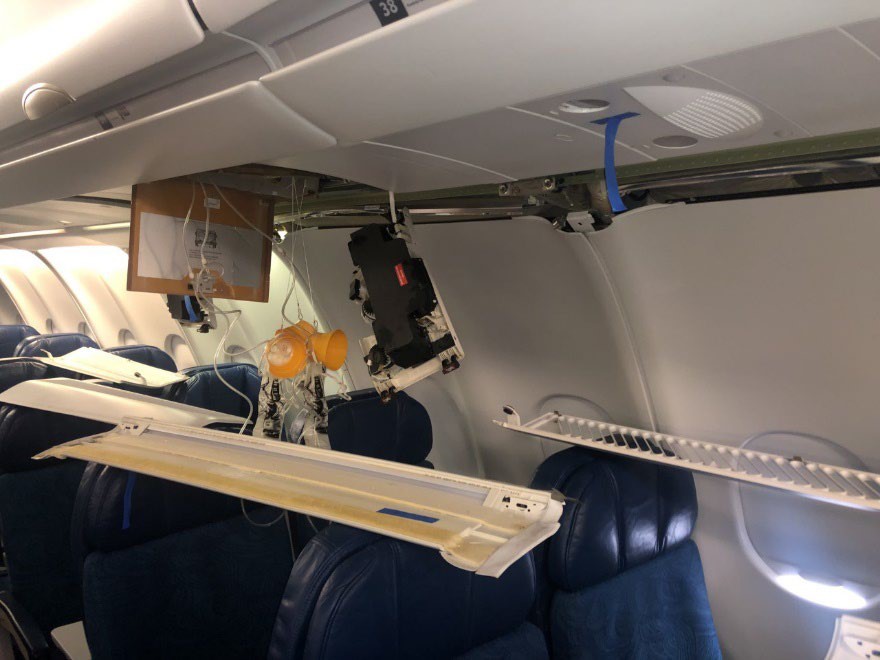
A detached Passenger Service Unit at row 39. [Reproduced from the Official Report]
Once on the ground and at the gate, the emergency services boarded to take the more seriously injured passengers and one of the cabin crew off first. All other passengers were then disembarked, with all those injured assessed and treated at a triage area. Most of the injured (including one lap-held infant) were the taken to local hospitals but some “reportedly sought medical treatment once they returned to their residences."
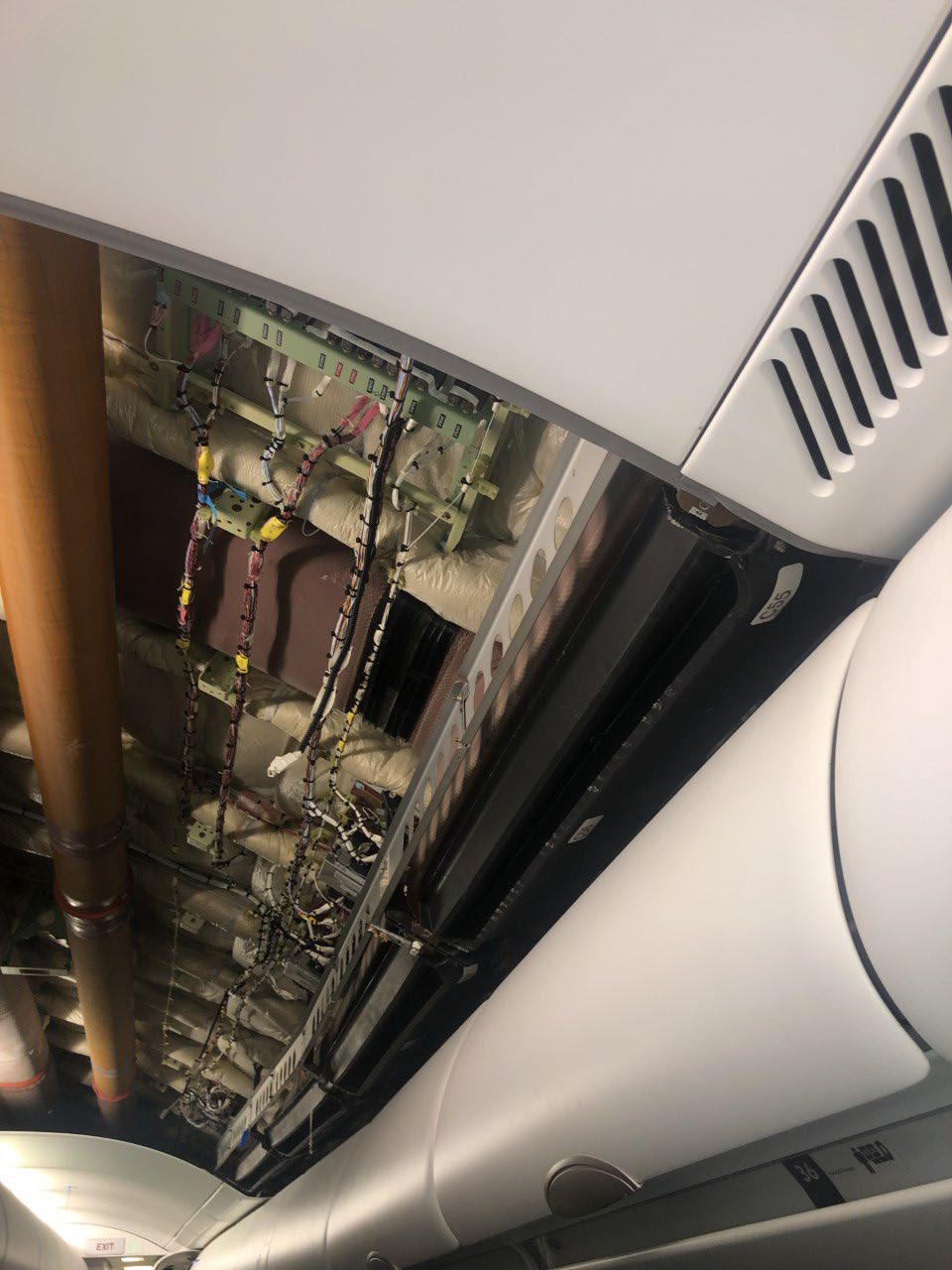
Missing ceiling panels at rows 36-41. [Reproduced from the Official Report]
It was noted that Hawaiian Airlines A330 flight crew operating manual (FCOM) included recommendations in respect of avoiding “significant” convective weather which included the following:
- Storm cells above 35,000 feet should be considered as “highly hazardous”.
- Storm cell tops at or above 25 000 feet should not be overflown because the aircraft may encounter stronger than expected turbulence.
- No attempt should be made to enter a storm cell or overfly its top by less than 5,000 feet because the aircraft may encounter severe turbulence.
It was confirmed that the flight crew had received a SIGMET which was valid for the area where the upset occurred, which advised the presence of embedded thunderstorms up to FL380 and thereby implied the potential for severe or worse turbulence encounters.
The image from the NOAA GOES-17 for the time of the upset showed that it occurred “near overshooting tops of embedded cumulonimbus clouds and thunder” and the image from the NOAA GOES-18 for a few minutes prior to the upset “depicted a greater than 50% probability of moderate or severe turbulence at the upset location between FL400 and FL410”.
The Probable Cause of the accident was determined to have been “the flight crew’s decision to fly over an observed storm cell instead of deviating around it despite sufficient meteorological information indicating the potential for severe convective activity."
The Final Report was published on 12 December 2024. This summary also draws on information contained in the corresponding published Investigation Docket. No Safety Recommendations were made.