A333 / GL5T, Dubai UAE, 2024
A333 / GL5T, Dubai UAE, 2024
Summary
On 29 January 2024, a Bombardier Global 5000 taxiing at Dubai International after landing received a conditional clearance to cross an active runway. The crew crossed the runway after seeing an unlit stop bar ahead, believing that an aircraft ahead was the conditional traffic. This followed the controller’s use of non-standard phraseology and incorrect stop bar switching and the crew’s failure to seek clarification. An Airbus A330-300 taking off from the same runway did not respond to a stop call but became airborne 1,330 metres before reaching the crossing point.
Flight Details
Aircraft
Operator
Type of Flight
Public Transport (Passenger)
Flight Origin
Intended Destination
Take-off Commenced
Yes
Flight Airborne
Yes
Flight Completed
Yes
Phase of Flight
Take Off
Flight Details
Aircraft
Operator
Type of Flight
Public Transport (Non Revenue)
Flight Origin
Intended Destination
Take-off Commenced
Yes
Flight Airborne
Yes
Flight Completed
Yes
Phase of Flight
Taxi
Location - Airport
Airport
General
Tag(s)
Copilot less than 500 hours on Type,
Flight Crew Training,
CVR overwritten
HF
Tag(s)
Procedural non compliance
RI
Tag(s)
Accepted ATC Clearance not followed,
Incursion after Landing,
Runway Crossing,
Phraseology,
Conditional Clearance
Outcome
Damage or injury
No
Non-aircraft damage
No
Non-occupant Casualties
No
Off Airport Landing
No
Ditching
No
Causal Factor Group(s)
Group(s)
Aircraft Operation
Air Traffic Management
Safety Recommendation(s)
Group(s)
Aircraft Operation
Air Traffic Management
Airport Management
Investigation Type
Type
Independent
Description
On 29 January 2024, a Bombardier Global 5000 (CS-GLY) operated by NetJets Europe on a non-revenue positioning flight from London Biggin Hill to Dubai as NJE316K was conditionally cleared to cross runway 30R in night visual conditions (VMC). The crew was unaware that an Airbus A330-300 (HZ-AQ14) operated by Saudi Arabian Airlines on a scheduled passenger flight from Dubai to Riyadh as SVA561 had already been cleared to take off from the same runway and was the ‘conditional aircraft.’ The Global 5000 captain, on seeing that the stop bar ahead was unlit, assumed that the aircraft which had crossed the runway ahead was the ‘conditional aircraft' and continued across the runway despite the lack of an illuminated taxi centreline. The A330 did not respond to a tower ‘stop’ call but became airborne 1,300 metres prior to the Global 5000 crossing position as it had almost completed its crossing.
Investigation
An investigation was carried out by the UAE GCAA Air Accident Investigation Sector (AAIS). When the Investigation commenced, the cockpit voice recorders (CVRs) of both the aircraft had been overwritten but both flight data recorders (FDRs) were downloaded and provided data which were synchronised with ground movement radar recordings and recorded ATC communications.
The 54-year-old Global 5000 training captain had a total of 5,585 hours flying experience, of which 3,903 hours were on type, with 2,651 of those type hours in command. The 31-year-old first officer had a total of 912 hours flying experience, of which 94 hours were on type and was acting as pilot flying (PF) until the captain took over shortly after landing. The flight sector was being used for a final line check on type for the first officer. The tower controller had been in position for about five minutes when the investigated event occurred.
What Happened
After the Global 5000 reached taxi speed after landing on runway 30L in CAVOK (Ceiling and Visibility OK) conditions, the captain took over as PF and the aircraft vacated the runway onto parallel taxiway ‘K’ (see the illustration below). It was then transferred from Tower South to Ground Control to begin taxiing to its assigned parking position on the east side of both runways. The ground controller instructed the aircraft to “continue on taxiway Kilo, transition to taxiway Lima 3 and hold at (the Intermediate Taxiway Holding Point) L3A."
Prior to reaching L3A, the aircraft was instructed to change to Tower North, having already noted a DHL Boeing 767 ahead on the same taxi route. The aircraft switched to the tower frequency as directed and reported holding at L3A, following which it was conditionally cleared to continue across runway 30R with the transmission “taxi holding point Mike Two, behind the rolling Three Thirty cross runway Three Zero Right behind." The clearance given was read back correctly. The Saudi Arabian Airlines A330 runway 30R takeoff clearance had been given prior to the Global 5000 changing from Ground to Tower North.
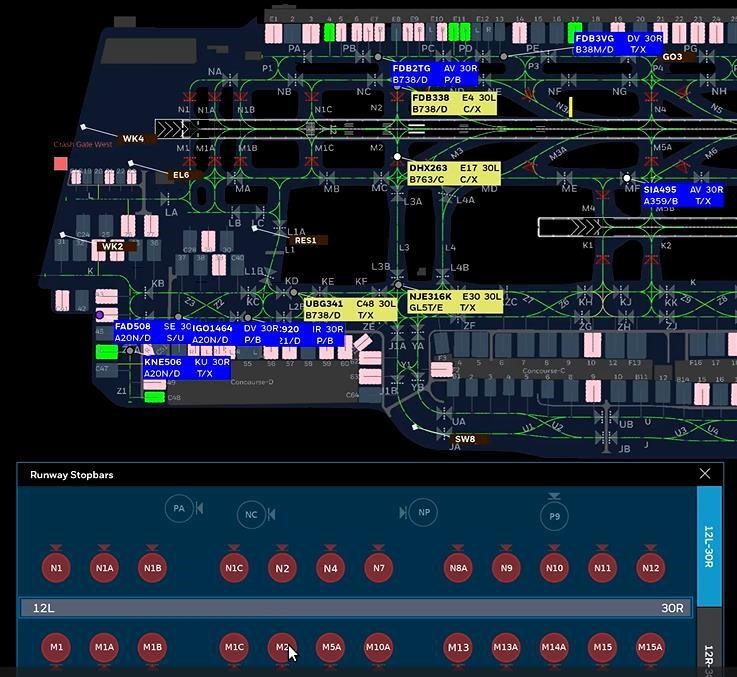
An extract from the Airport Lighting Control and Monitoring System. [Reproduced from the Official Report]
As the Global 5000 reached the holding point on taxiway M2, the stop bar was still unlit even though the DHL 767 had completed its crossing, and it was not activated until it was too late to be seen by the Global 5000 crew. Without querying the absence of green taxiway centreline lighting immediately ahead, they then continued across the runway without realising the A330 had already begun its takeoff roll. As the Tower North controller reactivated the stop bar, a RIMCAS Stage 2 Alert occurred and the tower controller immediately instructed the A330, which was already accelerating through a recorded 132 KCAS, to “stop immediately” but received no reply. The relative positions of the two aircraft at that time as recorded on Ground Movement Radar (GMR) were as below:

A screenshot from the GMR when the RIMCAS Stage 2 Alert began. [Reproduced from the Official Report]
An unidentified call “expediting” was heard on the tower frequency and five seconds after the Runway Incursion Alert had begun, the A330 lifted off at 161 KCAS as the Global 5000 reached the far side of the runway. The Tower Supervisor subsequently asked the Global 5000 crew if they were “aware they had crossed the runway without clearance” and (as per the captain’s subsequent statement) “responded that they observed the stop bar lights were off and believed they were cleared to cross behind an A330 aircraft taxiing in front of them." The Tower Supervisor then “informed the flight crew that they infringed on runway crossing and advised that they would check the matter” and instructed them to contact Ground Control.
The A330 crew statements said that with the first officer acting as PF, neither pilot had initially seen any traffic ahead although “the bright lights surrounding the runway made it difficult to identify any traffic planning to cross." The captain stated that he had not noticed the tower instruction to stop. The first officer stated that “during rotation, he saw a light moving onto the runway some distance ahead,” with the captain adding that he had seen traffic crossing the runway after they became airborne, and the tower confirmed that there had been.
Why It Happened
It was confirmed that all parts of the airport lighting system relevant to the incident were fully serviceable at the time it occurred. In respect of stop bar control, it was noted that all taxiway guidance lighting on taxiways leading to either of the runways terminates at the runway holding position where, by default, red stop bar lights remain on unless deselected by the tower controller. Also, if deselected by the controller, stop bar lights will re‐activate automatically back to red after 60 seconds.
To allow two aircraft to cross departure runway 30R shortly before the tower controller was planning to issue takeoff clearance to the Saudi Arabian A330, the stopbar at M2 had been deactivated by the tower controller but (as designed) they “automatically reverted to red just as the DHL 767 crossed the holding point (and) the controller deactivated the stop bar." He noted that although his subsequent manual reactivation of the stop bar occurred too late for the Global 5000 crew to see it, the linked green taxi route ahead and across the runway was automatically deactivated.
It was noted that by using the non-standard phrase “rolling” instead of “departing," the controller had diminished a first opportunity to prevent the runway incursion and that had the stop bar been reactivated in a more timely manner, it could have prevented the incursion. Also, because the tower controller had mentioned a “330” as the conditional aircraft and he could see the A330 lining up at the threshold of runway 30R from his elevated position in the tower, he had “expected the Global 5000 flight crew to identify the A330 as the conditional aircraft." It was noted that neither the controller nor the Global 5000 flight crew had sought to remove any doubt as to the identity of the conditional aircraft.
The Global 5000 captain stated that having not seen the stop bar on red, he had continued taxiing and although he recollected “some changes in the (taxiway) lights ahead he was uncertain which ones had changed” although he recalled that there were “still green lights ahead at the other side of the runway which went round the corner." Whilst crossing the runway, he heard tower “urging him to expedite the crossing" and then heard another aircraft (the Saudi Arabian Airlines A330) saying “I think there's an aircraft on the runway." He added that “during the crossing, he was unaware and he did not see an aircraft taking off to his right (and) also realised that the aircraft in front of him was not an A330, as he noticed the DHL logo on it."
It was noted that the lack of CVR evidence made it impossible to assess whether the fact that the Global 5000 first officer was undergoing a line check had any consequential effect on the way the taxi-in was monitored by the first officer.
The Causes of the Runway Incursion were recorded as follows:
- The Tower controller’s use of a non-standard phraseology in the conditional clearance issued to NJE316K flight crew for crossing the runway, led to the NJE316K flight crew incorrectly identifying the Boeing 767 taxiing ahead of them as the conditional aircraft.
- The NJE316K flight crew did not seek clarification from the Tower controller despite being uncertain about the taxiway lights being off beyond the stop bars and the guidance lights for crossing the runway.
Two Contributory Factors were also identified:
- The Global 5000 was not yet on the Tower frequency when the Tower controller issued take-off clearance to the Saudi Arabian Airlines A330 for runway 30R, resulting in the Global 5000 flight crew being unaware of its impending departure.
- The improper handling of the stop bars at Mike 2 led to their activation nearly simultaneously with the NJE316K crossing, preventing the flight crew from noticing the stop bar activation as they passed.
Safety Action taken as a result of the Investigated Serious Incident was noted as having included the following:
Dubai Air Traffic Services
- Temporarily suspended the issue of conditional runway crossing clearances on the departure runway pending the preparation and issue of a supplementary instruction updating the content of the Dubai MATS Part 3 on this subject. The revised arrangements now specify the order and content of such clearances and introduce specific requirements in association with their use.
- Initiated a review (not yet complete) of whether software can be updated to automatically activate stop bar lights whenever an aircraft or vehicle crosses the stop bar.
NetJets Europe
- Issued a Safety Notice titled “Safety Focus - Runway Incursions” to all their pilots which reinforced the importance of seeking clarity from ATC whenever doubts persist or when non-standard phraseology is used.
Five Safety Recommendations were issued as a result of the findings of the investigation as follows:
- that Dubai Air Navigation Services re-enforce among its air traffic controllers (the need) to apply correct standard phraseology incorporating aspects that raise awareness of how specific phraseology may affect pilot situational awareness. [SR19/2024]
- that Dubai Air Navigation Services re-enforce among its air traffic controllers (the need) to follow the revised standard procedures. [SR20/2024]
- that Dubai Air Navigation Services study the potential for enhancing the current system's functionality to allow stop bars to automatically activate as required based on its revised standard operating procedures. [SR21/2024]
- that Dubai Air Navigation Services ensure air traffic controllers are well acquainted with the actual night-time conditions at the airport when intense bright lights surrounding the airport can impair flight crews’ visibility - including at hotspot locations - by incorporating the circumstances into their training programs. [SR22/2024]
- that NetJets Transportes Aereos S.A. assess the effectiveness of the measures they have already taken by issue of a Safety Notice in respect of the fact that their flight crew did not seek clarification from tower on seeing that seeing that both the taxiway lights beyond the stop bar and the crossing runway guidance lights were not illuminated. [SR23/2024]
The Final Report of the Investigation was issued on 29 January 2025.