A333, Mactan-Cebu Philippines, 2022
A333, Mactan-Cebu Philippines, 2022
Summary
On 23 October 2022, an Airbus 330-300 failed to complete three night approaches to runway 22 at Mactan-Cebu due respectively to adverse weather, a low height ‘SINK RATE’ warning and a system fault. Touchdown followed the fourth approach but the aircraft failed to stop on the 3,300 metre-long runway and sustained major damage before coming to a stop 235 metres beyond the runway end. All occupants successfully evacuated without serious injuries. The lack of braking was found to have been caused by damage during brief aircraft ground contact just before the beginning of the runway during the second approach.
Flight Details
Aircraft
Operator
Type of Flight
Public Transport (Passenger)
Flight Origin
Intended Destination
Take-off Commenced
Yes
Flight Airborne
Yes
Flight Completed
No
Phase of Flight
Landing
Location - Airport
Airport
General
Tag(s)
Approach Unstabilised after Gate-GA
HF
Tag(s)
Manual Handling
LOC
Tag(s)
Aircraft Flight Path Control Error,
Unintended transitory terrain contact,
Undershoot on Landing
RE
Tag(s)
Overrun on Landing
EPR
Tag(s)
Emergency Evacuation,
Evacuation Injuries
AW
System(s)
Landing Gear
Contributor(s)
Component Fault in service
Outcome
Damage or injury
Yes
Aircraft damage
Hull loss
Non-aircraft damage
Yes
Non-occupant Casualties
No
Occupant Injuries
Few occupants
Occupant Fatalities
None
Off Airport Landing
No
Ditching
No
Causal Factor Group(s)
Group(s)
Aircraft Operation
Safety Recommendation(s)
Group(s)
Airport Management
Investigation Type
Type
Independent
Description
On 23 October 2022, an Airbus A330-300 (HL7525) operated by Korean Air Lines on a scheduled passenger flight from Incheon to Mactan-Cebu landed on runway 22 at destination in night instrument meteorological conditions IMC after three earlier discontinued approaches. The aircraft experienced braking problems and overran the end of the runway. This led to serious airframe and engine damage caused by collapse of the nose landing gear and collision with lighting and a localizer antenna within the runway 04 final approach area. All occupants successfully evacuated the aircraft through two of the available emergency exits. One of the pilots, four cabin crew, and 15 passengers sustained minor injuries whilst doing so. The aircraft damage was such that it was subsequently declared a hull loss.
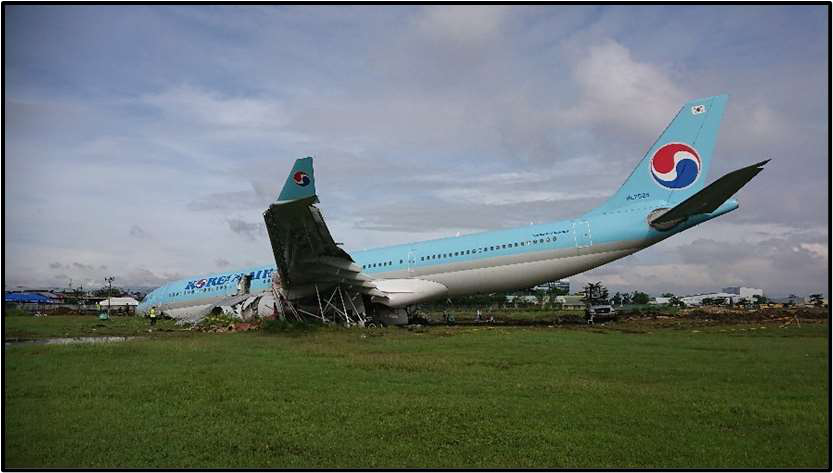
The aircraft where it came to rest showing door 2L, one of the two used for evacuation, open. [Reproduced from the Official Report]
Investigation
An accident investigation was carried out by the Aircraft Accident Investigation and Inquiry Board (AAIIB) of the Civil Aviation Authority of the Philippines. The cockpit voice recorder (CVR) and flight data recorder (FDR) were removed and their data were successfully downloaded. Both pilots were Korean nationals. The 52-year-old captain was the pilot flying (PF) when the accident happened and had a total of 13,043 hours flying experience, of which 9,285 hours were on type. The 37-year-old first officer had a total of 1,603 hours flying experience, of which 1,035 hours were on type.
What Happened
During the initial Instrument landing system (ILS) approach to runway 22, visual reference to the runway was available at decision height but then lost in heavy rain, and a go-around was flown. The aircraft was positioned for a second approach but after a sudden increase of descent rate on short final, which triggered EGPWS ‘SINK RATE’ warnings, a go-around was initiated. Whilst this was being initiated, an electronic centralized aircraft monitor (ECAM) alert advising of a landing gear control interface unit (LGCIU) 1 and 2 fault was annunciated. Having reported the go-around to tower, the crew requested clearance to hold at reporting point ‘ALMAR’ in order to run the ECAM actions for the landing gear fault. This was approved and once there, another ECAM message of ‘BRAKES ANTI SKID FAULT’ was seen, and both required responses were actioned.
A third approach was commenced but when the landing gear was selected down, the right main landing gear down-lock indicator was not illuminated. As a result, this third approach was discontinued and the flight returned to the ALMAR reporting point. The quick reference handbook (QRH) procedure for landing with abnormal landing gear status was reviewed. A hydraulic ‘B’ reservoir low level message was annunciated and the required response followed.
The fourth approach was commenced, and the crew completed a gravity extension of the landing gear. A normal touchdown followed, but as soon as braking was commenced, the aircraft could not be stopped, and it overran the end of the runway. The nose landing gear collapsed on hitting the first concrete base slab of the runway 04 approach lights, and the right-hand nose gear wheel then detached upon hitting another concrete lighting base. The aircraft then collided with the runway 04 ILS localizer antenna and the approach lighting system before coming to a stop on the grass approximately 235 metres beyond the end of the runway on a final heading of 245°. A total of four sets of runway approach lights and one of the ILS localizer antennae were destroyed by aircraft impact. The emergency evacuation used exits 2L and 2R on the instructions of the cabin crew. These exits had less than the standard downslope but more than exits 1L & 2L.
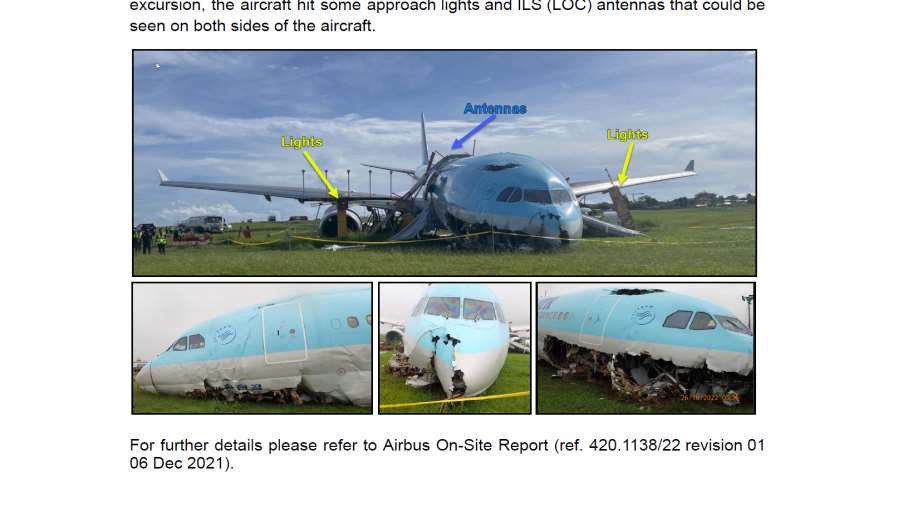
The damaged aircraft and ground equipment. [Reproduced from the Official Report]
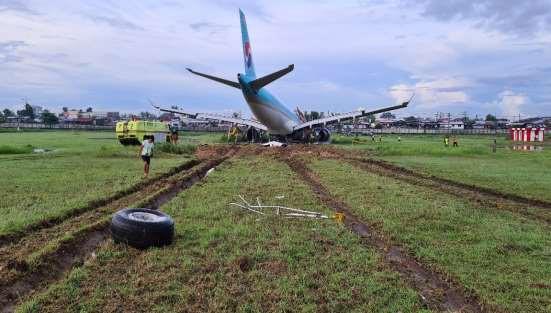
The damaged aircraft and the nosewheel which detached when the nose gear collapsed. [Reproduced from the Official Report]
Why It Happened
An analysis of the CVR and FDR data showed that an incorrect downward pitch input by the captain shortly before touchdown on the second approach was followed by a call of “sink rate” from the first officer, which was then followed by an EGPWS ‘SINK RATE’ warning. The first officer then called “go around” and this call was followed by the automated 40 feet agl callout and another EGPWS ‘SINK RATE’ warning. The captain then responded with a “go-around” call just before the 10 feet agl automatic callout occurred and just before the first officer called “flaps one step." Almost immediately, the noise caused by main landing gear ground impact was then followed by the first officer’s standard call of “positive climb.” The rest of the climb-out was completed without further event.
A reconstruction of the precision approach path indications (PAPI) showed that three red lights would have been visible to the pilots at around 130 feet agl and four reds at around 100 feet agl (indicating a low approch). It was noted that the aircraft had “experienced several downdrafts during the last 200 feet of the descent." However, although “both wind and pilot sidestick inputs had contributed to the late destabilisation," the captain’s sidestick inputs had made a greater contribution. It was also found that had the go-around been initiated one second earlier than it was - i.e. at 80 feet agl rather than at 60 feet agl, the aircraft would not have made ground contact.
The impact noise had been due to the right main landing gear hitting the 15 cm high cemented edge of the runway 22 paved surface (see the illustration below). This impact had resulted in damage to multiple components in that landing gear assembly. The damage was found to have been the cause of the subsequently annunciated landing gear fault, which had led directly to “the loss of most of the means of deceleration, specifically the braking failure which resulted in the subsequent runway overrun."
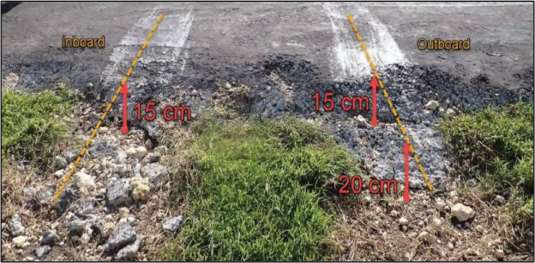
The 15 cm step after impact damage caused impact with the right main landing gear. [Reproduced from the Official Report]
The loss of all braking capability after touchdown was found to have been due to the collective effect of the following:
- Thrust reversers deployment was prevented by the Weight-On-Wheel discrepancy between the two MLGs, which defaults to a presumed in-flight condition in order to prevent thrust reverser deployment when airborne.
- Ground spoilers were inoperative because of the loss of both LGCIUs and all RH MLG wheel tachometers.
- Normal braking was not available because of the loss of all right MLG wheel tachometers.
- Alternate braking was unavailable and only limited emergency braking was available because the blue hydraulic system and accumulator pressure had been lost due to the combination of an internal leakage at the Park Hydraulic Manifold (PRV) (which was a dormant failure) and an external leakage caused by severed blue system hydraulic hoses at the right MLG brake level.
The Primary Cause of the accident was:
- The captain’s increase in the rate of descent, which led to ground contact before the runway 22 threshold during the second approach.
- The increase in vertical wind factor during the aircraft's descent during the second approach.
- The right MLG hit a 15cm step of the cemented edge of runway 22, resulting in multiple damage/faults to the said landing gear and consequently the loss of most of the deceleration means, specifically aircraft braking failure resulting in runway overrun.
Three Contributory Factors were also identified as:
- Loss of spoilers and reversers.
- Aircraft brake system dormant failure.
- A deficiency in the Airbus Flight Crew Operating Manual (FCOM) Procedure and (related) Alerting in respect of a Blue Hydraulic System Low-Level Fault.
Safety Action already taken by Korean Air Lines included the following:
- All aircraft have been incorporated into an Integrated Company Radio System wherein a one-touch SATCOM/VHF/Phone provides a reliable means of contact with Operations Control.
- ‘Flight Following’ has been enhanced by implementing Airbus- and Boeing-dedicated dispatchers. Previously, flights were managed based on geographical areas of operation.
- Cabin crew training on response to emergency evacuation commands has been simplified.
- Flight crew ground training has been changed from a lecture-based process to a self-directed one using a curriculum based on individual needs/requirements, and CRM training has been increased and the instructor ability improved. The frequency of recurrent training for nonprecision approaches has been increased, and training on adverse weather conditions on all approaches has been enhanced.
- Flight standards in respect of the quality of takeoff and landing briefings have been improved by adding “emphasis on the importance of communication” in those briefings.
- The need to identify and correct deficiencies during pilot line checks has been made a key focus, and where such a check identifies a need for extra training required, the success of this will be “thoroughly verified” in an unscheduled further line check. Minor deficiencies during line checks will now result in the pilot concerned being provided with both a debriefing against relevant evaluation standards and with the results of an analysis of their performance.
- Company requirements for pilots’ operational qualification for Mactan-Cebu Airport have been enhanced and proactive Safety Management of all “high-risk airports” has been introduced.
- Both the SMS and flight deck Safety Culture have been enhanced.
One Safety Recommendation was made based on the findings of the Investigation and having noted the safety action taken by Korean Airlines since the accident was as follows:
- that the Philippines CAA Aerodrome and Air Navigation Safety Oversight Office’ (AANSOO) ensures that the Mactan-Cebu International Airport Authority (MCIAA):
- amends section 3.9 (c) of the Disabled Aircraft Recovery Procedure (DARP) to replace the words “…release from custody to remove the disabled aircraft…” currently on page 23 to “…written authority to MCIAA to remove the disabled aircraft…” and that in coordination with the AANSOO, the Philippines CAA Aircraft Accident Investigation and Inquiry Board (AAIIB) is consulted when drafting procedures related to aircraft accidents and the removal of aircraft involved in events which are being investigated by AAIIB prior to implementation of the change to the DARP.
- Ensures the availability of a lifting bag for aircraft recovery for use in conjunction with the DARP.
- Complies with the published CAAP-AANSO Manual of Standards, 2nd Edition dated February 2017, chapter 6.4.1.13, ICAO Annex 14 Volume 1, chapter 3.5.8 and ICAO Doc 9157 Aerodrome Design Manual Part 1 which states that “a [runway end safety area] RESA must be prepared or constructed so as to reduce the risk of damage to an aeroplane undershooting or overrunning the runway" in respect of the conditions of the threshold end of Runway 04/22.
The Final Report of the Investigation was completed on 13 March 2025 and subsequently published online.