A339, en-route, north of Madagascar, 2023
A339, en-route, north of Madagascar, 2023
Summary
On 2 March 2023, an Airbus A330-900 level at FL390 encountered en route turbulence unanticipated by the two first officers occupying the pilot seats whilst the captain was in the crew rest area. All three pilots had only recently qualified on type. The risk of significant convective turbulence was not recognized in advance, which led to the seat belt signs being off until just prior to turbulence onset. The turbulence resulted in 6 severe and 16 minor injuries, all requiring hospital treatment. Multiple safety actions were implemented by the aircraft operator to reduce the risk of recurrence.
Flight Details
Aircraft
Operator
Type of Flight
Public Transport (Passenger)
Flight Origin
Intended Destination
Take-off Commenced
Yes
Flight Airborne
Yes
Flight Completed
Yes
Phase of Flight
Cruise
Location
Approx.
125nm north of Magacascar's northern tip
General
Tag(s)
Copilot less than 500 hours on Type,
PIC less than 500 hours in Command on Type
HF
Tag(s)
Flight / Cabin Crew Co-operation,
Inappropriate crew response - skills deficiency,
Plan Continuation Bias,
Procedural non compliance
LOC
Tag(s)
Flight Management Error,
Environmental Factors
WX
Tag(s)
En route In-cloud air turbulence
CS
Tag(s)
Turbulence Injury - Cabin Crew,
Pax Turbulence Injury - Seat Belt Signs off,
Cabin/Flight deck comms difficulty
Outcome
Damage or injury
Yes
Aircraft damage
Major
Non-aircraft damage
No
Non-occupant Casualties
No
Occupant Injuries
Few occupants
Occupant Fatalities
None
Off Airport Landing
No
Ditching
No
Causal Factor Group(s)
Group(s)
Aircraft Operation
Safety Recommendation(s)
Group(s)
None Made
Investigation Type
Type
Independent
Description
On 2 March 2023, an Airbus A330-900 (D-ANRA) operated by Condor on a scheduled international passenger flight from Frankfurt to Mauritius as DE2314 in night visual conditions (VMC) prior to recognition of cloud ahead encountered significant turbulence. Avoidance action occurred too late, with the seat belt signs off until just prior to turbulence onset. Serious or lesser injury to 21 passengers and one of the cabin crew occurred as a result. The flight was completed to destination, and those injured were all taken to hospital for treatment. Considerable damage was caused to the passenger cabin ceiling, interior trim, and to seats and cabin lighting.
Investigation
An accident investigation was carried out by the Bundesstelle für Flugunfalluntersuchung (the German Federal Bureau of Aircraft Accident Investigation). Relevant data were successfully downloaded from the cockpit voice recorder (CVR) and flight data recorder (FDR).
It was noted that the 55-year-old captain had a total of 11,274 hours flying experience of which 205 hours were on type. The accident flight was her first flight in command of an Airbus A330 after passing her final line check on the new aircraft type five days earlier. The 44-year-old first officer who had been acting as pilot flying (PF) at the time had a total of 8,500 hours flying experience, including 254 hours on type. The accident flight was his third flight duty on an Airbus A330 after passing his final line check on the new aircraft type 15 days earlier. He was being assisted by a 31-year-old first officer who had a total of 2,342 hours flying experience, including 1,030 hours on A330 variants. Though he had prior A330 experience gained at another operator, the accident flight was only his third flight duty on a Condor Airbus A330-900 after passing his final line check on type 15 days earlier.
What Happened
The 11-hour flight was nearing the top of descent on airway UM 665 with the cabin lights dimmed and many passengers sleeping but the seat belt signs remained off. The first officers were on the flight deck, and the captain was in a crew rest area. The weather radar in the standard ALL WX mode picked up a bank of clouds between 80nm and 160nm on track ahead. The SIGWX (significant weather) chart indicated a cloud area ahead close to track with embedded cumulonimbus. Another Airbus A350 ahead on a similar track 2,000 ft higher and laterally displaced by about five nm was observed to deviate from its track to the right. The crew were aware that a similar deviation would need to be obtained by controller-pilot data link communications (CDPLC). Such a request was made at about 20 nm before reaching the cloud bank. The crew stated that they commenced the turn in the vicinity of the UVESO waypoint without waiting for a response.
During this turn, the aircraft entered a cloud layer, and the crew said that's when they saw ice crystals on the flight deck windows. Shortly after light turbulence began, the pilots reported that they switched on the seat belt signs but made no cabin PA announcement in support of that action. A few seconds later, the turbulence intensified and “within about 10 seconds had become so intense that loose objects were flying around the cabin and galley” with some unsecured passengers lifted out of their seats. The pilots instructed the cabin crew on the intercom to be seated as the recorded vertical acceleration very briefly varied rapidly between +1.75g and -0.7g as airspeed increased to a recorded maximum of M0.856 (just below the maximum permitted M0.860). The autopilot (AP) remained engaged as the aircraft climbed to FL393 and this was corrected by a pitch change from +4.5° to -1.0°. The aircraft then entered a strong (approximately 40-knot) downdraft which was followed by a pitch up which resulted in a recorded +1.75g vertical acceleration. The AP was then deactivated but the autothrottle computer (A/THR) remained engaged with the engine N1 varying between 72% and 85%.
The turbulence quickly ended, and a stable flight path was re-established and there were no further turbulence encounters. The pilots on the flight deck were unable to make interphone contact with the captain in the crew rest area. (The accident report said to make contact, three specific buttons had to be pressed in succession.) Six passengers, some of whom were not wearing seat belts sustained serious injuries and fifteen other passengers and one of the cabin crew sustained minor injuries. Some injuries occurred after passengers had been lifted out of their seats and had then impacted passenger service units (PSUs), overhead luggage bins or seat armrests. Two of the six seriously injured passengers were identified as having been seated in the forward economy cabin and the other four had been seated in the rear economy cabin. Five had broken vertebrae or ribs, and one had a fractured ankle.
About eight minutes after the turbulence event, the senior cabin crew member (SCCM) asked any doctors or other medically trained personnel to make themselves known. A number did so and assisted in administering first aid. Approximately 25 minutes after the turbulence, the captain explained what had happened over the passenger address system.
Why It Happened
The investigation examined the functional aspects of the dual Honeywell RDR-4000 weather radar system to understand how it had been used. It was noted that the original equipment manufacturer (OEM) Honeywell knew of two types of incorrect function of the system, but there was no record of any related defects ever being raised.
The weather pattern at the time the turbulence occurred was reproduced by the German State Meteorological Service (see below) and confirmed that the aircraft had been flown though an isolated cell of “severe convection." This depiction of the convective weather was checked against satellite actual weather sensing and was consistent with it, showing how a Cb cloud in the occurrence area up to FL500 had built up.
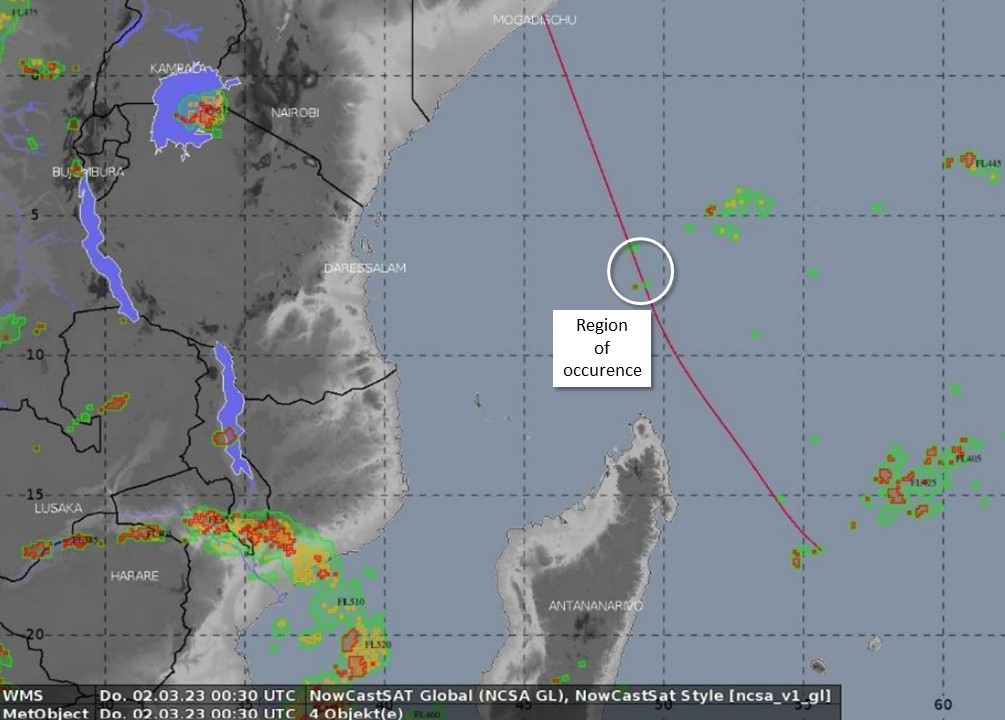
The nowcast weather chart showing the isolated convective cell penetrated. [Reproduced from the Official Report]
Using corrected anemometer leveraging of a DFDR inertial wind speed sensor, Airbus was able to determine “the influence of the wind on the flight behaviour of the aircraft” and the result on a time base is depicted in the graph below.

The influence of the horizontal and vertical wind velocity components on the aircraft. [Reproduced from the Official Report]
The investigation considered that “based on the flying experience of the flight crew, it could therefore have been expected that they would have changed their heading early in order to avoid the cloud area." Given the absence of any advance warning of a turbulence encounter, it was concluded that in responding to it, the cabin crew had “acted discreet(ly), prudently and without delay." A number of deficiencies in flight crew training material were identified including but not limited to use of generic A330 information based on an older aircraft type variant rather than the more advanced -900 variant. Also, after careful review of the aircraft documentation prior to release to service and the DFDR data, no evidence of any aircraft or system defects which could have indicated a defect of the weather radar at the time of the occurrence or any other technical defects “which could have affected a safe flight or distracted the flight crew” were identified.
Three Direct Causes of the event were determined as:
- The weather radar captured a bank of clouds which was displayed in green on the navigation display. This bank of clouds included an upwind and downwind region which could not be recognised in its intensity by the flight crew and generated severe turbulence over a period of 10 seconds.
- The change of heading initiated about 20 nm ahead of the bank of clouds occurred too late and as a result, the aircraft entered the top layer of clouds.
- Some passengers who were not wearing their seat belts suffered injuries, some of them serious.
Three Contributory Factors were also identified as follows:
- According to the two co-pilots’ statements, the weather radar was set to the ‘All WX’ mode and did not display turbulence on the Navigation Display.
- Due to the dynamic growth of the cloud area, its actual extent was only recognised shortly before entering the bank of clouds.
- The Initial Safety & Emergency Procedures Training the operator had conducted for both flight and cabin crew members showed deficits in handling on-board systems, especially the on-board communications system.
Safety Action relevant to the circumstances of the Accident and taken since it occurred was noted to have included the following:
- Airbus, having received information from other operators about crew’s in-service problems when using the IntuVue RDR-4000 weather radar, issued a ‘Flight Support Notice’ on 27 April 2023 to “improve the flight crews’ awareness about handling” this weather radar as a temporary measure which was also added to the corresponding Airbus briefing package. On the same day, Airbus also issued a Flight Crew Notice requesting that any defect reports made in respect of this radar should document the requested information for transmission to them.
- Condor began providing their pilots with additional information on how to use the weather radar which included an explanatory video and face to face training including “discussion for the purpose of exchanging experiences”.
- Condor acted to “improve and deepen” the weather-related training of its pilots in respect of “weather phenomena which affect long-range operation including aspects of the intertropical convergence zone (ITCZ)” after taking advice from the Deutscher Wetterdienst (DWD) (the German meteorological service provider).
- Condor began deployment of pilots to support their operations control center (OCC) as “Flight Watch Pilots." This new task mainly involved flight monitoring using the ‘eWAS’ APP Mission Watch system and advising en route flights (primarily using ACARS) especially in respect of “short term and large-scale weather phenomena." OCC employees’ use of the ‘eWAS’ APP during pre-flight planning was also introduced.
- Condor added training on the correct use of the service Interphone of the Airbus A330-900 to the Safety and Emergency Procedures (SEP) recurrent training of all flight and cabin crew.
- Condor took action to improve the crisis management processes in place at their “Special Assistance Team."
The Final Report was completed on 26 March 2025 and was subsequently published online. The BFU decided that “as a result of the measures taken” no Safety Recommendations would be issued.