A359-DH8C Tokyo Haneda Japan 2024
A359-DH8C Tokyo Haneda Japan 2024
Summary
On 2 January 2024, an Airbus A350-900 collided with a Bombardier DHC8-300 almost immediately after the A350 made a night touchdown in good visibility at Tokyo Haneda. The DHC8 had entered the runway for departure without clearance. Both aircraft caught fire. The DHC8 was destroyed and five of the six occupants died. The A350 then veered off the runway and stopped. All 379 occupants evacuated the A350 prior to its complete destruction by fire. A tower visual-only runway incursion warning was unnoticed for over a minute, and stop bar lighting was out of service for upgrading.
Event Details
When
02/01/2024
Day/Night
Night
Flight Conditions
On Ground - Normal Visibility
Flight Details
Aircraft
Operator
Type of Flight
Public Transport (Passenger)
Flight Origin
Intended Destination
Actual Destination
Take-off Commenced
Yes
Flight Airborne
Yes
Flight Completed
No
Phase of Flight
Landing
Flight Details
Aircraft
Operator
Type of Flight
Military/State
Flight Origin
Intended Destination
Take-off Commenced
No
Flight Airborne
No
Flight Completed
No
Phase of Flight
Take Off
Location - Airport
Airport
General
Tag(s)
Copilot less than 500 hours on Type,
Flight Crew Training
FIRE
Tag(s)
Post Crash Fire
RI
Tag(s)
Accepted ATC Clearance not followed,
Incursion pre Take off,
Ground Collision
RE
Tag(s)
Off side of Runway
EPR
Tag(s)
Emergency Evacuation,
Aircraft Exit Injuries
CS
Tag(s)
Cabin/Flight deck comms difficulty,
Cabin air contamination,
Flight Crew Evacuation Command
Outcome
Damage or injury
Yes
Aircraft damage
Hull loss
Non-aircraft damage
Yes
Non-occupant Casualties
No
Occupant Injuries
Few occupants
Occupant Fatalities
Few occupants
Number of Occupant Fatalities
5
Off Airport Landing
No
Ditching
No
Causal Factor Group(s)
Group(s)
Aircraft Operation
Safety Recommendation(s)
Group(s)
None Made
Investigation Type
Type
Independent
Description
On 2 January 2024, an Airbus A350-900 (JA13XJ) operated by Japan Airlines on a scheduled domestic passenger flight from New Chitose to Tokyo Haneda as JA516 had just made a night touchdown in visual meteorological conditions (VMC) on runway 24R when it collided with a Bombardier DHC8-300 (JA722A) operated by the Japanese Coast Guard on a nonscheduled cargo flight from Tokyo Haneda to Niigata. The DHC8 had entered the same runway contrary to air traffic control (ATC) instructions in the belief that such a clearance had been given. Both aircraft were extensively damaged by the collision and both caught fire. Five of the six occupants of the DHC8 were killed and one was seriously injured. Once the A350 had come to a stop after veering off the runway, a successful emergency evacuation of all 379 occupants was completed shortly before the fire engulfed the passenger cabin and rapidly intensified, leading to the destruction of the aircraft. One passenger was seriously injured after falling during the evacuation.
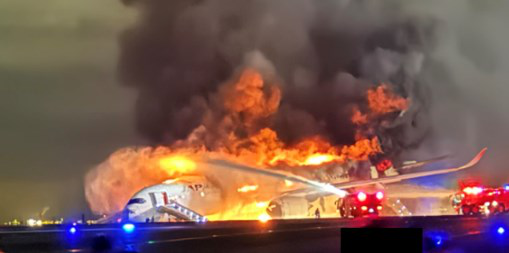
The Airbus A350 on fire. Photo taken by a passenger who had just evacuated from one of the three useable emergency exits.
Investigation
An accident investigation is being carried out by the Japan Transport Safety Board (JTSB). An interim report was published on 25 December 2024. Data were obtained from the recovered flight data recorders (FDR) and cockpit voice recorders (CVR) from both aircraft. All relevant recorded ATC and airport operations data were also available.
The 50-year-old training captain in command of the A350 was overseeing line training of the 29-year-old first officer in the presence of a 34-year-old first officer qualified on type who was acting as safety pilot and occupying a supernumerary crew seat. The captain had a total of 12,662 hours flying experience, which included 1,071 hours on type. The trainee first officer had a total of 1,663 hours flying experience, which included 24 hours on type. The safety pilot had a total of 2,135 hours flying experience, which included 678 hours on type.
The eight exit-stationed cabin crew were led by a 56-year-old senior cabin crew member (SCCM) who had 35 years flying experience. Two of the others had significant experience as cabin crew (22 and 25 years), and the experience of the remainder ranged from 3 months to 10 years.
The 39-year-old captain of the DHC8 had a total of 2,951 hours flying experience, with 1,345 hours on type.
What Happened
Runway 34R, also known as ‘Runway C,’ was operating in mixed mode and traffic was - as usual for the time of day - beginning to increase to a level that was leading to queuing of departing aircraft. The DHC8, loaded with enough fuel for 6½ hours flying, was instructed by ground control to continue taxiing along parallel Taxiway ‘C’ to a holding point before then being transferred to tower. This taxiway was also being used by aircraft taxiing for departure from Runway ‘D’ contrary to the normal use of a parallel separate Taxiway ‘E’. Taxiway 'E'; was being used by two aircraft under tow, which made the sequencing of Runway ‘C’ departures more complicated.
The DHC8 captain subsequently recalled that he had thought it likely that his flight would depart after the aircraft ahead. However, this aircraft then continued to the full-length Runway ‘C’ holding point on Taxiway C1 and at 17:45:14 the Tower Controller informed the DHC8 it was “Number One.” The tower also instructed it to taxi to the holding point on Taxiway C5, intending to indicate that the DHC8 would be the next aircraft to depart, and the correct readback followed. It was noted that the use by tower of numbers such as ‘number one’ or ‘number two’ for both arriving and departing aircraft “did not provide a combined runway usage sequence for both." However, unobserved by the tower controller, the DHC8 then passed the C5 holding point at 17:46:13 and continued onto the runway before stopping on the centreline at 17:46:46, approximately 560 metres from the beginning of Runway ‘C’. Meanwhile the A350 was on final approach and had already been cleared to land on Runway ‘C’ at 17:44:56.
The opportunity for the A350 crew to detect an unexpected aircraft on the runway centreline would have been brief at a busy time during a manually flown final approach and landing. The investigation considered how the stationary DHC8, abeam the precision approach path indicator (PAPI) on the right hand side of the runway, would have appeared through the A350 head-up display (HUD), which both operating pilots were using. This work, based on simulator imagery, was also used to collect representative data on typical pilot eye movements at this phase in the approach. However, it was accepted that “the flight data and simulation images do not completely reproduce the actual flight conditions and scenery” and also that the images from the simulator have symbols which are brighter than those the two pilots would have seen. It was, however, evident that as the DHC8 was "stopped in a position where the runway centreline lights and (the) touchdown strip lights were embedded in the runway surface, its navigation and the tail anti-collision light would have been in line with the runway centreline lights" (see the illustration below). It was also noted that the external view (directly rather than through the HUD) would have made sighting the unexpected DHC8 similarly difficult. 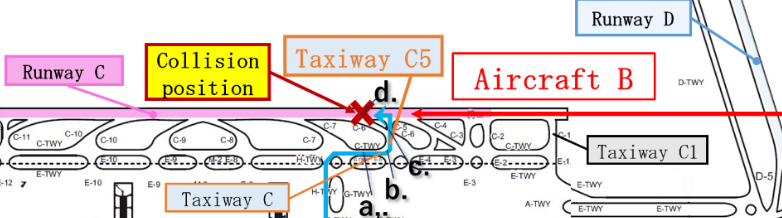
The taxi route of the departing DHC8 (blue) and the airborne track of the arriving A350 (red)
[Reproduced from the Official Report]
This unauthorised runway entry triggered a visual-only warning on the tower controller’s Runway Occupancy Monitoring System (TAPS), which was displayed on a secondary screen (see the illustration below) and went unnoticed. Such warnings are presented whenever it is detected that an aircraft has passed a holding point when an aircraft on approach is 48 seconds or less from time it is expected to cross the runway threshold. It was noted that “warnings by the support system may be issued even when the runway occupancy does not actually overlap (and) when runway occupancies overlap but are within normal ATC procedure and do not present a safety hazard." There were also no regulations stipulating how to respond to a Traffic Collision Warning System activation, with no controller training on its use. Nor were there “any materials to provide controllers with knowledge of the principles behind the warnings provided." This system was found to have recorded a warning issued for Runway C at 17:46:20 which then remained active for over a minute until ceasing at 17:47:28, one second after the collision had occurred. The in-position tower controller handed over his position to a relief controller less than a minute after the collision had occurred.
Only the captain of the DHC8 was able to escape from the aircraft. Whilst waiting for help near the remains of the aircraft, he spoke to the Coast Guard Haneda Office and described the aircraft as having “exploded” and said that after the flight having been cleared to “line up and wait," just before the impact, he had heard “cleared for takeoff” and had begun to increase engine power.
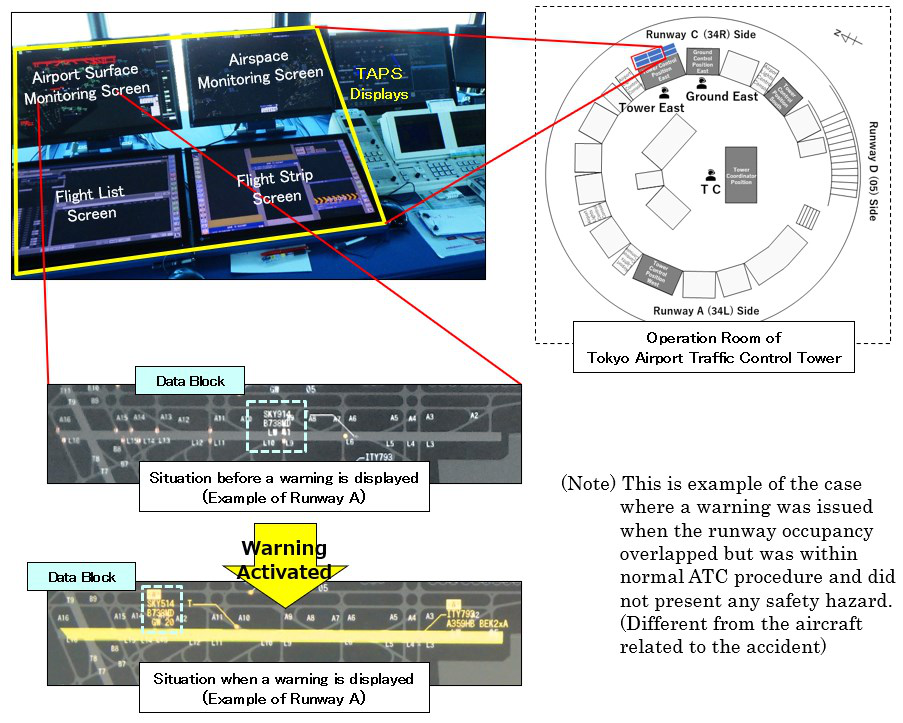
The TWR Runway Occupancy Monitoring Support System
[Reproduced from the Official Report]
The A350 main landing gear touched down at 17:46:26 and the crew (who were both using their HUDs) stated that at almost the same time as reverse thrust was selected, “a small aircraft, highlighted by the landing lights (of the A350) suddenly appeared in front and a large impact occurred”. At that time FDR data showed that the aircraft’s groundspeed was 120 knots, its pitch angle was +3.5°, its heading was 337°M and its nose landing gear was not yet in load bearing contact with the runway.
After the collision, the A350 captain took over control and applied the brakes but “did not feel a corresponding decrease in speed”. The aircraft's track gradually deviated to the right after the captain was unable to correct the deviation using either rudder or nose wheel steering. At approximately 2,118 metres from the beginning of the southeast end of Runway 34R, the aircraft left the east side of the 60-metre-wide runway onto grass. After striking the PAPI serving the opposite landing direction, the A350 came to a stop 2,298 metres from the touchdown end of the runway and 56 metres east of its centreline on a heading of approximately 345° M (see the illustration below) with its nose landing gear "buried in the ground and extended forwards."
An “abnormal sound” was reported to have been heard in the cabin immediately after the main landing gear touched the ground and “at the same time, it was felt as if the aircraft was running over something, but there was no sense of significant deceleration." Immediately after this “some passengers reported having seen fires near the undersides of both wings” and an unusual smell was reported to have appeared in the cabin near to the L3 door. As the aircraft decelerated, the individual cabin crew members seated next to the eight exits attempted to talk to each other but the intercom did not work. The aircraft began to vibrate, and the cabin crew "repeatedly shouted out instructions to passengers to ‘lower their heads’ as a precaution against impact."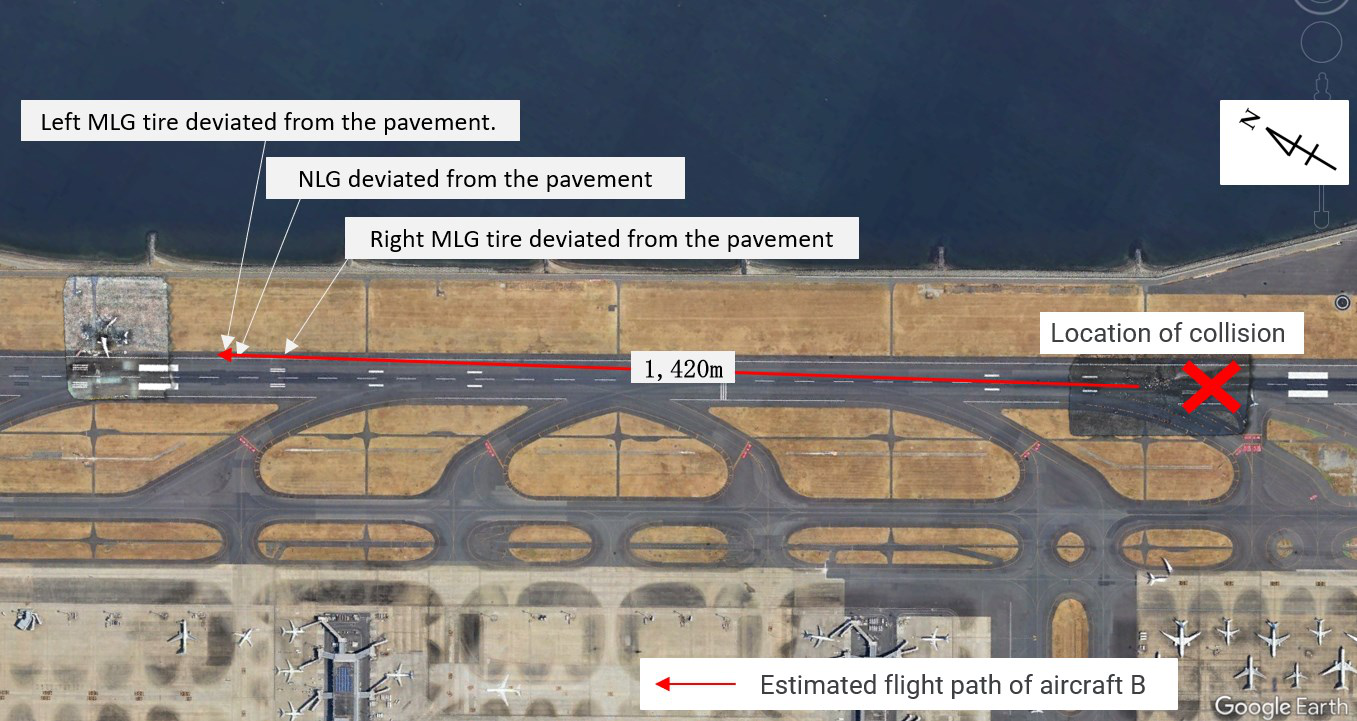
The ground track of the A350 after the collision
[Reproduced from the Official Report]
It was concluded that the likely positions of the two aircraft prior to impact as the A350 nose wheels were about to touch the runway centreline was as shown in the illustration below. The intense fuel-fed fire that immediately engulfed the DHC8 caused the A350 left main gear bay door to detach. This exposed the landing gear wheel well, and "it is believed that this area was set on fire by debris and fuel from the DHC8 which had ignited at the time of the collision." The nose landing gear then broke off from the middle of the strut 480 metres before the aircraft stopped, but the reminder of the strut continued to keep the aircraft's nose off the ground until it left the side of the runway. 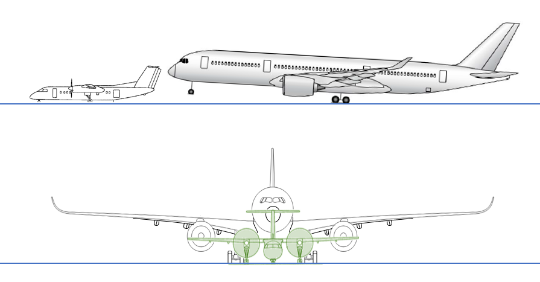
The estimated relative positions of the two aircraft as they were about to collide.
[Reproduced from the Official Report]
The A350 Evacuation
Once the aircraft had come to a stop, the captain and the trainee first officer followed the checklist to shut down both engines and activate the engine fire extinguishers. However, this action resulted in only the left engine shutting down. But as there were no indications of engine status on the flight deck instruments, they were unaware of the status of either engine. Fires continued to burn both engines and the lower fuselage and “the fire in the left engine in particular was spreading to the ground surface and gradually growing."
Having decided to order an immediate evacuation, the captain was about to order an evacuation on the PA and activate the Evacuation Command Device when he discovered that neither worked. The SCCM and the Door L1 Cabin Crew had observed that the flight deck door had come loose and entered the flight deck. The SCCM then received emergency evacuation instructions from the captain. The SCCM returned to the cabin and shouted instructions to the Door R1 Cabin Crew and after checking that the conditions outside the aircraft were safe, the L1 and R1 doors were opened and their slides deployed. This allowed the emergency evacuation of passengers using only those two exits initially. Because of the collapsed nose landing gear, both these slides deployed with a very shallow angle, and passengers using them found themselves stopping midway down as a consequence.
After completing their emergency evacuation procedures, the three pilots left the flight deck and began to assist with the passenger evacuation. In the cabin, smoke began to appear in the cabin through a gap between the cabin side wall and the floor near Door R3 and “gradually became thicker along with an irritating smell." A passenger located close to Door L3 took a series of photos of the cabin interior which showed how the smoke progressively reduced visibility (see the illustration below). The other six cabin crew also discovered that the intercom was inoperative and, having assessed the situation at each of their locations, those at doors L2, R2, L3, R3 and R4 concluded that it would be unsafe to use their exits due to fire visible outside.
Some of the cabin crew were able to use one of the four megaphones on board the aircraft to assist the evacuation. But some then stopped using them “because they felt that their voices were difficult to hear due to the noise of the cabin and the engine noise from outside.” Other crew members were unable to get the megaphones to work and reverted to giving instructions without them.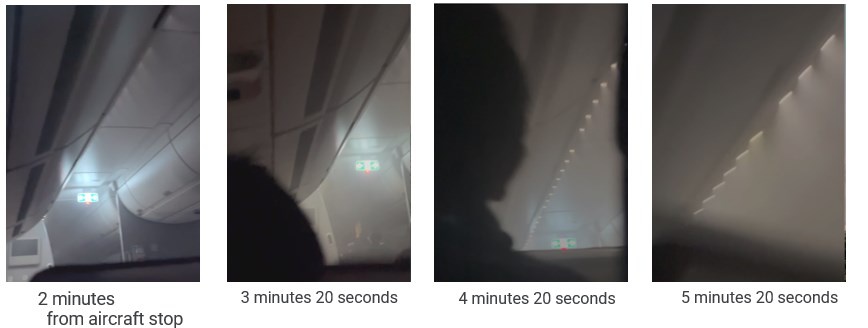
Photos looking in the same direction from a seat near Door L3 showing the increasing smoke density
[Reproduced from the Official Report]
The captain and the SCCM began to make their way towards the rear of the cabin amidst what was now rapidly intensifying smoke to direct passengers.
Most passengers were calm and followed the crew's instructions, but in the absence of any functioning PA system - or the automated emergency alerting system - some passengers did not receive direct emergency evacuation instructions from the crew (given in both Japanese and English). Some of these passengers saw that others were moving forward to escape and followed them, but others continued to follow initial cabin crew instructions to “stay low near their seats and wait for further instructions." Passengers who remained in or near their seats were found by the captain as he systematically searched the cabin for passengers who had not yet escaped and advised what to do.
The cabin crew at door L4 had initially kept their door closed in the absence of any contrary instructions being received. But as smoke filled the cabin and the surrounding situation became “increasingly dire” she reported having decided that in the interests of her passengers, she should open her assigned door. After checking that there appeared to be no fire or obvious fuel leaks and that there was space to deploy the slide, she opened the door approximately seven minutes after the aircraft had come to a stop. She then instructed the surrounding passengers to evacuate. With the tail of the aircraft elevated because of the collapse of the nose landing gear, the slide descent was steep and “many passengers fell when landing."
The captain eventually reached the back of the aircraft and, having ensured that no passengers or other crew members were still in cabin, evacuated from Door L4 ten minutes after the aircraft had come to a stop. He then called the company by mobile phone and advised that all the passengers on board his aircraft had escaped.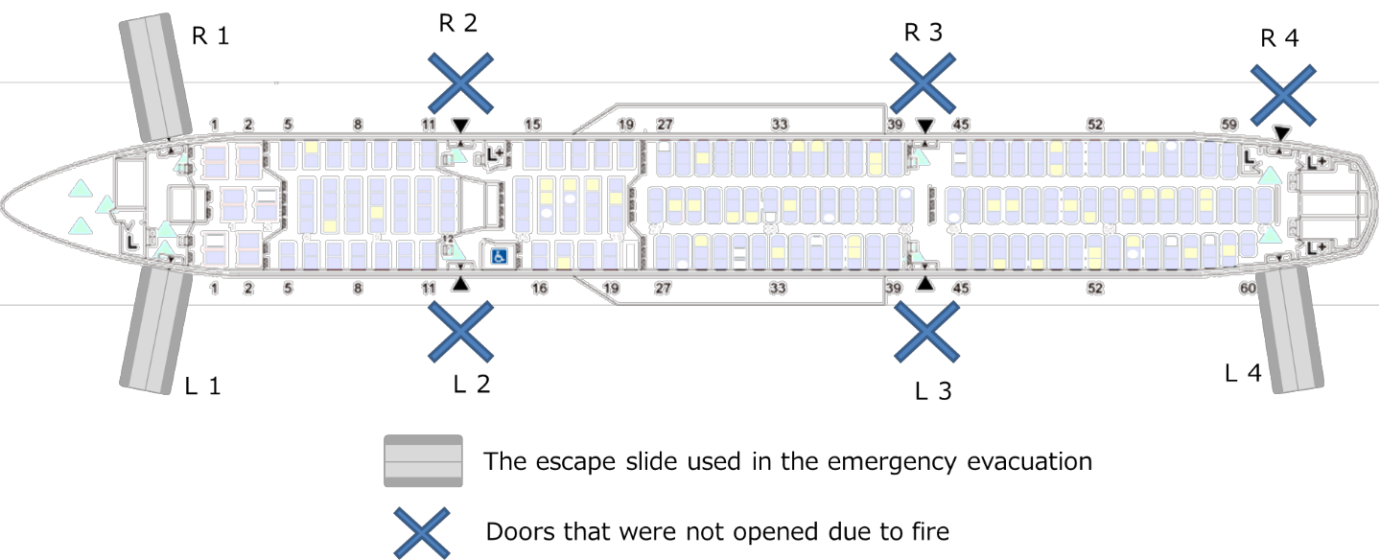
Only three out of eight emergency exits were assessed safe to use for evacuation.
[Reproduced from the Official Report]
Firefighting and the A350
By the time the first three fire appliances reached the A350 aircraft, the evacuation from doors L1 and R1 had begun. These passengers were observed to be gathering around the aircraft nose. They were initially guided by the rescue and firefighting services (RFFS) away from aircraft to a position behind one of the fire appliances. They were then directed to cross Taxiways ‘C’ and ‘E’ to a position approximately 500 metres from the aircraft where buses were waiting to take them to the airport terminal building. The much smaller group of 30-40 passengers who had subsequently evacuated from door L4 were then guided to the same location by crew members and two staff passengers who had used that exit.
The RFFS action at the aircraft was initially focused on cooling the fuselage with water spray to extend time for occupants to evacuate the passenger cabin whilst fires continued inside and outside the engines and in the lower fuselage. Only two minutes after the captain had evacuated the aircraft, “flames began to be visible through the L3 window and the amount of black smoke from the open L4 Door began to increase." The fire soon engulfed the entire aircraft. It was over nine hours before the fire was completely extinguished, by which time the aircraft fuselage, engines and parts of both wings had been destroyed.
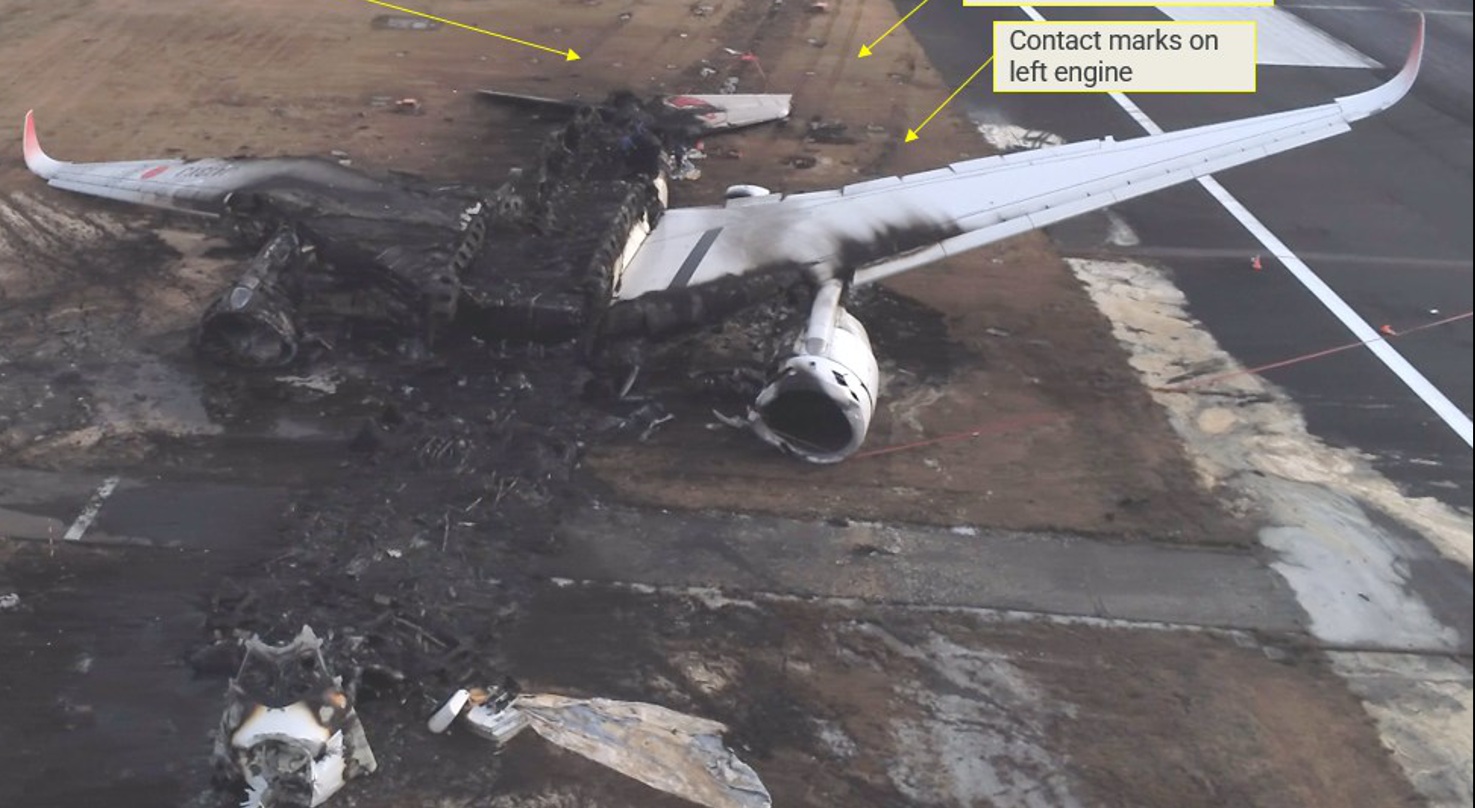
The burnt out remains of the A350 the following day.
[Part of an illustration from the Official Report]
It was subsequently found that both the airport firefighters and the Toyko Fire Department firefighters who had joined the attempt to extinguish the A350 fire “were not aware of the danger of dust generated from Carbon Fiber Reinforced Polymer (CFRP) combustion residues.” The A350 is heavily dependent on an aircraft structure made of CFRP. In addition, although the Japan Transport Safety Board had provided its air accident investigators training on the danger of dust generated from CFRP combustion residues at a fire scene, personal equipment for dust protection for the investigators who worked on the accident site on the day after the accident was not sufficient.
The Continuing Investigation
It was also noted that in respect of the A350, “the impact that occurred in this accident may have far exceeded the assumptions of the design standards for ensuring safety." It was considered that casualties “could have been greater if various conditions had been different” and since what turned out to be a time-constrained emergency evacuation became necessary, from the perspective of damage mitigation, the continuing investigation will need to focus on the following points:
- After the collision, although there was no major damage to the flight deck or passenger cabin prior to completion of the evacuation, the avionics compartment beneath the floor was completely destroyed, which caused serious damage to systems including the electrics, the flight control system, and the brake system.
- After the collision, the crew intercom did not work, nor did the equipment intended for the issue of emergency evacuation instructions or the public address system, all of which complicated and delayed the evacuation so that it was only just completed before the fire spread to the passenger cabin.
- Both engines continued to rotate until the final impact brought the aircraft to a stop and even then, only the left engine could be shut down.
Three Probable Contributory Factors have been identified at this stage in the investigation:
- The DHC8 crew believed that they had received clearance from the air traffic controller to enter the runway, line up and await takeoff clearance.
- The tower controller was unaware that the DHC8 had entered the runway and stopped on it.
- The A350 crew did not see the DHC8 stopped on the runway until just before the collision.
The Interim Report was published on 25 December 2024. It was noted that it describes the results of the Investigation so far, but “in order to protect the parties who in good faith provided information to it, the factual information recorded is limited to safety-related information consistent with the Investigation’s purpose”. It was also noted that it “contains many factual pieces of information that may have been involved in the accident, but further analysis is required to determine the relationship between this information and the cause of the accident and to the damage caused by it”.
It was noted that the English language version of the interim report is a translation from the Japanese original and the text in Japanese shall prevail in the interpretation of the report and that contents of the report “may be revised in the future as the latest information becomes available”.
Related Articles
- Runway Incursion
- Runway Holding Point Lighting
- Cabin Crew-Flight Crew Emergency Communication
- Emergency Evacuation on Land
- Controller Detection of Manoeuvring Area Conflicts
- Advanced Surface Movement Guidance and Control System (A-SMGCS)
- Runway Incursion Monitoring and Conflict Alert System (RIMCAS)
- Runway Incursion Device (RID)