AS50, Cambres, northern Portugal, 2024
AS50, Cambres, northern Portugal, 2024
Summary
On 30 August 2024, an Airbus Helicopters AS350 returning to base at Armamar, Portugal, in daylight after a firefighting callout where no action was required was unintentionally flown into a river when attempting a descent to route along it contrary to standard procedures. The helicopter was destroyed and the five firefighter passengers were killed but the pilot survived with serious injuries. The accident was caused by the pilot’s loss of situational awareness within a context of wider operational noncompliance, normalisation of procedural deviance, and inadequate oversight by the helicopter operator, the contractor and state safety regulator.
Flight Details
Aircraft
Type of Flight
Public Transport (Non Revenue)
Take-off Commenced
Yes
Flight Airborne
Yes
Flight Completed
No
Phase of Flight
Descent
General
Tag(s)
Helicopter Involved,
Inadequate Aircraft Operator Procedures,
Ineffective Regulatory Oversight
HF
Tag(s)
Procedural non compliance
Outcome
Damage or injury
Yes
Aircraft damage
Hull loss
Non-aircraft damage
No
Non-occupant Casualties
No
Occupant Fatalities
Most or all occupants
Number of Occupant Fatalities
5
Off Airport Landing
No
Ditching
No
Causal Factor Group(s)
Group(s)
Aircraft Operation
Safety Recommendation(s)
Group(s)
Aircraft Operation
Investigation Type
Type
Independent
Description
On 30 August 2024, an Airbus Helicopters AS350-B3 (EC-LBV) operated by HTA Helicopters under contract to transport aerial firefighting teams was returning to base at Armamar in day visual conditions (VMC) after assistance at the fire had not been required. En route, the single pilot misjudged the final level-off after a descent over the Douro River was misjudged and a violent impact with the water surface followed. This destroyed the helicopter. The five-person firefighting team were all killed although the pilot survived with serious injuries.
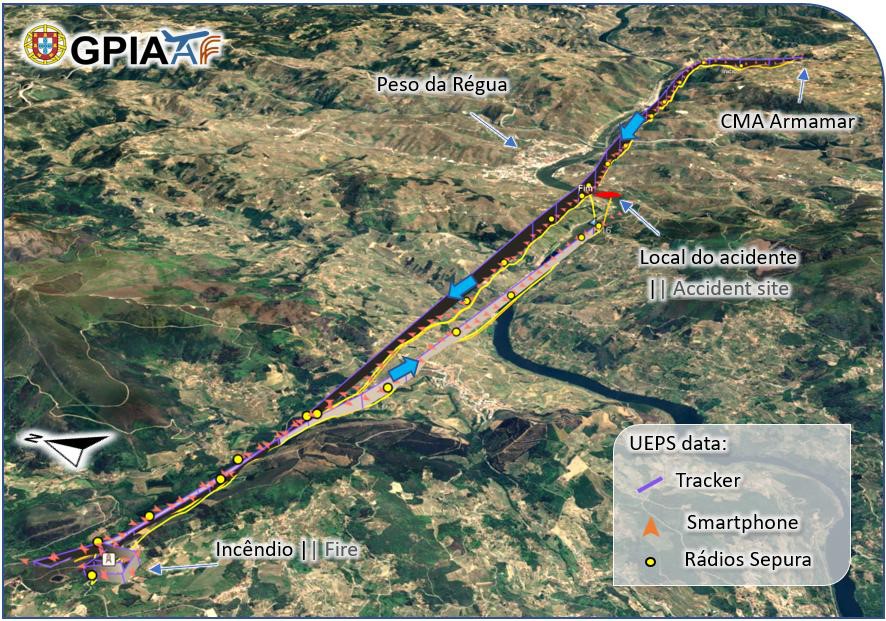
The flight track both to and from the fire location in yellow annotated with the three data sources which enabled its creation and the accident site. [Reproduced from the Official Report]
Investigation
An accident investigation was carried out by the Portuguese Gabinete de Prevenção e Investigação de Acidentes com Aeronaves e de Acidentes Ferroviários (GPIAAF). In the absence of any requirement for the helicopter to have a cockpit voice recorder (CVR) or a flight data recorder (FDR), these recorders were not installed. However, recorded flight data available from the memory of various onboard devices including the satellite navigation system and the recovered mission smartphone enabled the flight path to be replicated.
The 45-year-old pilot, a Portuguese national, had been flying since 2008 and held a commercial pilot license (CPL-H). He had a total of 2,301 hours flying experience, including 1,535 hours in command. He gained most of this experience operating aircraft for the purpose of fighting forest fires, with the most recent 12 years involving use of an AS350 helicopter. On 11 April 2024, he made a supervised training flight with an instructor lasting almost an hour, which involved a mountain flight with water drop from above 3,280 feet. This was followed by a routine one-hour 25-minute proficiency check flight in accordance European Union Aviation Safety Agency (EASA) Part FCL.740.H(a)(4) to revalidate his AS350 type rating. His authorisation to carry out firefighting flights was then reissued on 14 June 2024.
What Happened
The helicopter was dispatched to a fire location from its base at the Armamar Heliport. On arrival, the Emergency Protection and Rescue Unit (UEPS) team leader on board the helicopter decided that “the use of aerial assets at a fire with the perimeter already contained” was not warranted. The helicopter headed back to base and began a steady descent as it approached the south bank of the Douro River to follow it towards the city of Peso da Régua. As it was about to complete a left turn to align with the river, the helicopter impacted the surface of the water about 1,600 metres downstream from the city in an area without any natural or artificial obstacles.
The pilot and the UEPS team member seated alongside him were ejected from the helicopter with their seats. The pilot was able to surface and was rescued by bystanders, but the team member ejected with him did not reappear and was subsequently confirmed to have been fatally injured along with the other four members of the UEPS team.
There was no evidence of any in-flight collision prior to impact with water. Available data suggested that a flare manoeuvre had only been initiated about four seconds before impact at 120 feet above the river and at a high forward speed. When the helicopter's utility basket contacted the water, the aircraft swerved sharply to the left and the main rotor struck the water and detached. The tail cone fractured where it was attached to the fuselage and, along with the tail rotor and its gearbox, was projected approximately 70 meters forward. More detailed examination of the wreckage confirmed the impact occurred at a significant speed with significant power (rotation and torque). Examination of all recovered wreckage confirmed all structural damage was a consequence of the impact sequence.
Why It Happened
It was noted that “the contracting and management of aerial assets for rural firefighting in Portugal . . . is carried out by the Portuguese Air Force (FAP).” The FAP then arranges for them to be assigned to the ‘Special Mechanism for Fighting Rural Fires’ (DECIR) for allocation to the various UEPS bases such as Armamar.
Despite absence of data from the aircraft GPS navigation systems, which had not been activated for VFR flight, replication of the nonstandard flightpath was possible by reference to a flight tracking system (RockAIR.) This was provided by the helicopter operator, allowing the investigation to retrieve GPS-based flight data in the form of approximate trajectories, indicated altitudes and corresponding speed estimates. The UEPS mission smartphone carried by one of the firefighters to track the mission and supply information into the UEPS-integrated emergency management platform also provided a data source, as did the series of positions provided by the two ‘SEPURA’ radios carried by the firefighters. Finally, the on-board ‘Vehicle and Engine Multifunction Display’ (VEMD) - duplex equipment which manages and controls the main flight and engine parameters - was recovered from the riverbed and its data was downloaded by the French Accident Investigation Authority, the Bureau d'Enquêtes et Analyses pour la Sécurité del'Aviation Civile (BEA).
However, even more accurate replication of the final 33 seconds prior to impact was created using recordings obtained from five video cameras, notably one that recorded the last 7.6 seconds of flight and the impact. Eyewitness statements about the trajectory of the helicopter as it positioned and descended towards impact were consistent with the enhanced flight path replication based on video recordings.
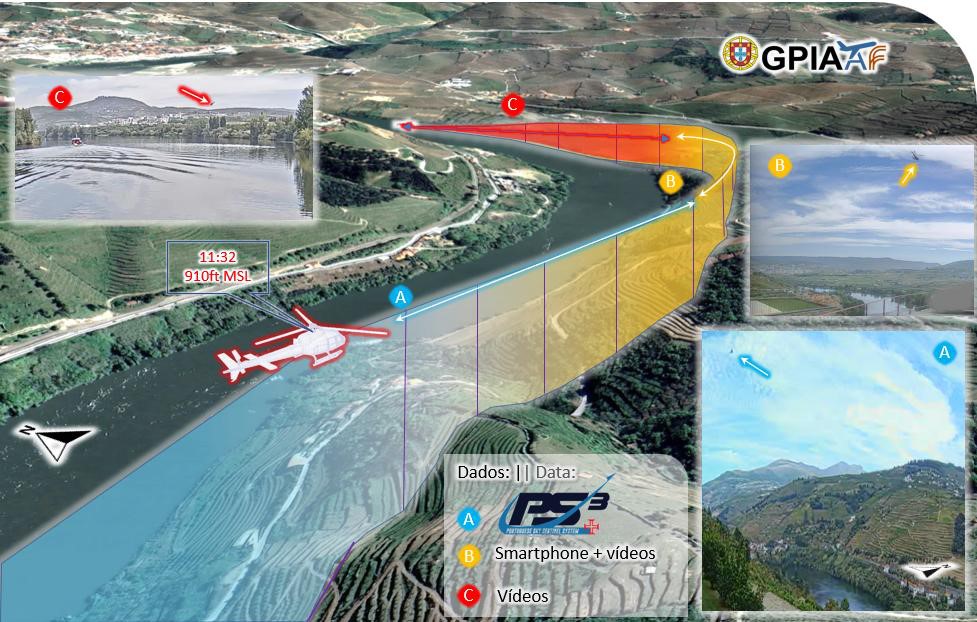
The flight profile for the final four minutes of the flight (Stage ‘A’ (3½ minutes) based on on-board recordings, Stage ‘B’ (33 seconds) on-board recordings supplemented by video recordings and Stage ’C’ the final 7.6 seconds refined using photogrammetric analysis of images captured from a fixed camera. [Reproduced from the Official Report]
Various sources of data were used to look for evidence of technical faults or irregularities which might have influenced the sequence of events which preceded the impact, but none were found. In particular, the report said the engine was operating normally and delivering high power at the time of impact, and there was no evidence of deficiencies. Examination of the recovered wreckage found no evidence of structural failure or system malfunction prior to impact. Also, no evidence to suggest that impact was a consequence of an evasive manoeuvre and/or a collision with birds was found. In addition, “the constant descent trajectory and low ‘g’ load factor was not conducive to contributing to the onset of an aerodynamic overload of the rotor system” which, had it occurred, might have induced a jam or control lock. These findings led to the elimination of airworthiness issues as contributory to the accident.
The prevailing weather was benign and was assessed as unlikely to have played a direct part in the accident except for one possibility. This was an assessment that a mirrored (glassy) water appearance as the helicopter descended towards the river may have increased risk. The illustration below shows the relevant parameters for this phenomenon compared to the descending flight path of the helicopter.
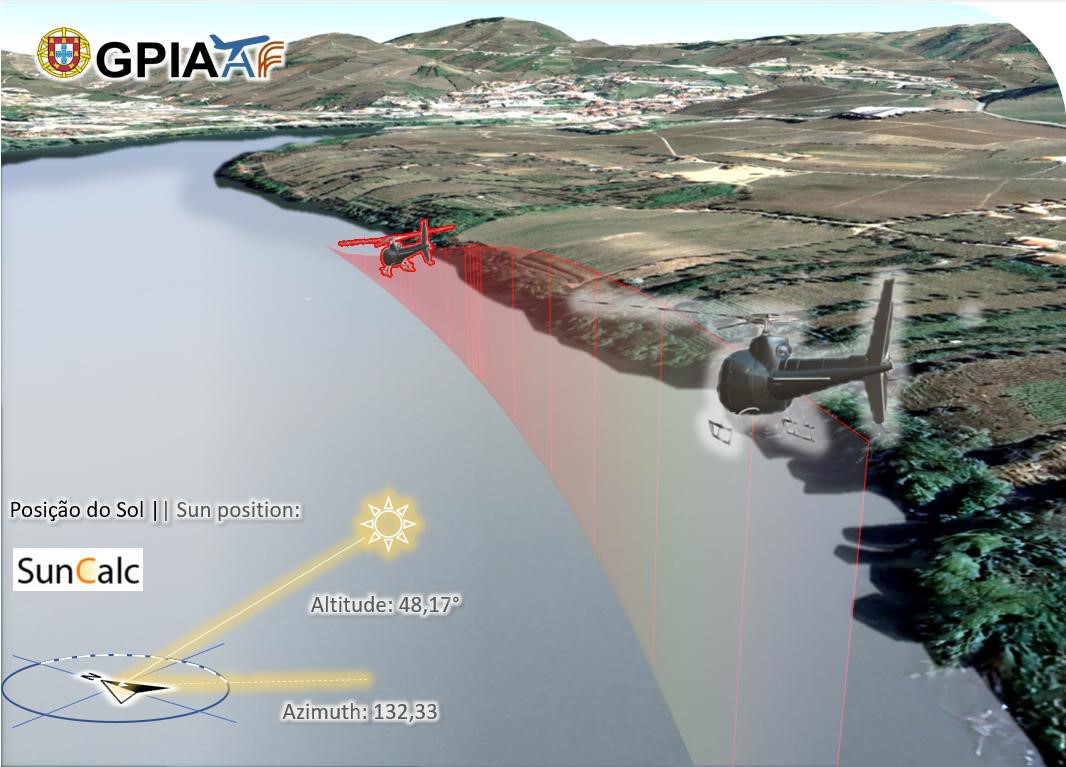
The light conditions which may have compromised the pilot’s judgment in respect of the water surface. [Reproduced from the Official Report]
Regarding efforts by the helicopter operator to maintain an acceptable level of operational safety for the firefighting task, it was noted that their safety management system (SMS) did not include the collection of flight data in to monitor possible deviations, nor was this required by legislation. It was also “not possible to identify any effective supervision process of pilots by the operator regarding route deviations made during missions" and neither was there any awareness of the extent of such deviations within the relevant oversight authority, the Special Rural Firefighting Service (DECIR). Finally, in overall terms, it was assessed that the regulatory framework for aerial firefighting activity had not satisfactorily addressed the need for human factors training which had been identified in several investigations into occurrences involving firefighting aircraft in recent years.
The Cause of the accident was formally determined to have been “the helicopter's contact with the surface of the river water, on a low-altitude flight, during the return to base after cancellation of an aerial firefighting mission to a rural fire."
Six Contributing Factors to the accident were determined to have been as follows:
- the pilot's chosen trajectory for the return to base, with the overflight of the river at high speed and low altitude which considerably increased risk;
- the pilot’s possible loss of situational awareness due to the visual conditions (glassy/mirrored water) present in the impact area, creating conditions for a deficient assessment of the helicopter distance to the water surface;
- the high mass of the helicopter and its forward CG position out of the loading envelope (which) contributed to a delay in reducing the rate of descent in the moments preceding the impact with water;
- noncompliance with the regulations and operating procedures relating to minimum flight altitudes;
- the normalisation of deviation (from prescribed operational practices) and a widespread acceptance among those involved in aerial firefighting activity of the practices of overflight of certain areas at low altitude, without any operational justification, by aircraft assigned to the Special Rural Firefighting Service (DECIR);
- the absence of supervision of the flight operation by the helicopter operator, the service contractee or the certifying authority of the operation;
The following Safety Action was noted to have been taken by the Portuguese Air Force whilst the investigation was in progress:
- A team was set up internally to analyse the routes followed by the aircraft contracted by the Air Force, during the missions assigned to them, within the scope of DECIR by ANEPC, with the aim of identifying any deviations that may raise doubts regarding the purpose of the mission. The Air Force declared and informed the contractors that in the face of such “deviations” and in case of doubt, the Air Force, through the Coordinating Office of the Mission in the scope of Rural Fires (Gabinete Coordenador da Missão no Âmbito dos Incêndios Rurais - GCMIR), will request additional information from the respective operators.
- The use of helmets has been made mandatory for all helicopter pilots and is now reflected in all new contracts for helicopter operation and involves verification of the existence of a helmet at the beginning of each contract, complemented by oversight of its use in each mission, through third parties or Air Force inspectors, whenever they travel to the DECIR bases during oversight activities."
A total of six new Safety Recommendations were made at the conclusion of the investigation based on its findings:
- that the Helicopter Operator re-evaluate its aafety management system to implement a process to collect and analyse flight data, acting on deviations identified according to established practices and Helicopter Flight Data Monitoring (HFDM) tools or others considered pertinent to the purpose. [Recommendation PT.SIA 2025/01]
- that the Helicopter Operator carries out a risk analysis of its operation and determines the minimum necessary safety equipment on board based on the provisions of the European Union Air Safety Agency Regulation Part-SPO.IDE.H205 and the respective GM. It shall also establish effective procedures to ensure that occupants use the aircraft’s safety systems foreseen by the aircraft manufacturers and determined by regulators. [Recommendation PT.SIA 2025/02]
- that the Helicopter Operator, although such a requirement is not specified in the current wording of the Portuguese Civil Aviation Authority (ANAC) Regulation 641/2022, establishes a detailed training program in aspects of human factors and crew resource management (CRM) for its personnel, following the references and principles set out in European Union legislation, such as AMC1 ORO. FC.115. [Recommendation PT.SIA 2025/03]
- that the Republican National Guard (GNR) Emergency Protection and Rescue Unit (UEPS) works together with aircraft operators that provide the aerial firefighting service to forest fires within the scope of Special Rural Firefighting Directive (DECIR) and with the Portuguese Civil Aviation Authority (ANAC), to establish a training syllabus in human factors, just culture and CRM for the operational training of its Equipa Helitransportada de Ataque Inicial (EHATI) [Heliborne Intervention Team for Fighting Forest Fires] which can integrate and adapt the concept of task specialism foreseen in the EASA Air Safety Regulations Part-SPO.SPEC.HEC.100. [Recommendation PT.SIA 2025/04]
- that the Portuguese Civil Aviation Authority (ANAC) adjust and detail the training requirements for pilots involved in firefighting activities, particularly in the general and overarching principles of human factors stated in Article 6 of ANAC Regulation No. 641/2022, namely but not limited to the loss of situational awareness, tunnel vision, excessive motivation, external pressures management, CRM notions, in order to ensure that compliance will result in an acceptable level of safety performance. [Recommendation PT.SIA 2025/05]
- that the Portuguese Civil Aviation Authority (ANAC) review the operational requirements of aerial firefighting activity, an activity authorised under national regulations, in order to monitor and examine, at least, what is established in the EASA Part-SPO for special operations, making the use of a helmet mandatory, as recommended by the EASA in their SIB 2021-07 as well as other equipment that it deems necessary as a result of the necessary risk analysis. [Recommendation PT.SIA 2025/06]
The Final Report of the investigation was published on 28 August 2025 in a dual language (Portuguese/English) version with the Portuguese version taking precedence over the English translation in the event of any discrepancy between these versions.