AT75, Guernsey, Channel Islands, 2024
AT75, Guernsey, Channel Islands, 2024
Summary
On 12 August 2024, an ATR 72-500 making a Category 1 ILS approach to Guernsey with thick fog breached an approach ban by continuing its descent below the applicable minimum altitude of 1,000 feet agl. The aircraft then continued below what would have been the applicable 200 feet agl Decision Altitude without visual reference. At around 70 feet agl, a go-around was called but not correctly commenced, and the aircraft passed close to an unseen mast north of the runway before it eventually climbed. In the absence of any visibility improvement, a diversion to Southampton then followed.
Flight Details
Aircraft
Type of Flight
Public Transport (Passenger)
Flight Origin
Intended Destination
Actual Destination
Take-off Commenced
Yes
Flight Airborne
Yes
Flight Completed
Yes
Phase of Flight
Missed Approach
Location - Airport
Airport
General
Tag(s)
Destination Diversion,
CVR overwritten
CFIT
Tag(s)
No Visual Reference
HF
Tag(s)
Authority Gradient,
Procedural non compliance
WX
Tag(s)
Fog
Outcome
Damage or injury
No
Non-aircraft damage
No
Non-occupant Casualties
No
Off Airport Landing
No
Ditching
No
Causal Factor Group(s)
Group(s)
Aircraft Operation
Safety Recommendation(s)
Group(s)
None Made
Investigation Type
Type
Independent
Description
On 12 August 2024, an ATR 72-500 (LY-JUP) operated by Lithuanian company Jump Air on a scheduled domestic passenger flight from Southampton to Guernsey for Aurigny Air Services breached an approach ban. Jump Air is Aircraft, Crew, Maintenance, and Insurance (ACMI) operator, which provides aircraft services through leasing. The approach ban was in place because of thick fog at the airport. The aircraft flew a Category 1 ILS approach in daytime instrument weather conditions (IMC). When this descent was continued to the Decision Altitude (DA), which would have applied without the approach ban, a confused crew interaction resulted in a failure to correctly commence a go-around. The aircraft came within 61 feet of the ground and into close proximity with an unseen mast before the intended go-around was eventually commenced. The subsequent diversion to Southampton was completed without further event.
(The approach ban as applied in European Union Aviation Safety Agency (EASA) and UK regulations prohibits a crew from continuing an approach below 1,000 feet above airport elevation if the governing RVR is not met.)
Investigation
A field investigation into this serious incident was carried out by the UK Air Accident Investigation Branch (AAIB) in accordance with applicable arrangements for Dependent Territories. As the event was not reported until over 24 hours after it had occurred and the aircraft had continued in service, cockpit voice recorder (CVR) data which would have been relevant had been overwritten. The flight data recorder (FDR) was provided by the aircraft operator. Relevant recorded ATC radar and radio communication data were also available, as were recorded runway visual range (RVR) data.
It was noted that the 56-year-old captain, who had been acting as pilot flying (PF) for the investigated flight, had a total of 4805 flying experience on type. It was also noted that he had an unquantified amount of experience on the Boeing 757, 767, and 777 but no information was recorded on how much of this time was as pilot in command (PIC). He had joined Jump Air five months prior to the event and had completed training which included a crew resource management (CRM) refresher as well as aircraft type revalidation. It was noted that a comment on his initial records at the operator said he had been “reminded that the ATR is a multi-pilot aircraft."
The first officer had “over 2,000 hours flying experience” of which “over 760 hours” was on type. He had joined Jump Air earlier in 2024 and had completed an operator type conversion course without significant comments recorded. However, the investigation noted: “The Training Captain who conducted his line check did suggest to him that he should not hesitate to offer help to a Captain."
What Happened
The flight under investigation was the crew’s second that morning. They had previously operated a flight from Guernsey to Southampton. When the aircraft left Southampton to return to Guernsey, “fog was already developing at the airport” although the RVR was - at that time - above 1,500 metres. Having reviewed the latest forecast (TAF) and recent weather observations (METARs), the captain reported he considered it likely that the weather at Guernsey would improve by the ETA. However, he decided to load enough fuel to be able to return to Southampton if necessary. The investigation found that the last three METARs prior to departure all had equal air and dew point temperatures, and the most recent TAF predicted 100 metres in fog with clouds overcast and on the surface, although with a 40-percent probability of intermittent improvements.
Several weather updates were received en route and speed was reduced to delay arrival. Although the RVR fluctuated, it was “rarely above the 550 metres required for the CAT 1 ILS approach which was available” and on reaching Guernsey, the flight entered the holding to await an improvement. After completing a number of holds, the Guernsey approach controller advised that the RVR had improved to 550 metres, the minimum for an ILS approach, so the captain decided that an ILS approach to Runway 27 should be commenced.
Descent and radar vectors onto the ILS localizer were provided by Guernsey approach. After the controller advised that the RVR had decreased to 450 metres, the flight was cleared for the approach and transferred to the tower as descent on the ILS glide path commenced. As the aircraft checked in passing 1,750 feet QNH, the tower controller advised that the Runway 27 touchdown RVR was 325 metres and the stop end was 400 metres. (The runway has a 1,463 metres of available landing distance). As the aircraft passed 1,540 feet QNH (1,204 feet aal), the RVR was passed as still 325 metres, the same at touchdown but reduced to 374 metres at the stop end.
Shortly after this, the aircraft reached and continued descent through the approach ban height of 1,000 feet (1,336 feet QNH) despite the RVR being less than the 550m minimum permitted to continue. The tower controller provided two further RVR updates (both still below 550 metres) during the remainder of the approach and, as the aircraft approached the applicable ILS decision altitude, both pilots reported having acquired the required visual references to land. However “there was some confusion” between the two pilots at this point and this led to the first officer calling for a go-around. The captain reported having begun the go-around by calling for the flaps to be retracted one stage (from 35° to 15°) and selecting go-around power. However, FDR data showed that “for the next 15 seconds the aircraft did not climb (and) the pitch attitude remained around that for level flight" with the aircraft at a recorded 61-78 feet agl. Only after travelling more than halfway along the runway did the aircraft begin to climb. The tower was then advised of the go-around and the intention to divert to Southampton.
A closer examination of the FDR data showed that on reaching the ILS procedure DA of 536 feet QNH, the aircraft had been briefly flown at that level before engine torque was reduced to flight idle and the autopilot (AP) was disconnected. The aircraft then descended to around 70 feet agl just past the runway (displaced) landing threshold. Full power was then selected and the flap setting changed from 35° to 15°. With the landing gear still down, height was held in the 61-78 feet agl range over the next 15 seconds as the aircraft began to deviate north of the runway and it passed within 40 metres laterally of a distance measuring equipment (DME) transmitter mast (see the illustration below). The landing gear was then retracted and the aircraft begin to climb, north of rather than on the extended runway centreline.
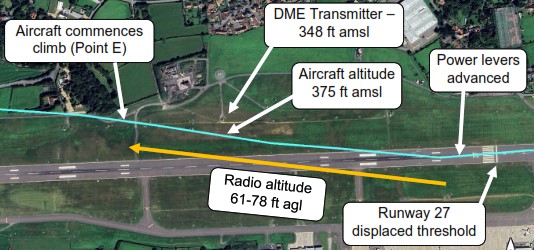
The Ground Track of the aircraft as it deviated north of the runway. [Reproduced from the Official Report]
The investigation noted that advection fog is characteristic of spring and summer weather in and around the Channel Islands and typically clears over land, as it did eventually after this event, as the air temperature rises.
Why It Happened
Without CVR data, a full understanding of why the approach ban was disregarded and exactly what happened over the runway could not be reliably explained, nor could the interaction between the two pilots at various points be objectively assessed. However, it seemed that “the approach brief did not include any conversation about the Approach Ban or which altitude it would apply into Guernsey (and that) there was no discussion about the RVR as the approach progressed."
The aircraft appears to have descended below the approach ban altitude “without comment from either pilot” despite the RVR being continuously below the 550 metre minimum required around that time. The captain “stated that he was working to what he described as ‘old rules’ where you could continue down to the minima” and he was not challenged by the first officer despite their awareness of the requirement.
The captain recalled that having reached the ILS DA, “he could see the runway lights and had the required visual references to continue.” He also said when the first officer called “Minimums” he replied “Contact, Land” as per the standard operating procedures (SOP). He said that having disconnected the AP in preparation for landing, “he was surprised then when he heard the copilot call for a go-around” but was aware that one had to be flown if either pilot called it. He said he called for landing gear retraction at least three times, and when the first officer could not or would not raise the gear, the captain raised the gear lever himself.
The first officer recalled saying “Minimums” but heard nothing in response, so he called for the go-around as he “assumed that the [captain] was not visual with the lights." He remembered the captain “kept asking for the gear to be retracted but the aircraft did not have a positive rate of climb, so he was unable to comply with the request." He added that “he had prompted the [captain] to climb" and explained why he could not retract the gear. Eventually the first officer pulled on the control column himself to establish a climb, and the captain retracted the gear.
The investigation noted the use of the NOTECHs (Non Technical Skills) system but said that system does not always explicitly cover communication. The EASA's framework for NOTECHs include cooperation, leadership and managerial skills, situational awareness and decision-making. The investigation also considered the potential implications when Jump Air crews “come from a variety of backgrounds and nationalities for whom English is not their native language.” The report noted that in this case, neither pilot spoke English as their first language and they did not share any other common language.
It was also noted that Jump Air did not have an flight data monitoring (FDM) programme, nor were they required to have one.
The formal narrative Conclusion of the Investigation was as follows:
The flight continued the descent below the approach ban altitude whilst on an approach to Runway 27 at Guernsey Airport despite not having the required RVR. The commander may have been reverting to a previous understanding of the regulations and this was not challenged by the copilot at any point. When the aircraft passed the approach minima, confusion and miscommunication between the crew resulted in a go-around being called and selected, but the pitch remained at around that required for level flight. The aircraft flew over the airfield between 61 and 78 feet agl for 15 seconds before interventions from both pilots resulted in a climb. The flight was diverted to Southampton Airport where it landed without further incident.
Safety Action taken by Jump Air as a result of the investigated event was noted as having included the following:
- Implemented a flight data monitoring (FDM) programme to enable the early identification of operational safety issues and help proactively prevent future occurrences by preventive action whenever a negative trend is thereby identified.
- Revised and enhanced their pilot recruitment process in respect of the psychological assessment of potential employees.
- Amended simulator training exercises so that they include opportunities for First Officers’ to practice actively challenging Captains’ decisions when deviations, errors or violations are noticed.
- Issued guidance to Training/Check Captains to emphasise validation of crew coordination and collaboration.
- Provided guidance for Training/Check Captains requiring them to increase the written feedback provided to trainees after training or checking activity.
- Considered whether to add ‘communications’ as a standalone NOTECHS assessment subject (outcome not recorded).
The Final Report was published on 27 February 2025. No Safety Recommendations were made.