B734, Amsterdam, Netherlands, 2023
B734, Amsterdam, Netherlands, 2023
Summary
On 19 December 2023, the flight crew of a Boeing 737-400F making a night takeoff at Amsterdam experienced difficulty rotating the aircraft to a liftoff attitude. After the crew applied more backward pressure on the control column than usual, the aircraft got airborne and no more control problems occurred. After completing their short flight to Brussels without further event, the crew were informed that the load and trim sheet provided and accepted had not shown correct information because the usual cross-checks before presentation to the crew had not been performed.
Flight Details
Aircraft
Type of Flight
Public Transport (Cargo)
Flight Origin
Intended Destination
Take-off Commenced
Yes
Flight Airborne
No
Flight Completed
Yes
Phase of Flight
Take Off
Location - Airport
Airport
General
Tag(s)
Use of Erroneous Performance Data
HF
Tag(s)
Procedural non compliance
GND
Tag(s)
Cargo Aircraft Loading
LOC
Tag(s)
Aircraft Loading,
Take off Trim Setting,
Incorrect Thrust Computed
Outcome
Damage or injury
No
Non-aircraft damage
No
Non-occupant Casualties
No
Off Airport Landing
No
Ditching
No
Causal Factor Group(s)
Group(s)
Aircraft Operation
Safety Recommendation(s)
Group(s)
None Made
Investigation Type
Type
Independent
Description
On 19 December 2023, a Boeing 737-400F (EI-ATW) operated by ASL Airlines Ireland on an international cargo flight from Amsterdam to Brussels did not initially respond to attempts to rotate at the required takeoff speed during its night takeoff. However, when considerably more back pressure was applied, rotation was achieved and the aircraft became safely airborne after an extended takeoff roll. No further pitch control issues occurred. Only after landing at their destination were the flight crew advised that the actual aircraft loading had not corresponded to the information on the load and trim sheet presented to and accepted by the captain prior to departure.
Investigation
An investigation was carried out by the Dutch Safety Board (DSB) into how the incorrect load and trim sheet had been prepared. Flight data recorder (FDR) data was available. Detailed accounts of the pre-departure activities which led to the presentation of an incorrect load and trim sheet for the captain were obtained. Details of the experience of the individual flight crew and ground personnel involved were not recorded.
What Happened
With the first officer acting as pilot flying (PF), the aircraft entered runway 18L for departure from taxiway E4 which was just beyond the displaced landing threshold which resulted in an takeoff run available (TORA) of 2,582 metres and an takeoff distance available TODA of 2,642 metres. The load and trim sheet presented showed a gross takeoff weight of 39,664kg and the crew had planned a flap 5 takeoff which meant a V1 of 116 KIAS and a VR 118 KIAS using reduced thrust based on an assumed temperature of 62°C against a 9°C OAT.
The takeoff proceeded normally with the first officer as PF until rotation was attempted at the expected speed using “almost full nose up elevator deflection” but rotation to a liftoff attitude did not occur. Only when the airspeed had increased to 134 knots - 16 knots above the calculated VR - was the first officer able to achieve rotation. Liftoff did not follow until a recorded airspeed of 150 knots, and the elevator trim was then used to reduce the manual control force this rotation had required. Due to the light load and despite the use of reduced thrust, the aircraft became airborne before the midpoint of the available runway length and subsequently crossed the reciprocal runway threshold at 718 feet agl.
Thereafter, the flight, including the landing, was completed without further event. En route the pilots reported that they had reviewed the takeoff performance calculation and the load sheet and concluded that their actions based on the load sheet provided had been correct. After landing at Amsterdam, the captain was informed that the aircraft had been incorrectly loaded and advised the aircraft operator accordingly. The operator then notified the Dutch Safety Board of the occurrence the following day.
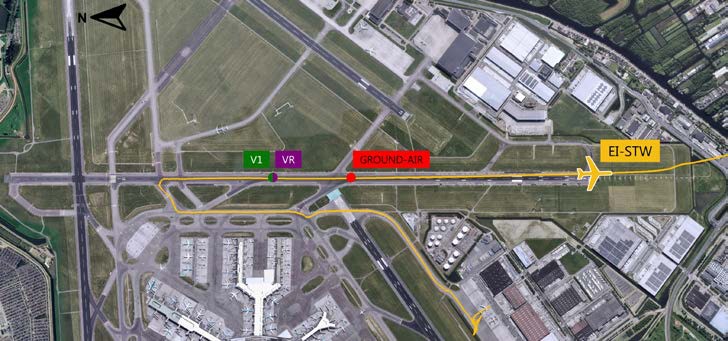
The actual unstick position compared to the loadsheet VR and V1. [Reproduced from the Official Report]
Why It Happened
Earlier the same night, the aircraft had been flown from Dublin to Amsterdam with five empty cargo containers and a ballast block which was positioned in the most aft cargo position on the cargo main deck. According to the cargo company supervisor, he had advised the foreman of the contracted Ground Handling Service Provider (Menzies Aviation) that only the five containers had to be offloaded and that the ballast block (inert material deliberately loaded onto an aircraft to alter its centre-of-gravity to ensure that it remains within allowable limits) could stay where it was. According to the Menzies Aviation internal report, its foreman had been told that their six-person ground handling team should offload five containers but had also been told to move the 1,458 kg ballast block to a position adjacent to the (forward) cargo door and had done so.
However, during the 30-minute turnaround time, not only had the five empty containers been offloaded but the ballast block in the now otherwise empty cargo load space had been moved forward. Since no new cargo had been loaded at Amsterdam, it was essential the ballast block remained at its rear location in order to achieve an allowable CG position for the departure.
The ASL Airlines Ground Operations Manual for the B737-400 was found to state that “no aircraft shall depart unless a load sheet has been produced and signed by the aircraft captain” and that based upon his load plan the supervisor of the cargo company will normally complete the load sheet. The Ground Handling Service Provider will then sign a statement on the load plan given to them confirming that the aircraft has been loaded in accordance with the plan and that the load is secure. At the end of this process, it was stated to the investigation that “there is time pressure to have the paperwork signed."
It was noted that a few months prior to the event under investigation, the way in which the cargo company communicated loading instructions to the Ground Handling Service Provider had changed. Instead of using a paper loading plan, the required loading instructions are now provided electronically to loading supervisors through their handheld computer/scanners which are connected to a central computer system. The loading process now starts with the Ground Handling Service Provider foreman scanning each container to be loaded before it is moved to the aircraft for loading. Once each cargo container is at its designated position on the aircraft, the foreman manually enters the mass and position of the container into a second handheld computer and this updates the system to show correct loading is complete. This system can also be used for ballast block loading but the report did not discuss how or if the ballast block loading position had been specified on the electronic loading plan or reported after the unloading/loading had been completed.
The narrative Conclusion of the Investigation was as follows:
The incorrect loading of the ballast block happened within the context of time pressure, where papers were signed without actually checking the correct position of the ballast block. This resulted in centre of gravity being significantly further forwards than the flight crew assumed and created a mismatch of the stabiliser trim position.
Elevator deflection during rotation at the calculated VR was ineffective because the stabiliser was seven units away from the required trim position. This delayed rotation and liftoff and demanded more runway length. Despite the fact that the centre of gravity was significantly out of the flight envelope, with the adjusted stabiliser trim the aircraft was controllable during the remainder of the flight.
When using intersection E4, the available runway length (TORA) and takeoff distance available (TODA) were adequate for the actual required runway length and threshold obstacle clearance.
The Final Report was published on 28 August 2025.