B738 / A321, Sarasota-Bradenton FL USA, 2023
B738 / A321, Sarasota-Bradenton FL USA, 2023
Summary
On 16 February 2023, an Airbus A321 crew did not promptly begin a night takeoff from Sarasota runway 14 on receiving clearance after confirming that the flight was ready for takeoff. The crew had been advised of a Boeing 737-800 at 3 miles to land on the same runway. When the A321 was still rolling as the 737 crossed the runway threshold, the 737 crew announced they were commencing a go-around. This alerted the controller, who was working alone, to a potential airborne conflict. He instructed the 737 to immediately begin a right turn which created 0.6 nm of same-altitude horizontal separation.
Flight Details
Aircraft
Operator
Type of Flight
Public Transport (Passenger)
Flight Origin
Intended Destination
Take-off Commenced
Yes
Flight Airborne
Yes
Flight Completed
Yes
Phase of Flight
Missed Approach
Flight Details
Aircraft
Operator
Type of Flight
Public Transport (Passenger)
Flight Origin
Intended Destination
Take-off Commenced
Yes
Flight Airborne
Yes
Flight Completed
Yes
Phase of Flight
Climb
Location - Airport
Airport
General
Tag(s)
Visual Approach,
PIC aged 60 or over
HF
Tag(s)
ATC clearance error
LOS
Tag(s)
Required Separation not maintained,
ATC Error,
Go Around Separation
Outcome
Damage or injury
No
Non-aircraft damage
No
Non-occupant Casualties
No
Off Airport Landing
No
Ditching
No
Causal Factor Group(s)
Group(s)
Air Traffic Management
Safety Recommendation(s)
Group(s)
None Made
Investigation Type
Type
Independent
Description
On 16 February 2023, a Boeing 737-800 (N826NN) operated by American Airlines on a scheduled domestic passenger flight from Charlotte-Douglas to Sarasota-Bradenton as AL2272 lost airborne separation in night visual meteorological conditions (VMC) with an Airbus A321 (C-GKFB) operated by Air Canada Rouge on a scheduled international passenger flight from Sarasota-Bradenton to Toronto as ROU1633. The loss of separation took place after the 737, which had been cleared to land, began a go-around because the A321 was still accelerating for takeoff on the same runway. Minimum separation occurred at 100 feet agl as the A321 was climbing on runway heading and the 737 was going around. The A321 was still on the runway as the 737 crossed the landing threshold, and the 737 was instructed by ATC to turn right to re-position. The controller was working alone and had not monitored the A321's start of takeoff relative to the landing traffic position.
Investigation
An investigation was carried out by the U.S. National Transportation Safety Board (NTSB). All relevant recorded radar, ADS-B and ATC communications data was available. The 61-year-old Boeing 737 captain had a total of 14,600 hours flying experience which included 3,616 hours on the type variant, and his 31-year-old first officer had a total of 4,970 hours flying experience which included 1,246 hours on the type variant. No information was obtained in respect of the A321 flight crew. The tower controller was qualified and current on all positions including tower supervisor and had been at Sarasota since 2018 after previous positions at two general aviation (GA) airports and one at an Air Route Traffic Control Center (ARTCC).
What Happened
The tower controller - who was working alone as the other controller on duty was on a break - issued a landing clearance to the 737, which was about 12 miles out on a visual approach to the runway in use (2,895 metre-long runway 14). When this aircraft had about four miles remaining to touchdown, its crew heard the A321 being cleared to take off and instructed to fly runway heading. The A321 crew was advised that an inbound aircraft was “on a three-mile final” to land on the same runway. The controller then advised the 737 of the imminently departing aircraft.
However, the A321 did not immediately commence the takeoff roll, and half a minute later asked the controller to confirm they were to fly runway heading. The controller responded in the affirmative. At this time, ADS-B data indicated that the 737 was approximately 2.5 nm from the runway 14 threshold. Less than a minute later, the 737 was over the runway and the A321 had just lifted off. The 737 commenced a go-around. As the 737 passed over the runway 14/taxiway A3 intersection, the A321 was airborne over the runway 14/taxiway B intersection - see the illustration below.
The resultant loss of separation was managed by instructing the 737 to turn off the runway centreline onto a heading of 270° as it began its climb. The closest proximity between the two aircraft was found to have been 0.6 nm horizontally as they both climbed through 100 feet agl. The investigation noted that for an aircraft to land on a runway from which a departing aircraft has just become airborne, FAA regulations stated that a Category III departing aircraft such as the A321 need not have crossed the runway end before an approaching aircraft is permitted to cross the landing end runway threshold provided that it is at least (the equivalent of) 1,829 metres from that threshold. The exact distance between the two aircraft when the 737 crossed the landing threshold was not determined but it was evident that the minimum ATC separation requirement for crossing the landing threshold had not been met. An airborne collision risk had existed until the controller, alerted by the ‘going-around’ call, instructed the 737 to turn away from the extended runway centreline. Whilst the airborne separation thereby achieved had been sufficient to avoid a collision, it had not met airborne traffic minimum separation standards for controlled airspace.
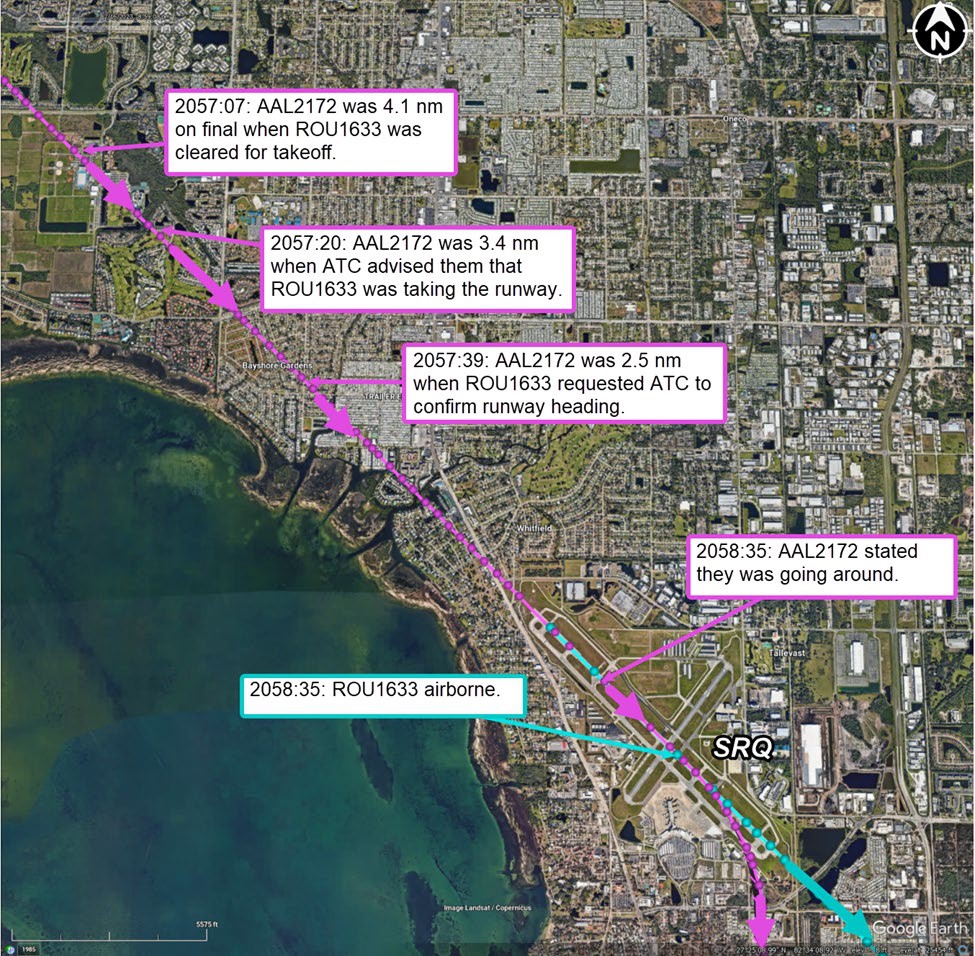
A satellite aerial view with the annotated ADS-B tracks of both aircraft overlaid.
[Reproduced from the Official Report]
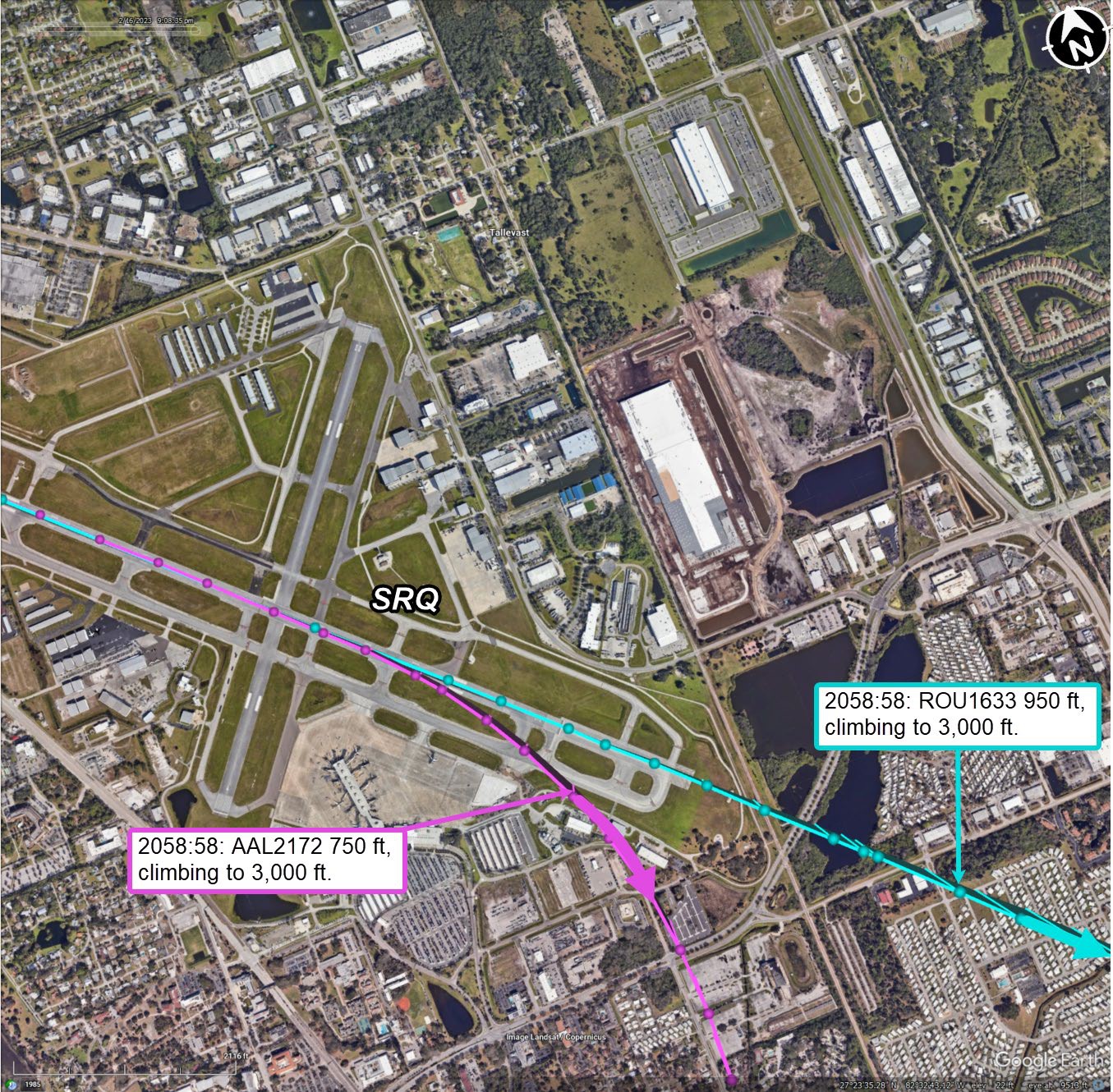
The tracks of the two aircraft deviate as the 737 turns away from the runway extended centreline showing their relative position at minimum separation.
[Reproduced from the Investigation Docket]
Why It Happened
Despite being alone in the tower control room, the controller was found to have “turned his attention to a lower priority task” - leaving his position to update the automatic terminal information service (ATIS) information - before confirming that the A321 had departed. Once the 737 flight crew, judging they could not safely touchdown despite having clearance to do so, had commenced and announced their go-around, the controller realised the situation and instructed the A321 to turn off the runway centreline, thus increasing separation of the two aircraft to the extent possible.
The Probable Cause of the conflict was determined as “The local controller’s failure to prioritize and properly monitor the runway and airport environment along with his erroneous assumption that the Airbus A321 would depart from runway 14 before the Boeing 737 arrived to land on the same runway, which resulted in a loss of separation between both airplanes."
The Final Report of the investigation was published on 26 February 2025. This summary also draws on the corresponding published Investigation Docket. No safety recommendations were made.
Editor's Note: The information in the Final Report which was the primary source of the above summary was supplemented where deemed appropriate by reference to the event ‘Docket’ which if required is accessible via the link at the end of the Final Report.