B738, Barcelona Spain, 2023
B738, Barcelona Spain, 2023
Summary
On 16 July 2023, an Airbus A320 hit a bird at high speed during takeoff from Barcelona. The first officer was the pilot flying (PF). The captain’s airspeed indicator failed at that time but the first officer’s did not, so he called V1. The captain responded with a “stop” call and rejected the takeoff. The aircraft stopped with 600 metres of runway remaining. When the aircraft could not be moved, concern about rising wheel temperatures led the captain to order an emergency evacuation during which 15 passengers received minor injuries. The inability to taxi the aircraft was found to be because the autobrake was still at MAX.
Flight Details
Aircraft
Operator
Type of Flight
Public Transport (Passenger)
Flight Origin
Intended Destination
Take-off Commenced
Yes
Flight Airborne
No
Flight Completed
No
Phase of Flight
Take Off
Location - Airport
Airport
BS
Tag(s)
Coastal or Large Inland Water Location
HF
Tag(s)
Procedural non compliance
EPR
Tag(s)
Emergency Evacuation
Outcome
Damage or injury
Yes
Aircraft damage
Minor
Non-aircraft damage
No
Non-occupant Casualties
No
Occupant Injuries
Few occupants
Off Airport Landing
No
Ditching
No
Causal Factor Group(s)
Group(s)
Aircraft Operation
Safety Recommendation(s)
Group(s)
None Made
Investigation Type
Type
Independent
Description
On 16 July 2023, an Airbus A320 (EC-JTR) operated by Vueling Airlines on a scheduled domestic passenger flight from Barcelona to Seville struck a single medium-sized bird shortly before V1 in day visual meteorological conditions (VMC). The bird was heard impacting the aircraft. The captain’s airspeed indicator failed and when the V1 call was made by the first officer, the captain responded with a stop call and rejected the takeoff. An emergency evacuation was ordered because of concern about rising wheel temperatures, and 15 minor injuries resulted. All four main gear wheels and their brake units were replaced before the aircraft was towed clear of the runway.
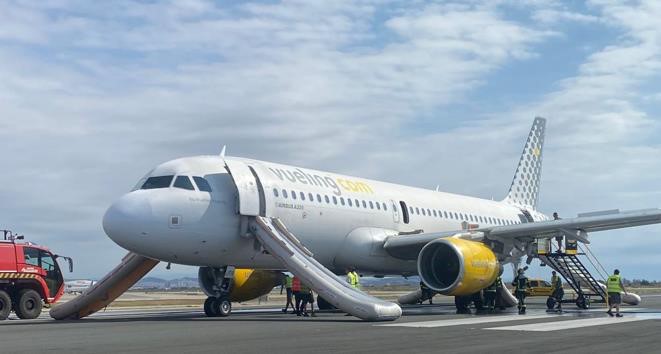
The aircraft following the evacuation. [Reproduced from the Official Report]
Investigation
An investigation was carried out by the Spanish Commission for the Investigation of Accidents and Incidents (CIAIAC). The cockpit voice recorder (CVR) and the flight data recorder (FDR) were removed from the aircraft and downloaded. Useful data was available from the CVR download as was most of the data of interest on the FDR, but despite assistance from Airbus, it was not possible to access recorded data from the standby airspeed indicator.
The 45-year-old captain had a total of 12,000 hours flying experience, which included 8,000 hours on type and had held a command with the operator for 8 years after serving as a first officer for 4 years. The 45-year-old first officer had a total of 4,000 hours flying experience, which included 2,500 hours on type and had been employed by the operator for 4 years.
What Happened
Six seconds after the captain made the 100-knot speed call during takeoff, the first officer, who was the pilot flying (PF), saw a single medium-sized bird ahead and called “bird” at a recorded 129 knots, calibrated airspeed (KCAS). The groundspeed at that time was 134 knots. Almost immediately, an impact noise near the flight deck was accompanied by the failure of the captain's airspeed indicator. The captain reported that he did not check his standby airspeed indicator and so it was left to the first officer to call V1 (142 knots KCAS). The captain responded with a “stop” call and almost immediately selected maximum reverse. The maximum groundspeed reached was 153 knots, which was likely to have been close to 148 KCAS. The exact figure was not known because the airspeed on the first officer’s airspeed indicator was not a recorded parameter on the installed FDR. MAX Autobrake had been set for takeoff, so it was applied throughout the deceleration. The control tower was informed of the rejection as the groundspeed reduced through approximately 100 knots, and at 75 knots groundspeed, the thrust levers were set to reverse idle. The aircraft came to a complete stop on the runway 20 seconds after the rejection had been initiated.
A few seconds after the aircraft stopped, the captain advanced the thrust levers to taxi clear of the runway but the aircraft did not move. Having recognised that the wheel temperature was increasing as a result of heavy braking, the crew reported having begun to smell what they described as a strong "smell of burning rubber," and the captain decided to order an emergency evacuation. The last recorded brake temperatures were, in wheel order, 617°C, 638°C, 738°C and 668°C.
Twelve seconds after the aircraft had come to a stop, the tower was advised that the aircraft was unable to taxi. The crew also said they needed assistance from the rescue and firefighting service (RFFS) because the wheel temperatures were rising and an emergency evacuation was about to begin. The call was acknowledged and the evacuation commenced with five of the available eight exits used, and all 191 occupants exited the aircraft. The unused exits were three of the four overwing exits which were not opened by the passengers sitting next to them. Approximately four minutes after the evacuation commenced, the RFFS arrived and reported that three of the main gear tyres were deflating. They then cooled the wheels which were later replaced where the aircraft had stopped and the aircraft was then towed clear after almost two hours on the runway.
The single bird struck was recovered and found to be a peregrine falcon weighing 900 gm. No evidence was found that there was any other relevant bird presence around the runway at the time. The available evidence indicated that the species was not a common bird strike risk - records showed that four had been struck over the preceding ten years and that five carcases suspected as being evidence of unreported or unseen bird/aircraft impacts had been recovered from the runways.
Why It Happened
The investigation report said the cause of the rejected takeoff was a bird striking the captain's pitot tube, which led the captain to reject the takeoff after exceeding decision speed.
It was noted that the subject of high speed rejected takeoffs was covered in the Airbus A320 flight crew training manual (FCTM) as was the advisability of a rejected takeoff commenced above 100 knots but below V1. The relevant content included the following:
- The decision to reject a takeoff is the captain's responsibility and must be made before V1 speed. With speed above V1, the takeoff must be continued because it may not be possible to stop the aircraft within the runway limits.
- Above 100 knots the captain should be "go-minded" and very few situations should lead to the decision to reject the takeoff. Such situations would be:
- Fire warning, or severe damage
- Sudden loss of engine thrust
- Malfunctions or conditions that give unambiguous indications that the aircraft will not fly safely
- Any red electronic centralised aircraft monitor (ECAM) warning
- Any amber ECAM caution listed below:
- F/CTL L(R) SIDESTICK FAULT
- ENG 1(2) FAIL
- ENG 1(2) REVERSER FAULT
- ENG 1(2) REVERSE UNLOCKED
- ENG 1(2) THR LEVER FAULT
Safety Action taken as a result of the event and the investigation of it was noted as having included the following:
▪ Vueling Airlines provided guidance to its flight crew on when an emergency evacuation is appropriate.
▪ AENA as the airport operator took measures to improve the airport RFFS response times.
The Cause of the investigated event was formally documented as “a bird striking the captain's pitot tube, which led to him rejecting the takeoff after exceeding the decision speed."
The Final Report of the Investigation was approved on 18 December 2024 and subsequently published simultaneously in both the definitive Spanish language version and in an English language translation on 12 March 2025. No Safety Recommendations were made.
Related Articles