B738, Brisbane, Australia, 2022
B738, Brisbane, Australia, 2022
Summary
On 30 November 2022, a Boeing 737-800 took off from Brisbane after entering a temporarily closed section of the departure runway, and the aircraft became airborne within the closed section. A NOTAM had described the closure as a displaced threshold on Runway 01R. A training captain had interpreted a dispatcher's note to mean performance for using the runway in the opposite direction, Runway 19L, was not affected. In addition, ATIS advisory of the reduced landing distance for 19L was not identified and accounted for in performance calculations for landing when the aircraft had arrived. Action to improve the both the presentation and use of NOTAMs followed.
Flight Details
Aircraft
Operator
Type of Flight
Public Transport (Passenger)
Flight Origin
Intended Destination
Take-off Commenced
Yes
Flight Airborne
Yes
Flight Completed
Yes
Phase of Flight
Take Off
Location - Airport
Airport
General
Tag(s)
Flight Crew Training,
Use of Erroneous Performance Data
HF
Tag(s)
Distraction,
Pre Flight Data Input Error,
Procedural non compliance
GND
Tag(s)
Maintenance work in progress
RE
Tag(s)
Overrun on Take Off,
Runway Length Temporarily Reduced
Outcome
Damage or injury
No
Non-aircraft damage
No
Non-occupant Casualties
No
Off Airport Landing
No
Ditching
No
Causal Factor Group(s)
Group(s)
Aircraft Operation
Safety Recommendation(s)
Group(s)
None Made
Investigation Type
Type
Independent
Description
On 30 November 2022, a Boeing 737-800 (VH-YFH) operated by Virgin Australia Airlines on a scheduled passenger service from Brisbane to Melbourne as VA324 became airborne after briefly entering a section of the upwind end of runway which was subject to notice to airmen (NOTAM) closure for maintenance. No impact damage was found on the aircraft. A NOTAM had described the closure as a displaced threshold on Runway 01R. The training captain had interpreted a dispatcher's note to mean performance for using the runway in the opposite direction, Runway 19L, was not affected.
Automatic terminal information service (ATIS) advisory on the partial closure was being broadcast but having earlier landed on the same runway and seen no obstructions marking any closed section, neither pilot interpreted the NOTAM correctly before takeoff.
Investigation
An investigation was carried out by the Australian Transport Safety Bureau (ATSB). Relevant data from the aircraft flight data recorder (FDR) was available, as was ADS-B data from Airservices Australia. Airport video recordings from various aircraft gates were also available. It was noted that the training captain in command had a total of “about 9,000” hours flying experience, which included “about 5,500” hours on type, and was supervising line training for the first officer. The first officer had recently completed the operator’s type variant conversion course and had a total of “about 13,000” hours flying experience which included “about 9,200” hours on all Boeing 737 variants.
What Happened and Why
The aircraft arrived from Melbourne 34 minutes behind schedule, exiting the runway at the A6 rapid-exit taxiway (RET). Both pilots (the first officer was acting as pilot flying) stated they had not noticed “any runway works activity or markers indicating works on the runway” or any other indications of the runway closure (which was about 850 metres beyond A6) as they exited the runway.
At the gate, preparations for the flight back to Melbourne were deferred as the captain’s observations of the first officer’s PF performance had “identified a need to alter the intended flight crew duties for the next sector” so that the first officer could act as PF again. To explain this decision, he “allocated time to debrief the first officer on their performance during the completed sector and to provide training support for the return flight." Before this training-related discussion had finished - it was estimated to have taken about five minutes in total - the flight planning package for the next sector (leg) arrived. The training discussion was put on hold while the flight crew reviewed the operational flight plan (OFP) and dispatcher notes and determined the fuel uplift required.
This standard package included the OFP, relevant NOTAMs and flight operations engineering data. The OFP commenced with a section titled ‘Dispatcher Notes to Crew’ which included a note on the displaced landing threshold for runway 01R with the remarks (in abbreviated form) “no landing weight performance limitation." The captain “incorrectly interpreted the Dispatcher’s Note to mean that the Runway 01R displaced threshold did not have any associated performance requirements for runway 19L." He then reviewed the Brisbane NOTAMs, which included the NOTAM with the title “RWY 01R THR DISPLACED.” The report says the captain dismissed the NOTAM because the headline did not refer to Runway 19L, the expected departure runway.
The captain then completed the training-related discussion, and the first officer left the flight deck to carry out the external pre-flight check. The captain obtained a hard copy of the ATIS from the aircraft communications, addressing, and reporting system (ACARS) and used it to complete the takeoff data card and made a handwritten addition “2689 takeoff run available (TORA)” in the remarks section at the bottom of the card. He then determined the takeoff performance data using the onboard performance tool (OPT). Having decided to begin the takeoff from the A3 intersection with runway 19, the thrust, takeoff speeds and other data relevant to this position were calculated. However, these numbers were based on the full-length runway TORA from A3 rather than the reduced length.
The first officer returned to the flight deck following the external check and carried out the required independent calculation of the takeoff performance. The first officer used data from the takeoff data card previously completed by the captain, and the two results were cross-checked using the OPT cross-check function and agreement confirmed. The first officer subsequently reported not noticing the captain’s annotation of “2689 TORA” in the remarks section. Once the remaining preflight procedures and checklists had been completed, the first officer then conducted a departure briefing in which he stated that the takeoff was planned to commence from the A3 intersection of runway 19L. It is considered likely that “the NOTAMs were not reviewed by either pilot during the turnaround and that while the specific reasons could not be determined, it may have been due to a combination of distraction, time pressure and a previously formed view of the NOTAM content."
The preferred A3 departure was granted by air traffic control (ATC), and as the aircraft approached the intersection, the aircraft was cleared for takeoff. The captain recalled that once the thrust had been set, “their own attention was mostly inside the aircraft performing PM duties” and that they had not observed any obstructions or cones on the runway during the takeoff. The first officer recalled that when passing about 100 knots, they had seen “cones positioned in a line across the runway.” While the first officer had considered the cones to be an immediate threat, they thought the aircraft would become airborne before them and so had not called out sighting them. The first officer recalled seeing the cones passing underneath the aircraft as it climbed through 50-70 feet agl.
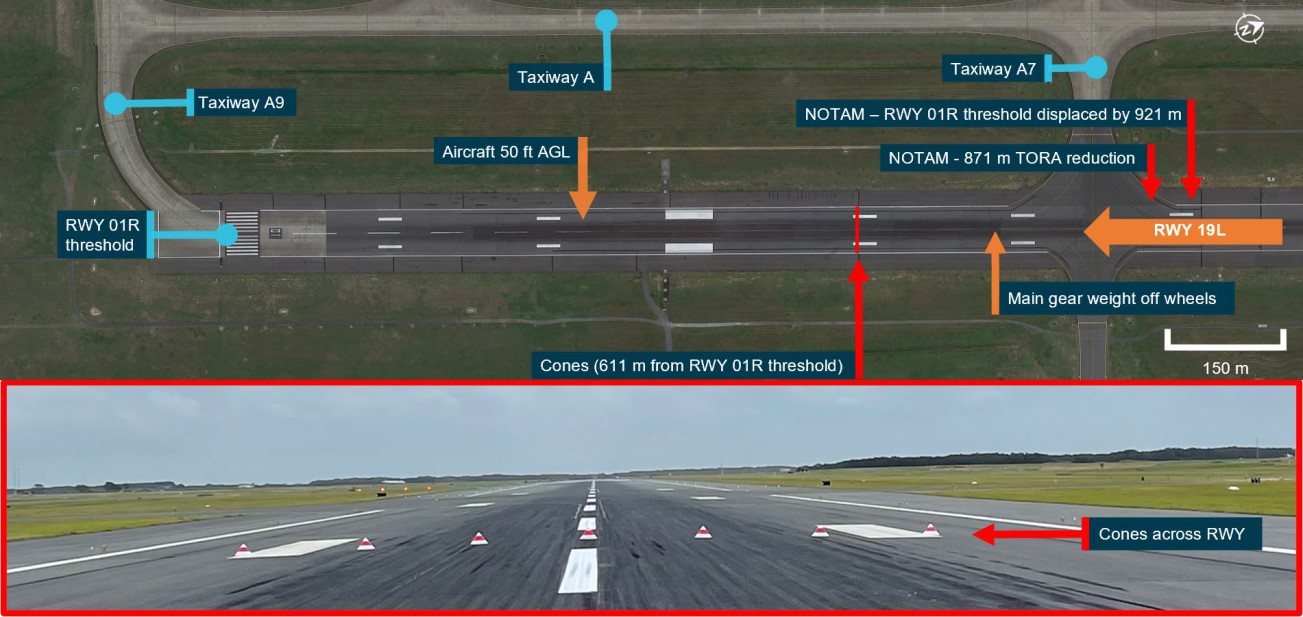
The relative position of the line of cones marking the closed upwind section of the runway from overhead relative to other features and as they would have been seen from the aircraft. [Reproduced from the Official Report]
When the aircraft was about midway between the A6 and A7 intersections, the tower controller commented about whether the aircraft was going to rotate and then saw it pass close over the cones. ATC then immediately called a ground vehicle to inspect the cones, and the flight crew heard this transmission before switching to the departure frequency. The inspection found that although no cones seemed to have been struck, three had been blown from their original position and the flight crew were then informed of the finding. Shortly after this, the captain called company maintenance to report that they may have struck cones during departure and requested an aircraft inspection on arrival. The flight was completed without further event and no aircraft damage was found.
The investigation noted the recent publication of the comprehensive ‘Global Action Plan for the Prevention of Runway Excursions (GAPPRE)’. This included recommendations to extend industry best practices beyond regulatory compliance. The plan considered a number of runway excursion risk factors that were precursors to the event under investigation. These included erroneous or inadequate takeoff performance data calculations, the non-incorporation into electronic flight bag (EFB) databases of changes to runway normal length, and “time pressure and/or complacency leading to pilots not fully checking NOTAMs given the current NOTAM format."
It was noted that Virgin Australia’s standard operating procedures (SOPs) did not require that pilots confirm that the runway distance used in the performance calculation matched that stated on the ATIS. Also, whilst the operator’s dispatch NOTAM update service and the routine Flight Operations Engineering (FOE) Review did provide the latest information available for runway performance calculations, “it did not mitigate inadvertent flight crew error where FOE performance requirements were not identified as part of the briefing process." It was also noted that although a somewhat unlikely risk, there was also “the likelihood of late changes in runway configuration being reported on the ATIS being outside of any update to the NOTAM package being provided to flight crew."
It was considered that tools which enable visualisation of performance distances - in particular the stopping margins available for the takeoff - are of great value in enabling pilots to “easily build a correct risk picture for their takeoff in terms of runway excursion prevention." It was noted that whilst company pilots had visual tools available in the OPT en route landing calculator, there was no equivalent capability for the OPT takeoff calculator.
Six Contributing Factors which led to the runway excursion were identified as follows:
- For the Melbourne to Brisbane sector, the dispatcher notes on the operational flight plan stated that Brisbane runway 01R displaced threshold had no landing weight performance limitation. The captain misinterpreted the operational flight plan to mean that there were no performance requirement limits for operations on runway 19L.
- While the Brisbane NOTAM with the headline RWY 01R THR DISPLACED contained data concerning a significant reduction in the length of runways 01R/19L, the previously established misunderstanding of this NOTAM and the absence of any reference to 19L in the heading resulted in the captain incorrectly dismissing this NOTAM, which was also probably missed by the first officer.
- The flight crew did not identify the critical performance data that was appended to the Brisbane NOTAM that stated the runway length reduction for 01R/19L prior to the departure from Melbourne.
- The ATIS notification of the reduced length of runway 19L was not recognised or accounted for in the performance calculations for operations on that runway, probably due to the captain’s established belief that there were no performance requirements for runway 19L and the absence of the required independent check by the first officer.
- Due to time pressures and distractions from prioritising training requirements during the preparation for departure from Brisbane's runway 19L and a previous assessment that it was not relevant, the flight crew dismissed a dispatcher's note alerting the crew to the ‘RWY 01R THR DISPLACED’ NOTAM. Also, while the crew reviewed the operational flight plan component of the briefing package prior to departure, they probably did not review the NOTAM package.
- Unaware of the reduced available length of the departure runway, which was reinforced by the absence of any visible runway works or restrictions during the previous landing on 19L, the flight crew miscalculated the aircraft's takeoff performance data. That resulted in a departure with insufficient available runway due to the aircraft being overweight for that reduced runway length.
Two Other factors that increased risk were also identified as:
- Having not reviewed the NOTAMs as part of the approach briefing prior to descent into Brisbane, contrary to the requirements of the Operations Manual, or on an opportunity basis en route, the flight crew missed an opportunity to correct the incorrect mental model developed for Brisbane's Runway 19L during the turnaround in Melbourne.
- Contrary to the requirements of (the) Part 139 Manual of (Aerodrome) Standards, the A3/19L intersection departure point TORA Movement Area Guidance Sign (MAGS) presented a takeoff distance that was more than that available, creating the potential to mislead flight crews about the status of the runway when conducting a departure from that point.
Safety Action taken as a result of the event included the following:
Virgin Australia Airlines:
- Introduced threat-based standard dispatcher notes, with enhanced engagement between Virgin Australia’s Flight Dispatch and Flight Operations in identifying impactful NOTAMs, while also constructing standard dispatcher notes that focus on the threat presented to flight crew.
- Updated the Operational Performance Tool (OPT) to place runway options with a work-in-progress (WIP) designator ahead of the normal runway selection options.
- Made SOP changes to limit pilot distraction at the runway entry point and to remove scan items requiring action below the glareshield.
- Enhanced engagement with Brisbane Airport on safety initiatives.
- Adapted the risk assessment methodology for runway TORA/LDA displacement from a general risk model to an airport-specific risk analysis.
- Providing enhanced guidance for pilots in respect of runways with temporarily closed sections using an easy to read format with marked-up runway diagrams.
- Engaged a specialist consultant to conduct an independent human factors review of safety events where distraction/situational awareness had been evident and have implemented a number of recommended actions which are being tracked to assess their benefit.
Brisbane Airport Corporation:
- Made adjustments to departure and arrival procedures associated with all runway works.
- Redrafted the runway 01R/19L partial closure NOTAM to ensure that the operational consequences for both directions of use were more evident for both landing and takeoff in either direction.
- Introduced procedures to ensure correct runway distances are displayed on available takeoff run Movement Area Guidance Signs.
- Published an aeronautical information circular supplement for the runway maintenance work currently taking place.
A Safety Message based on the Investigation Findings was included in the Report as follows:
Flight crews must ensure they consider possible variations to takeoff and/or landing dimensions when determining runway performance data. While this operator’s procedures accounted for such changes through notification of performance requirements within their NOTAM system, due to a combination of distraction and incorrect assumption, they were not identified.
When presented with many NOTAMs, flight crews need to be aware that dismissing them based on the headline alone increases the risk that safety relevant data may be overlooked. As an additional defence, flight crews should ensure that the data input into that calculation is in conformance with other relevant information, such as the ATIS.
The Final Report was released on 5 November 2024.
Related Articles
- Runway Excursion
- Effective Briefings
- Pre-flight Preparation
- Pre-flight Planning
- Aircraft Performance
- Displaced Threshold
- Takeoff Run Available (TORA)
- Automatic Terminal Information Service (ATIS)
- Notice to Airmen (NOTAM)
- Interruption or Distraction