B738, Copenhagen, Denmark, 2024
B738, Copenhagen, Denmark, 2024
Summary
On 3 January 2024, a Boeing 737-800 taxiing for departure at Copenhagen was cleared to the assigned holding point, unaware that snow clearance vehicles had been tasked with slush clearance from the same taxiway route and the departure runway. On seeing that two such vehicles had pulled off the taxiway onto the adjacent hard surface and stopped, the aircraft captain, judging that sufficient wingtip clearance would exist, continued taxiing past. However, one of the vehicle drivers expressed concern about the perceived clearance. The investigation concluded that better tactical communication between airport management and air traffic control could have helped.
Event Details
When
03/01/2024
Day/Night
Night
Flight Conditions
On Ground - Normal Visibility
Flight Details
Aircraft
Type of Flight
Public Transport (Passenger)
Flight Origin
Intended Destination
Take-off Commenced
No
Flight Airborne
No
Phase of Flight
Taxi
Location - Airport
Airport
HF
Tag(s)
Plan Continuation Bias
GND
Tag(s)
Aircraft / Vehicle conflict,
Wingtip clearance
Outcome
Damage or injury
No
Non-aircraft damage
No
Non-occupant Casualties
No
Off Airport Landing
No
Ditching
No
Causal Factor Group(s)
Group(s)
Aircraft Operation
Airport Operation
Safety Recommendation(s)
Group(s)
None Made
Investigation Type
Type
Independent
Description
On 3 January 2024, a Boeing 737-800 (9H-QEN) operated by Malta Air on a scheduled international passenger flight from Copenhagen to Cologne/Bonn as Ryanair flight FR408 was taxiing for departure from the apron to runway 04R. The aircraft was cleared in good night visibility to cross runway 12 and continue taxiing on Taxiway B all the way to the departure runway (04R) holding point. Although not mentioned in the clearance issued, the aircraft would be following a convoy of snow clearance vehicles tasked with clearing slush from the same route. When the flight crew observed, without having reached the main clearance group on the taxiway, that two of these vehicles were stopped and clear of the taxiway edge, they continued to taxi past them towards the remaining vehicles ahead. The flight crew was confident that their overhanging wing clearance was sufficient, whereas the drivers of these vehicles were not.
Investigation
Recorded communication data were available from the tower frequency and from the three discrete radio channels used to communicate with and between the group of 14 snow removal vehicles and a service vehicle. The 51-year-old captain was recorded as having a total of 16,970 hours flying experience, which included 11,690 hours on type. No information was provided on the experience of the drivers of the vehicles in the snow clearance convoy, or on communications between airport operations and the clearance vehicle group or ATC.
The snow removal vehicles had their rotating beacons on and the tower controller had them in sight as they began clearance activity. The eight vehicles involved in active clearance moved along the taxiway in formation whilst the remaining six vehicles drove along the taxiway hard shoulder remaining clear of the runway. When the vehicle convoy passed the intersection of Taxiway ‘B’ and taxiways E2, E3 and B3 (see below) the last two of the six inactive clearance vehicles “turned slightly right to clear snow in the intersection between Taxiway ‘B’ and Taxiway ‘E2’” whilst the rest of the convoy continued ahead. After this maneuver, the two vehicles which had separated then caught up to the rest of the convoy and stopped to the right of the taxiway edge marking.
The taxiing aircraft crew noticed the involved two snow removal vehicles to the right of the taxiway edge marking. The investigation report said, "Because of the positions of and no issued traffic information about the snow removal vehicles, the flight crew considered the vehicles to be of no risk to the aircraft and continued taxiing on the taxiway centreline with a close lookout."
The driver of the rearmost snow clearance vehicle noticed that the service vehicle following the convoy had “suddenly turned right on taxiway ‘E2’” and that an aircraft was approaching from behind. The driver initially assumed the aircraft would turn left onto taxiway ‘B3’ for departure. However, the driver then realised that the aircraft was continuing along taxiway ‘B’ and therefore asked the controller to stop the aircraft. The driver of the second to last snow removal vehicle stated they had not noticed the approaching aircraft until they heard aircraft engine noise and checked the rear-view mirror. Fearing a collision between the aircraft right wing and the cab of the vehicle, this driver laid down along the front seat of the vehicle. The driver reported hearing a scraping sound from the cab top.
The controller instructed the taxiing aircraft to “hold position.” The flight crew complied but by this time the aircraft had passed the two vehicles with what the investigation described as “marginal wing clearance."
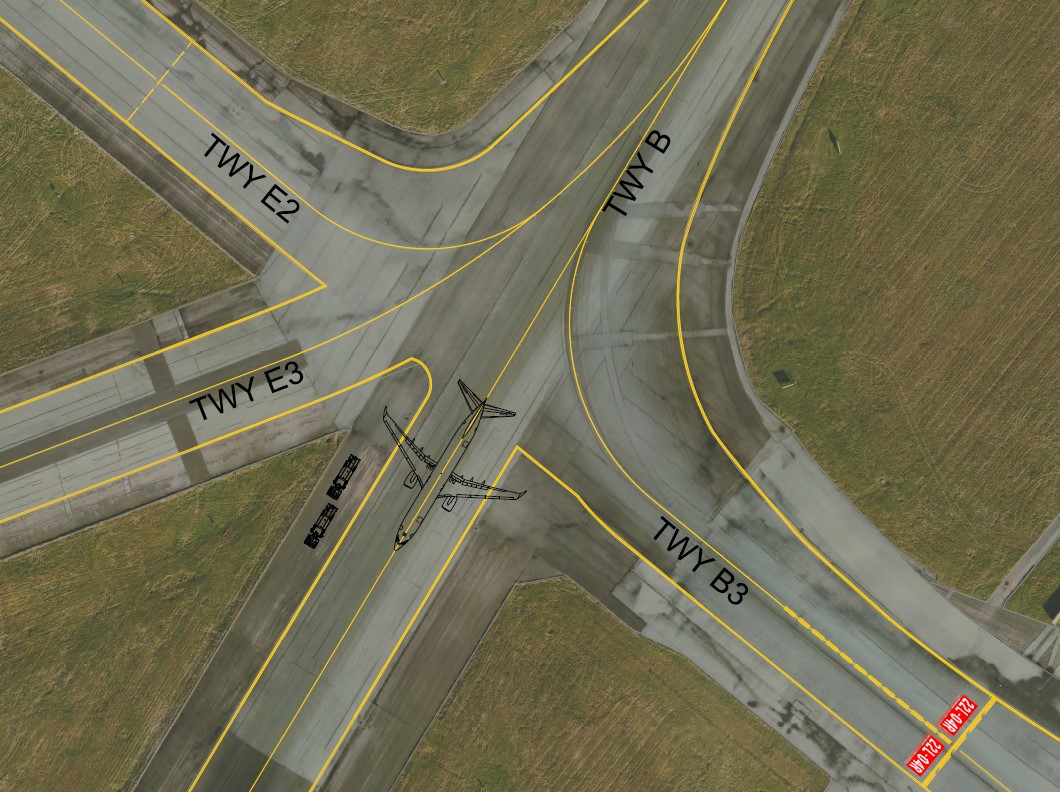
The Intersection through which the vehicles and the 737 were moving with their relative positions. [Reproduced from the Official Report - not to scale]
The tower controller transmitted to the aircraft, “you are overtaking the sweepers. You are not supposed to” and received the response “okay, they are outside the line, and we were going [as cleared] all the way to the holding point." The controller then stated “if you have traffic on the taxiway - of course you go behind....you even have a slot time. You cannot depart for the next ten minutes. I do not see the rush." The flight crew added that they were “not in a rush." The controller then advised that they had been informed of “a potential collision with a snow removal vehicle” and asked the flight crew if they wanted a wing inspection. The crew declined because given their close lookout throughout the sequence of events, they believed a collision had not occurred.
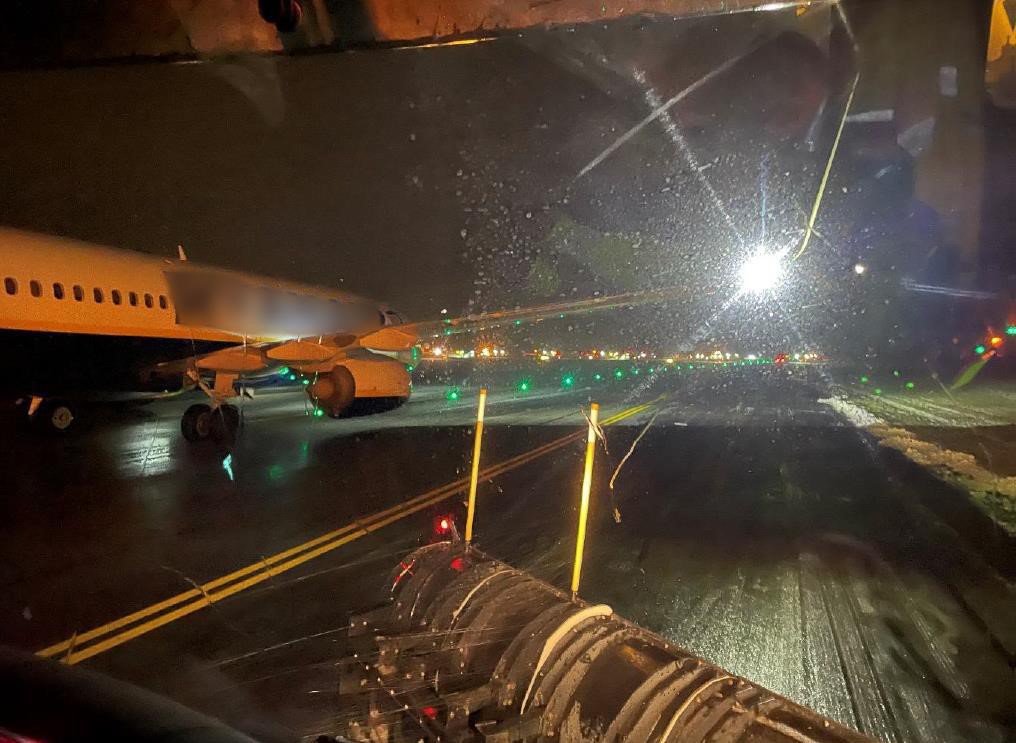
The view of the aircraft after it had passed the second snow clearance vehicle. [Reproduced from the Official Report]
The investigation noted, without comment, the regulatory requirements relevant to the event:
- At controlled aerodromes “the movement of persons or vehicles.......on the manoeuvring area of an aerodrome shall be controlled by the aerodrome control tower as necessary to avoid hazard to them or to aircraft landing, taxiing or taking off” subject only to the overriding priority for emergency vehicles responding to aircraft in distress.
- Subject only to the exception of emergency vehicles responding to aircraft in distress, vehicles on the manoeuvring area shall be required to give way to aircraft which are taxiing in accordance with controller instructions.
It was also noted that at three major aerodromes in Denmark, including Copenhagen, the National Aeronautical Information Publication (AIP) states that for operational handling of essential traffic in all but very low visibility on the ground - defined as less 550 metres runway visual range (RVR) - “traffic information is not issued to traffic on taxiways when a sequence is established” and “it is expected that aircraft keep their own appropriate separation to ahead taxiing” since “ATC does not necessarily know that minimum required separation”."
The investigation report said the weather allowed “appropriate visual contact between the aircraft and the convoy of snow removal vehicles” and so ATC separation was not required. It was considered that the controller’s assumption that the whole convoy of snow removal vehicles were occupying taxiway ‘B’ had probably been attributable to:
- Difficulty in darkness in distinguishing visually the position of each individual snow removal vehicle in the convoy on taxiway B.
- A “cluttered and uniform [advanced surface movement guidance and control system] A-SMGCS presentation” of the convoy on taxiway B.
- A lack of any detailed knowledge of the applied driving formation of the snow removal vehicles on the taxiway.
It was considered that the controller may have assumed that "overtaking the convoy on taxiway B was not physically possible” and that expecting the aircraft to ensure own their own separation from traffic ahead was therefore reasonable.
As far as the flight crew were concerned, they had been issued a clearance to taxi, by implication in sequence if required, to the Runway 04R holding point. The report said the position of the snow removal vehicles "might have caused a flight crew visual illusion that the convoy gave right of way."
It was noted that “the actual circumstances led to marginal clearance or a possible collision between the top of the antennas of the snow removal vehicle and the underside of the aircraft right wing.”
The Summary Conclusion of the Investigation was recorded as “diverging perceptions of the traffic situation on Taxiway ‘B’ led to marginal clearance or a possible collision between the aircraft right wing and a snow removal vehicle”.
The investigation proposed some suggested mitigations which it felt could reduce the chances of a similar potential conflict between a taxiing aircraft and snow removal vehicle convoys. These included:
- Irrespective of requirements, instructions and operational handling, mutual challenge communications might strengthen flight crew situational awareness of clearance convoy disposition.
- Better knowledge sharing between Air Traffic Control (ATC) and the aerodrome in respect of the disposition of formations of operational snow clearance vehicles might increase both parties' situational awareness.
The Final Report was published on 31 May 2024. No Safety Recommendations were made.