B738, Dortmund, Germany, 2022
B738, Dortmund, Germany, 2022
Summary
On 5 December 2022, a Boeing 737-800 overran the end of the runway at Dortmund despite making a normal wet runway touchdown after a stabilised Cat 2 ILS approach with low visibility procedures in force. The unexpected continuation onto the clearway was followed by a stop within it. The most recent runway condition measurements gave good braking action on the entire length of the runway. However, after the overrun, it was found that new precipitation had covered the middle section of the runway with wet snow. The report concluded that this had been the cause of the overrun.
Flight Details
Aircraft
Operator
Type of Flight
Public Transport (Passenger)
Flight Origin
Intended Destination
Take-off Commenced
Yes
Flight Airborne
Yes
Flight Completed
Yes
Phase of Flight
Landing
Location - Airport
Airport
General
Tag(s)
LVPs in Place
GND
Tag(s)
Surface Friction
RE
Tag(s)
Overrun on Landing,
Frozen Deposits on Runway,
Runway Condition not as reported
Outcome
Damage or injury
No
Non-aircraft damage
No
Non-occupant Casualties
No
Off Airport Landing
No
Ditching
No
Causal Factor Group(s)
Group(s)
Airport Operation
Investigation Type
Type
Independent
Description
On 5 December 2022, a Boeing 737-800 (EI-STW) operated by Ryanair on a scheduled international passenger flight from London Stansted to Dortmund as FR2640 touched down normally in day instrument meteorological conditions (IMC) on what had been recorded as a wet runway, but not one contaminated with snow. It was unable to stop before reaching the end of the runway and continued onto the 60 metre-long clearway beyond it before coming to a stop within it. Since the latest runway condition report, wet snow had fallen. The aircraft was undamaged and was subsequently taxied to the terminal for normal passenger disembarkation.
Investigation
A serious incident Investigation into the overrun was carried by the German Federal Bureau of Aircraft Accident Investigation (BFU). The cockpit voice recorder (CVR) and the flight data recorder (FDR) were both removed from the aircraft and useful data were downloaded from both of them. Relevant recorded air traffic control (ATC) data were also available.
The 42-year-old captain, who had acted as pilot flying (PF) for the sector (Dortmund was a captains-only landing), had approximately 8,800 hours flying experience, with all but 200 hours on type. The 23-year old first officer had held a commerical pilot licence (CPL) for just over a year and had 768 hours flying experience, of which about 616 hours were on type. Both pilots were on the third sector (leg) of a four-sector duty and well within the maximum permitted Flight Duty Period. The airport ground service staff member responsible for taking runway braking action measurements at the time had ten years experience on the task and had been trained and certified in the use of the global reporting format (GRF) in September 2021. He had been on duty for two hours when the overrun occurred and had taken a runway braking action measurement which read 5/5/5 eight minutes before aircraft touched down. The radar controller had passed this information to the inbound flight on final approach.
What Happened
During the flight, after obtaining the latest Dusseldorf weather, the captain briefed for an instrument landing system (ILS) Cat 2 approach to runway 06. This was aided by use of the Boeing Onboard Performance Tool (OPT) to calculate the landing distance required for the estimated landing weight (ELW) of 61,400 kg and the approach speed using Flap 40. As the flight neared Dortmund, it was radar vectored onto the runway 06 extended centreline. With about five minutes to go before touchdown, the radar approach controller advised that “the runway code is triple five, it’s one hundred percent wet with two mm wet snow” which corresponded to the information provided in the most recent SNOWTAM for Dortmund.
The approach was flown as briefed with both autopilots (APs) engaged in preparation for an autoland. Landing clearance was given and on short final, the tower controller passed a spot wind of 260° at two knots - which meant a tailwind component of two knots. DFDR data showed that the aircraft had touched down approximately in the centre of the runway 06 touchdown zone and recorded activation of the thrust reversers, deployment of the ground spoilers and automatic initial activation of the wheel brakes. DFDR data showed that almost immediately, the captain deactivated auto brake by commencing manual braking to ensure that the maximum brake pressure was applied. According to the captain, the runway awareness and advisory system (RAAS) did not generate any warning during the landing roll. Deceleration continued but as the aircraft crossed the runway 24 displaced threshold (see the illustration below) the groundspeed was still 60 knots. The end of the runway was only 300 metres away and on reaching it, the aircraft continued onto the 60 metre-long paved clearway before coming to a stop with about 15 metres of clearway remaining.
It was undamaged and was able to turn around and taxi via the taxiways D, M, L to the parking apron where the 175 passengers were disembarked.
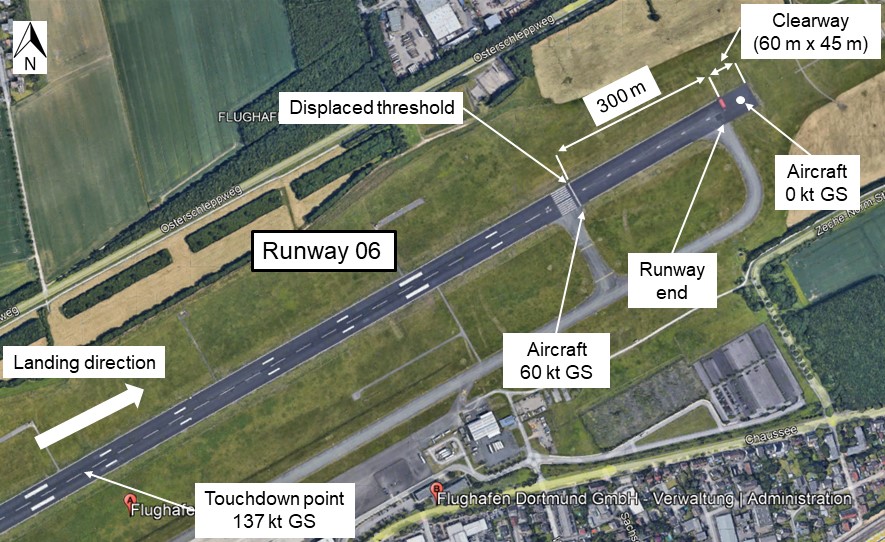
An overview of the Dortmund runway with DFDR data speed data points shown. [Reproduced from the Official Report]
Why It Happened
A braking action measurement taken 15 minutes after the overrun recorded a five mm depth of wet snow over 100% of the runway length, which was equivalent to a runway condition code (RCC) of 3/3/3. This contrasts with the one passed to the flight by ATC when the aircraft was on short final, which was 5/5/5 based on a measured contaminant depth of two mm of wet snow over 100% of the runway length.
It was found that the method of measuring precipitation depth on the runway was an aluminium ruler. There were no associated specifications regarding use of this instrument. Measurement of surface temperature was part of the RCC determination and was obtained using an infrared thermometer which had been +1°C. This confirmed that the runway had not been icy. The same temperature had been recorded in support of the pre-landing RCC, which had followed mechanical clearance of surface contaminant and an application of de-icing fluid due to the continuing light snowfall.
It was noted that the ICAO Annex IV definition of a contaminated runway included one with more than 25 percent of the runway surface area (whether in isolated areas or not) covered by water or by slush more than three mm deep. It was therefore highly likely that by the time the landing occurred, the runway was contaminated, since the depth of wet snow was likely to have exceeded 3mm.
Regarding flight crew actions, it was observed that they had not fully complied with their airline’s procedures since a very slight tailwind component had been accepted. However, it was considered that the Primary Cause of the overrun was likely to have been that “the runway contamination assessment eight minutes prior to landing may not have corresponded with the real environmental circumstances."
Safety Action
- Dortmund Airport decided, in the absence of any additional external training on the GRF that in-house refresher training would be provided for ground services personnel involved in this work during the winter season 2024/2025.
- Ryanair determined that the risk of a runway excursion represented a ‘Key Operational Risk Area’ (KORA) and took action which included the following:
- The Airfield Briefing on Dortmund in the operations manual (OM) Part ‘C’ was revised to emphasise the limitations for landing on contaminated runways more strongly.
- Guidelines for the interpretation of the GRF information were compiled for pilots.
- The investigated event will be used as a case study in future Winter Operation Training.
- The Operations Control Centre internal operating procedures for publishing SNOWTAMs were reviewed but no changes to existing procedures were considered necessary.
- The Boeing OPT software version 4.7 which was in use at the time did not have the selection of Auto Land customised by the operator. This matter had already been discussed with Boeing prior to the Dortmund overrun and an alternative method has since been introduced into the OM Part ‘B’. Flight crews have since been trained accordingly.
- Implementation of the Auto Land function in the Boeing OPT software was to be achieved in September 2024.
The Final Report of the Investigation was published online on 10 April 2025.