B738, en-route, southeast of Brisbane, Australia, 2024
B738, en-route, southeast of Brisbane, Australia, 2024
Summary
On 4 May 2024, a Boeing 737-800 descending towards Brisbane encountered unanticipated brief severe convective turbulence passing through convective clouds. Three unsecured cabin crew were injured, one seriously, who could not then be moved from the rear galley. Risk of injury was found to have been increased by the absence of any company requirement to confirm cabin secure for landing to the flight crew. An absence of company procedures to validate fitness to operate after injury meant that a concussion sustained by one of the cabin crew was detected by colleagues only after a premature return to flying duties.
Flight Details
Aircraft
Operator
Type of Flight
Public Transport (Passenger)
Flight Origin
Intended Destination
Take-off Commenced
Yes
Flight Airborne
Yes
Flight Completed
Yes
Phase of Flight
Descent
Location
Approx.
southeast of Brisbane
General
Tag(s)
Inadequate Aircraft Operator Procedures
HF
Tag(s)
Flight / Cabin Crew Co-operation,
Procedural non compliance
LOC
Tag(s)
Environmental Factors
WX
Tag(s)
En route In-cloud air turbulence
CS
Tag(s)
Turbulence Injury - Cabin Crew
Outcome
Damage or injury
Yes
Aircraft damage
None
Non-aircraft damage
No
Non-occupant Casualties
No
Occupant Injuries
Few occupants
Off Airport Landing
No
Ditching
No
Causal Factor Group(s)
Group(s)
Aircraft Operation
Safety Recommendation(s)
Group(s)
None Made
Investigation Type
Type
Independent
Description
On 4 May 2024, a Boeing 737-800 (VH-VYK) operated by Qantas on a scheduled domestic passenger flight from Sydney to Brisbane as QF520 encountered unanticipated severe turbulence when passing approximately 11,000 feet in day instrument meteorological conditions (IMC). Three of the four unrestrained cabin crew were injured, one seriously. Assistance to the seriously injured cabin crew member in the rear galley by four unrestrained cabin crew and passengers, including a doctor, was still in progress when the landing occurred despite the captain’s prior insistence that all uninjured passengers return to their seats. However, no further injures occurred as a consequence.
Investigation
An accident investigation (defined as such because of the serious injury sustained) was carried out by the Australian Transport Safety Bureau making use of quick-access recorder (QAR) data downloaded by the aircraft operator. It was noted that the captain had a total of 23,177 hours flying experience, which included 15,005 hours on type. The first officer had a total of 10,163 hours flying experience, which included 1,717 hours on type.
What Happened
The flight entered cloud during the descent and when passing 11,400 feet briefly encountered severe turbulence. No warning had been given to the cabin crew who were, with the captain’s awareness, about to complete their preparation of the cabin for landing. The seat belt signs had been switched on for only less than a minute. The senior cabin crew member (SCCM) and two other cabin crew who were in the rear galley were still unsecured as they complete their duties. The SCCM recalled having seen one of the crew in the rear galley “rising off the floor and colliding with the aircraft's ceiling before immediately falling to the floor." That crew member later recalled having felt “a crushing sensation as they landed on their ankle” which was immediately followed by intense pain and had been unable to move.
The SCCM contacted the captain to report the seriously injured cabin crew, and the captain contacted the operator’s Brisbane airport coordinator to advise that an injured cabin crew member would require medical assistance on arrival. Although the captain had said that everyone should remain secured in their seats, the SCCM then went to the rear of the aircraft to assist the injured crew member. The SCCM found the crew member lying on the floor while a passenger held their leg and the other rear-stationed cabin crew supported their head. Another passenger identified themselves as a doctor and offered to assist. The SCCM informed the group of the captain’s instruction that everyone must return to their seats but they were unwilling to leave the injured crew member unattended.
On being advised of this, the captain, who did not recall receiving requests for additional time to address the situation, reiterated the instruction that “all uninjured occupants must return to their seats as the aircraft was in the final stages of the approach and would be landing soon." Meanwhile the SCCM was retrieving the onboard physician's kit from the front of the cabin and whilst doing so was advised by an off-duty cabin crew member that they could assist if required. This person subsequently relieved the passenger who was holding the injured cabin crew member’s leg. Whilst the SCCM was attempting to provide first aid and preparing a splint with the assistance of the doctor, a passenger seated nearby yelled, “we’re about to land." Shortly after this and 11 minutes after the severe turbulence encounter had occurred, the aircraft touched down with 4 unrestrained passengers and cabin crew in the rear galley. Previously requested paramedics reached the aircraft after a delay of 10 minutes. It was subsequently found that an ambulance had been requested 13 minutes prior to the aircraft arriving at the gate.
The Injuries sustained due to the unforeseen severe turbulence were as follows:
- The right side rear cabin crew member had been getting seated when the turbulence occurred and had been thrown into the air, striking their head on the ceiling before landing heavily on their feet. The crew member told the left side rear flight attendant that they were injured “possibly with a broken bone." Once the crew member was hospitalised, a complex fracture involving two breaks in the ankle and another break in the leg was diagnosed with surgery required.
- The SCCM sustained minor injuries due to striking aircraft fixtures while standing unsecured during the turbulence, and self-assessed the injuries. The SCCM applied first aid the following day after noticing lower back pain and pain in the right shoulder blade. Two days after the event, the SCCM also became aware of facial pain.
- The left side rear cabin crew member sustained a head injury as a result of hitting the ceiling and/or other aircraft fixtures but did not initially believe they were injured. After six rostered days off following the accident flight they reported for and worked their rostered duties for two days. However, during this time, they were made aware by their colleagues that they were “displaying symptoms of possible injury” and 12 days after the turbulence event had occurred, they were diagnosed with concussion.
Why It Happened
The investigation found that the captain did not inform the cabin crew about the expected turbulence during descent, likely due to not being aware of its severity. The relevant area forecast showed (see the chart extract reproduced below) that the descent into Brisbane was expected to encounter moderate turbulence and that transit through any embedded towering cumulus could cause severe turbulence.
Recorded flight data from the aircraft QAR examined by Qantas found that during a four-second period which matched the time when the severe turbulence had occurred, vertical acceleration went from +1.2g to -0.06g to +1.35g to +0.61g to +1.59g and that at one point during this upset, the aircraft pitch attitude had changed from -2.4° to -0.7° within one second. These measurements were beyond the limits defined by Australian regulations for moderate turbulence. Any change of more than 1.0 g in the vertical (or lateral) acceleration rate was defined as severe turbulence. In the captain’s post-flight conference call with Qantas personnel, he described the turbulence experienced as “moderate." The flight crew also could not recall making a special air report to air traffic control (ATC) in accordance with regulation 91.675 of the Civil Aviation Air Safety Regulations (CASR) after the turbulence encounter.
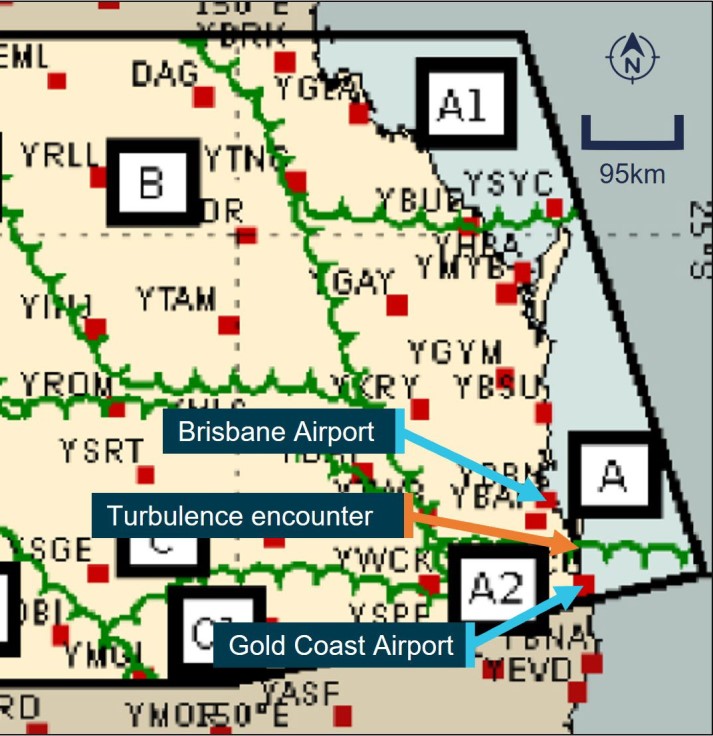
An extract from the forecast chart which would have been available on both pilots’ iPads. [Reproduced from the Official Report]
The member of cabin crew who was medically diagnosed as (still) suffering from concussion 12 days after the accident had not recognised the symptoms of concussion until alerted by colleagues. It was noted that use of the Qantas “Injury Response Tool” triage process was completely dependent on staff self-awareness of injuries and specifically an understanding of what the definition of "special circumstance" associated with this tool actually meant. Under a "special circumstance," crew members must stop work immediately.
It was also noted that because the captain had erroneously reported the turbulence encountered as moderate rather than severe, the Qantas Integrated Operations Control was not required to contact the Qantas on-call doctor.
The investigation identified two Contributing Factors to the Accident as follows:
- The captain did not communicate to the cabin crew about the expected turbulence, likely as a result of the captain not knowing the severity of the turbulence.
- Three cabin crew were unrestrained while performing duties during unanticipated severe turbulence, resulting in all three receiving injuries.
Four Other Factors That Increased Risk were also identified, one of which was identified as a Safety Issue:
- Although the captain had instructed that the uninjured passengers and crew needed to be seated, three cabin crew and one passenger were unrestrained for landing due to being preoccupied with administering first aid to the injured cabin crew member. This increased the risk of injury to the unrestrained occupants and had the potential to compromise a safe emergency evacuation if required.
- The Qantas 737 procedures did not require flight crew to receive positive confirmation that the cabin was secure for landing. This increased the risk that occupants and objects were not secure for landing.
- A crew member with undiagnosed concussion from the accident flight operated on subsequent flights without receiving appropriate medical attention.
- Qantas lacked a procedure to ensure cabin crew fitness was assessed after a significant injury. This increased the risk that a crew member could continue to operate while being unfit for duty. [Safety Issue]
In respect of the identified safety issue, the ATSB was advised by Qantas shortly before this report was finalised (8 April 2025) that the company had implemented additional controls to adequately assess the fitness of crew member after a turbulence event, or other unplanned aircraft movement. These new procedures required that “following any turbulence or unplanned aircraft movement event that is classed as severe, or an event classed as moderate with reported injuries, the operator will arrange immediate medical consultation (and) additionally, in the case of a moderate turbulence event or aircraft movement with unrestrained crew, immediate medical assessment will be conducted." Accordingly, the ATSB formally closed this safety issue on the basis the identified risk had been adequately addressed by “the introduction of medical assessment guidelines, which (now) include unrestrained crew during a moderate turbulence event”.
The following general Safety Message was also annunciated:
Effective coordination and communication among all crew members is critical in managing turbulence and ensuring cabin safety. This coordination should extend beyond preflight briefings to include continuous communication throughout the flight, particularly during periods of increased workload and operational complexity.
Collaboration between the flight and cabin crew helps ensure the timely completion of service-related tasks while minimising the risk of injury during known or anticipated encounters with turbulence.
Flight crew rely on clear and timely communication from the cabin crew to maintain awareness of the condition in the cabin. When there is a different understanding of the state of the cabin, there is an increased risk [of] delayed responses or misaligned decision-making which may lead to safety being compromised.
Aircraft are more likely to experience the effects of weather and wake turbulence during the descent, approach, and landing phases of flight, highlighting the importance of effective communication procedures to promote cabin safety and minimise the risk of injury to passengers and crew.
The Final Report was completed on 27 May 2025. No safety recommendations were made.