B738, Kitchener/Waterloo, Ontario, Canada, 2022
B738, Kitchener/Waterloo, Ontario, Canada, 2022
Summary
On 25 November 2022, a Boeing 737-800 landing at Kitchener/Waterloo Airport, Ontario, with the left thrust reverser inoperative overran the runway before stopping approximately 500 feet beyond the runway end. The captain had unintentionally selected the takeoff/go-around switch instead of disconnecting the autothrottles and then removed his hand from the left thrust lever to select reverse thrust on the right engine. The captain was experienced but new to type, and the first officer was a recently employed inexperienced pilot who had just completed his type rating. The left thrust reverser had been intermittently defective for the previous six months.
Flight Details
Aircraft
Type of Flight
Public Transport (Passenger)
Flight Origin
Take-off Commenced
Yes
Flight Airborne
Yes
Flight Completed
No
Phase of Flight
Landing
General
Tag(s)
Copilot less than 500 hours on Type,
Inadequate Airworthiness Procedures
HF
Tag(s)
Distraction,
Fatigue,
Manual Handling,
Procedural non compliance
RE
Tag(s)
Overrun on Landing,
Directional Control,
Ineffective Use of Retardation Methods
AW
System(s)
Other
Contributor(s)
Contributing ADD
Outcome
Damage or injury
Yes
Aircraft damage
Minor
Non-aircraft damage
No
Non-occupant Casualties
No
Off Airport Landing
No
Ditching
No
Causal Factor Group(s)
Group(s)
Aircraft Operation
Aircraft Technical
Safety Recommendation(s)
Group(s)
None Made
Investigation Type
Type
Independent
Description
On 25 November 2022, a Boeing 737-800 (C-FFLC) operated by Flair Airlines on a scheduled domestic passenger flight from Vancouver to Kitchener/Waterloo as FLE501 overran the landing runway in night instrument meteorological conditions (IMC). This took place after the captain’s unintentional asymmetric thrust setting whilst operating the aircraft under Minimum Equipment List (MEL) provisions for one thrust lever inoperative on the second of two overnight sectors (legs) totalling nine hours flying time.
Investigation
An investigation was carried out by the Canadian Transportation Safety Board. The flight data recorder (FDR) and cockpit voice recorder (CVR) were removed from the aircraft and their data were successfully downloaded.
The captain had a total of 24,200 hours flying experience, including 542 hours on type. He had been employed as a direct entry captain by the operator six months prior to the event. The first officer had a total of 2,762 hours flying experience, including 182 hours on type and had been employed by the operator three months prior to the event under investigation, having spent the first month gaining his 737 type rating.
What Happened
The left reverse thrust lever was inoperative, and despatch occurred with it locked in the stowed position in accordance with the MEL. The initial five-hour sector from Kitchener/Waterloo to Vancouver was uneventful, and after an eighty-minute turnaround, the return flight departed Vancouver. During this flight “a passenger medical issue occupied the flight crew’s attention for a significant length of time, preventing them from having an opportunity to obtain controlled rest on the flight deck during the flight” which was otherwise uneventful until the landing.
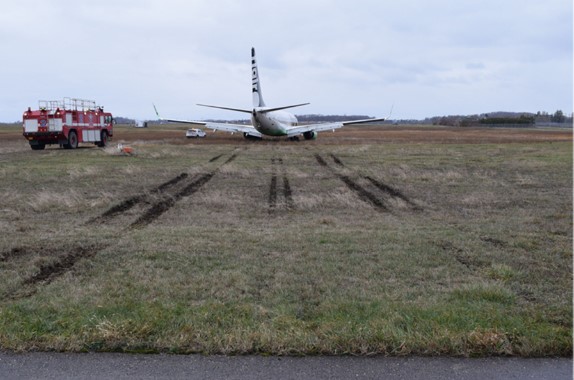
The aircraft in its final stopping position. [Reproduced from the Official Report]
During descent, destination weather was obtained from the automated weather observing system (AWOS), which gave a cloudbase of 600 feet in rain, with gusty westerly winds. The flight received clearance for an ILS approach to runway 26, and this was flown with the autopilot (AP) and autothrottles (A/T) engaged. The flight was reported to have become visual shortly after descending though 600 feet agl. At approximately 300 feet, the captain disconnected the AP whilst leaving the A/T engaged “as a result of a habit formed from past flying experience where the practice was permitted." Passing a recorded 70 feet agl, the captain reported intending to disconnect the A/T but instead inadvertently selected takeoff/go-around (TO/GA).
Although the A/T then commanded both thrust levers to move towards TO/GA thrust temporarily, the captain held both of them at or near the idle position during the flare and touchdown. At this point, he had removed his hand from both forward thrust levers which allowed the A/T to begin advancing left engine thrust without either pilot noticing. This movement resulted in the speed brakes, which had briefly deployed, retracting and in the auto-braking system deactivating, all of which reduced deceleration during the initial ground roll.
It immediately became difficult to maintain directional control, and the captain reverted to manual brakes and stowed the right engine thrust reverser. This enabled him to keep the aircraft within the available 45-metre runway width whilst applying maximum manual braking. But with only 760 metres of the 2,135 metre-long runway remaining and a 115 knot groundspeed, without speed brakes and with the left engine now at nearly maximum forward thrust (the right engine was now nearing maximum reverse thrust) there was insufficient runway remaining to stop the aircraft. It exited the runway, and after travelling for 60 metres on a paved surface then continued for a further 90 metres on a wet grassy area. In that area, wheel ruts on damp ground assisted further deceleration and the aircraft came to a stop approximately 150 metres beyond the end of the runway. There were no injuries and no aircraft damage.
The airport rescue and firefighting service (RFFS) responded, followed by employees of the airline’s approved maintenance organisation (AMO). After receiving confirmation that the aircraft appeared undamaged, the captain decided to run the auxiliary power unit (APU) to keep passengers comfortable until mobile air stairs and buses could be brought to the aircraft to transfer the 134 passengers to the terminal.
A more detailed inspection of the aircraft confirmed the lack of damage to either engine or the airframe but “cleaning and lubrication procedures were completed on the engines, fuselage, and landing gear to remove foreign object debris contamination." Displaced washers were also found at the left main landing gear forward trunnion and fuselage attachment pin during inspection, which necessitated replacement of both upper and lower pins.
Why It Happened
The Investigation examined both the immediate cause of the overrun - the captain’s inadvertent TO/GA selection - and the underlying context, which was despatch of the aircraft with one thrust reverser inoperative.
The captain’s error was attributed to his level of fatigue after having been awake for nearly 18 hours and being at the end of a window of circadian low (WOCL). He had then been “primed” to press the TO/GA switch after mentally rehearsing actions for a possible go-around shortly before becoming visual in final approach. It was also noted that this inadvertent selection had occurred at a time when both pilots’ primary focus was outside the flight deck as the landing flare was about to begin. This meant that the flight mode annunciator and the consequent change in engine thrust display indications could have been missed. Finally, an examination of the sleep history of both pilots indicated that the captain had experienced “acute and chronic sleep disruption” for several days prior to the flight duty period involved.
A deeper look into the implications of accepting a thrust reverser fault as an acceptable deferred defect (ADD) found two noted items in the company's flight crew operating manual (FCOM). One was “a reminder that the wet runway/obstacle limited weight and V1 must be reduced to account for the effects of having only one thrust reverser available on accelerate-stop performance." There was also a limitation preventing despatch to runways less than 45 metres wide. Of equal note was that whilst the operator’s pilots have an opportunity to “practice using a single thrust reverser during one-engine inoperative landings in the simulator," there was no similar opportunity to practice landings with both engines operating and one reverse thrust lever locked in the stowed position. Nor was there any opportunity to practice scenarios involving inadvertent mode selections. It was also noted that the operator’s training included pilots being taught to “maintain physical contact with the forward thrust levers using the palm of their hand or their forearm when operating the reverse thrust levers, although it is not a comfortable or natural hand position to maintain while using reverse thrust, especially while using only a single reverse thrust lever."
Regarding Canadian regulations on ADDs where rectification is attempted but the same defect recurs, it was found they define a recurring defect as one in which “a failure mode is repeated three times on a particular aircraft, within 15 flight segments of an approved repair made in respect of that failure mode." This principle was found to be reflected in the aircraft operator’s maintenance and repair organisation (MRO) tracking system, which was configured to generate an alert whenever three defects in the same ATA 2-digit classification system occur within 15 segments. And it was also found in the Transport Canada “Commercial Air Service Standards” (CASSs), in section 726.05 that aircraft operators are “responsible for ensuring that its maintenance personnel are aware of recurring defects to avoid duplication of unsuccessful attempts at rectification."
In the light of these requirements as well as any related best practices, the investigation looked into the history of repetitive raising of an ADD for the same left engine thrust reverser defect. It was found that between 9 May 2022 and 24 November 2022, 23 defect entries had been made in the aircraft’s Technical Log on the aircraft’s left thrust reverser. On 18 of these occasions, the only maintenance action taken was to reset the corresponding Engine Accessory Unit (EAU) and then cycle the reverse thrust levers to confirm no defect was present. These resets were found to have been performed by six different approved maintenance organisations (AMOs) at ten different Flair destinations.
During the same six-and-a-half-month period, an ADD under MEL provisions was used on six occasions, although in one of these, the only action taken before release to service with the defect cleared was to reset the EAU. In the case of three of the five remaining MELs, “a 10-day MEL extension was applied including the extension in effect at the time of the occurrence due to the replacement parts being unavailable." Again, during the same period, it was found that “the left thrust reverser had been deactivated and locked in the stowed position for a total of approximately 50 days." It was concluded on this and other evidence that whilst the airline’s MRO system was capable of recognising recurring defects, “its capabilities did not extend to identifying defects such as the left thrust reverser fault” where these faults did not meet the definition of a recurring defect.
A replacement A/T switchpack was first requested with a “rush” designation in May 2022, having been correctly identified as the cause of left thrust reverser defect based on guidance in the fault isolation manual (FIM). However, this was only approved by the Flair AMO almost six months after it was first identified as the cause of the problem.
It was also noted that the operator’s safety management system (SMS) had not recorded persistent faults with the left thrust reverser and more widely that this persistent defect “had not been entered in the SMS as an identified hazard or risk” and that repetitive aircraft defects “were not normally entered into the SMS." Overall it was considered that “the associated risks of prolonged operation of an aircraft with an inoperative system such as a thrust reverser had not been assessed for potential mitigations and/or corrective actions."
The following Findings from the completed investigative work were formally documented as follows:
Causes and Contributing Factors
- The captain, who was the pilot flying (PF), left the autothrottle engaged after disengaging the autopilot as a result of a habit formed from past flying experience where the practice was permitted.
- The captain had accrued a significant sleep debt in the week before the occurrence and was operating the aircraft after a nearly 18-hour awake period, at the end of a circadian low. As a result, at the time of the occurrence, the captain’s level of fatigue decreased his attention and vigilance and increased the likelihood of [an error].
- Shortly before landing, the captain intended to press the autothrottle disengage switch, but inadvertently pressed the takeoff/go-around switch. This [error] probably occurred due in part to the captain’s level of fatigue and because he was primed to press the takeoff/go-around switch, having mentally rehearsed a go-around earlier in the approach.
- The inadvertent takeoff/go-around selection at 70 feet above ground level occurred during a period on the approach when the flight crew’s primary focus was outside of the flight deck. Therefore, with the indications of the takeoff/go-around selection insufficiently salient to alert the crew, the flight mode annunciator and engine thrust display indications for mode change went unnoticed by the flight crew.
- The left reverse thrust lever had been locked in the stowed position per the MEL. When selecting the right reverse thrust lever following touchdown, the pilot removed his hand from the forward thrust levers, allowing the left one to advance, undetected, as commanded by the autothrottle.
- Although the aircraft was on the ground and the right thrust reverser was deployed, the autothrottle permitted simultaneous operation of reverse thrust on 1 engine and forward thrust on the other. As a result, the autothrottle continued to command the engines towards go-around thrust until it disengaged automatically when the aircraft slowed below 80 knots.
- The advancing left forward thrust lever caused the speed brakes, which had briefly deployed, to retract and resulted in the deactivation of the auto-braking system, significantly reducing deceleration during the initial ground roll.
- When the captain applied maximum braking, there was 2,500 feet of runway remaining, and the aircraft was travelling at a ground speed of 115 knots with no speed brakes, one engine at near maximum thrust and the other engine nearing maximum reverse thrust. At this speed and in this configuration, there was insufficient runway remaining to stop the aircraft and it overran the end of the runway.
‘Risk Factors’ [safety deficiencies which were assessed not to have been a factor in this occurrence but could be in future ones]
- If pilots do not monitor their rest to assess if they have accrued a sleep debt, there is an increased risk of fatigue going undetected and unmitigated.
- If the underlying issue behind a persistent maintenance defect is not addressed in a timely manner, there is a risk that it may compound, resulting in a serious consequence.
Finally, one ‘Other Finding’ [action which could enhance safety, resolve a controversial safety issue or provide a data point for future safety studies] was recorded as follows:
- Flair Airlines’ maintenance, repair, and overhaul tracking system was capable of identifying recurring defects as defined by regulations, but its capabilities did not extend to identifying defects such as the left thrust reverser fault in this occurrence, which did not meet the definition of a recurring defect. The defect had been reported 23 times during the six months leading up to the occurrence.
Safety Action taken by Flair Airlines as a result of the investigated event was noted as having been the replacement in the Standard Callouts subsection in its B737‐800 FCOM Volume 1 of the calls “AUTOPILOT DISENGAGED” and “AUTOTHROTTLE DISENGAGED” with a “MANUAL FLIGHT” callout in order to align with the existing operational procedure, which requires both the AP and the A/T to be disengaged at the same time.
The Final Report of the Investigation was authorised for release on 18 December 2024 and officially released on 13 February 2025. No Safety Recommendations were made.