B738, vicinity Palma de Mallorca, Spain, 2023
B738, vicinity Palma de Mallorca, Spain, 2023
Summary
On 27 August 2023, a Boeing 737-800 was subjected to significant ATC delay whilst en route from Glasgow to Palma de Mallorca after adverse weather affected all three Balearic Islands. After multiple ATC errors, a MAYDAY was declared for low fuel before a landing with less than Final Reserve Fuel despite extra fuel having been carried. Confused ATC flight handling in both French and Spanish airspace was attributed to an excessive workload, which resulted in no pre-tactical measures taken and subsequent errors in the implementation of the tactical response, which then led to use of reserve fuel.
Flight Details
Aircraft
Operator
Type of Flight
Public Transport (Passenger)
Flight Origin
Intended Destination
Take-off Commenced
Yes
Flight Airborne
Yes
Flight Completed
Yes
Phase of Flight
Landing
Location - Airport
Airport
General
Tag(s)
Copilot less than 500 hours on Type,
Flight Crew Training,
CVR overwritten
HF
Tag(s)
ATC Unit Co-ordination
EPR
Tag(s)
MAYDAY declaration,
Fuel Status
Outcome
Damage or injury
No
Non-aircraft damage
No
Non-occupant Casualties
No
Off Airport Landing
No
Ditching
No
Causal Factor Group(s)
Group(s)
Air Traffic Management
Safety Recommendation(s)
Group(s)
None Made
Investigation Type
Type
Independent
Description
On 27 August 2023, the crew of a Boeing 737-800 (G-DRTW) operated by Jet2 on a scheduled international passenger flight from Glasgow, Scotland, to Palma de Mallorca, Spain, had anticipated the possibility of delay due to destination weather, and they loaded additional fuel. However, the flight was held for an extended time in both Bordeaux and Barcelona Area Control Centre (ACC) airspace. After the crew realized a landing with less than Final Reserve Fuel was likely, a ‘MAYDAY FUEL’ declaration was made. As anticipated, the eventual landing was made with remaining fuel below the minimum, although by only a small amount.
Investigation
An investigation was carried out by the Spanish Commission for the Investigation of Accidents and Incidents (CIAIAC). Relevant flight data recorder (FDR) data was available, but relevant cockpit voice recorder (CVR) data had been overwritten.
The 51-year-old training captain (no information on flying experience recorded) was accompanied by a 29-year-old first officer who, having recently joined the operator, had a total of 252 hours flying experience of which 92 hours were on type.
What Happened
After an earlier-than-normal flight crew report time due to pilot training on the flight, preflight preparations noted that the latest destination terminal aerodrome forecast (TAF) included a 40% probability of thunderstorms with hail at Palma all day. Accordingly, 1,000 kg more fuel than the operational flight plan (OFP) requirement was loaded. Departure with the first officer acting as pilot flying (PF) was then delayed by 1 hour 41 minutes because of the forecast. The complete flight routing is depicted on the illustration below.
Just over an hour after takeoff, the cruise of FL350 was reached, with the aircraft having already entered French airspace. Forty minutes later, Palma ceased accepting inbound traffic which was not already airborne due to adverse weather, and this was reported to Bordeaux ACC by Barcelona ACC. As the flight reached the Pyrenees shortly after this, it was instructed to hold at waypoint ‘ROCAN’ at FL350, which was done at 239 KCAS. During the second turn in holding, the flight advised that they wished to proceed to their flight plan alternate, Menorca, and were directed to waypoint ‘IBRAP’ to continue holding.
Just after the aircraft had begun holding at ‘IBRAP’ at 228 KCAS, it was transferred to Barcelona ACC to continue holding before being returned to Bordeaux ACC shortly before it completed the second hold at ‘IBRAP’. It was noted that these holds had resulted in 1,356 kg of fuel being used. Palma then reopened and the flight was transferred back to Barcelona ACC and given a southerly heading direct to waypoint ‘LORES’ (for an arrival at Palma, the intended destination). Soon after taking up this heading, LOW FUEL alerts were annunciated for both tanks.
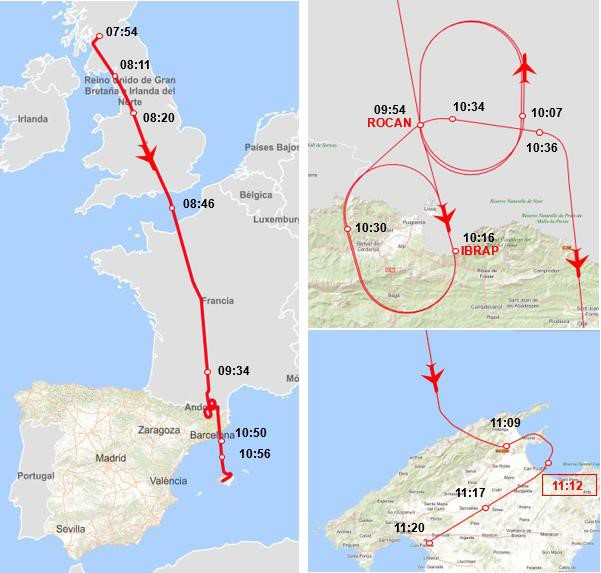
The flight route with times (in UTC) and insets showing the holds carried out in French airspace. [Reproduced from the Official Report]
Three minutes later, the flight was cleared to begin descent from FL350 and then, after a further six minutes, it was transferred to Palma Radar and once over the Island at 1109, to Palma Approach where it was cleared to establish on the runway 24L ILS LOC. Three minutes after this, as it passed a recorded 5,800 feet QNH and almost established on the ILS LOC with about 25 nm to run, the flight declared a ‘MAYDAY FUEL’. It was subsequently transferred to tower and landed with 1,115 kg of fuel recorded in tanks after 3 hours 26 minutes airborne and a block time of 3 hours 45 minutes.
Why It Happened
The cause of the delay and consequent holding was the temporary closure of Palma Airport following a severe thunderstorm. Thereafter, although less severe thunderstorm activity continued in the vicinity of the airport, no more thunderstorms affected the airport and reopening of the airport followed after an hour of closure.
The flight’s request to divert to Menorca due to uncertainty on how long Palma would be closed resulted in the cancellation of the existing flight plan and the creation of a new one. However, the controller involved (Bordeaux ACC sector N3) did not enter the correct ICAO code for Menorca. Even though the flight crew told the controller what it was, the controller incorrectly specified the destination as ‘LEML’ (which was the ICAO code for Badajoz) and the flight disappeared from the system (i.e. was non-correlated). When the flight was subsequently asked by Bordeaux ACC to give its ETA for ‘LEML’ the crew read back ‘LEMH’ and the error was corrected in the response but not in the system. The flight was then transferred to Barcelona ACC ‘CCC’ sector but was not visible to the controller, and it was not one of five aircraft inbound to Palma which had been accepted from Bordeaux ACC N3 Sector.
Only after the third call did the Barcelona ACC ’CCC’ sector controller respond - with a ‘stand by’ request. This controller then informed two other aircraft inbound to Palma that the airport was not accepting any more inbounds and they would have to divert. One of these ‘other aircraft’ was another (uninvolved) Jet2 flight. Aware of the absence of any controller response to the involved flight beyond “stand by,” this crew reminded the controller that another company aircraft (callsign given) was holding at FL350. Almost 3 minutes after being told to “stand by”, the Jet2 crew waiting for a response beyond “stand by” tried again for a fourth time and the ‘CCC’ sector controller responded by asking all aircraft to “stand by” - three times over the next 1½ minutes. The controller then asked “the aircraft that had previously called to transmit” but another aircraft replied. After almost two more minutes, the Jet 2 flight called again. The controller responded by identifying it and manually activated the flight plan, which reinstalled the flight on the system but still showed the destination as LEML.
The flight was then transferred to the Barcelona ACC ‘GO2’ sector. On checking in there, the flight was immediately transferred back to Bordeaux ACC ‘N3’ sector where the controller “asked what their intentions were” and was told that they were waiting to proceed to Menorca. The aircraft was instructed to continue in the ‘ROCAN’ hold. The controller then contacted Barcelona ACC ‘CCC’ sector to ask why the flight had been returned after being handed over 10 minutes previously. The controller found that the destination had been incorrectly recorded by Barcelona as ‘LFML’ (Marseille) instead of ‘LEMH’ (Menorca). The Barcelona ACC en-route supervisor then informed the Bordeaux ACC supervisor that Palma Airport had fully re-opened and, therefore, all aircraft could be transferred to it normally. Given this new situation, the controllers in the two control centres coordinated the transfer of the aircraft. On returning to the Barcelona ACC ‘CCC’ sector frequency, the flight was a last cleared to route to Palma. The ATC-caused delay resulted in far more fuel being used than the small margin by which the flight’s Final Reserve fuel was diminished.
The only observation made by the investigation regarding the aircraft crew was that they had failed to declare ‘Minimum Fuel’ as defined by ICAO in Annex 6 Part 1 as a "recommended practice."
The Probable Cause of the investigated event was formally documented as “an excessive workload in the ‘CCC’ sector of Barcelona ACC and in the collateral sectors of Bordeaux ACC as a consequence of the weather conditions in the Balearic Islands, as well as an error in the alternate airport entered in the aircraft's flight plan while in French airspace."
Editors Note: The report also found that a similar but different error had occurred whilst the flight was in Spanish airspace.
Two Contributory Factors were identified as:
- the overload of the air traffic controllers and the inefficiency of the Air Traffic Flow Management (ATFM) measures implemented on the tactical phase.
- the complexity of managing a huge traffic flow disruption when Air Navigation Service Providers (ANSPs) in two neighbouring States are affected.
The Final Report of the Investigation was approved on 18 December 2024 and subsequently published simultaneously in both the definitive Spanish language version and in an English language translation on 11 February 2025. No Safety Recommendations were made.