B739 / CRJ2, Nassau, Bahamas, 2024
B739 / CRJ2, Nassau, Bahamas, 2024
Summary
On 8 February 2024, a Boeing 737-900ER taking off from runway 14 at Nassau in accordance with its clearance was instructed to reject its takeoff at high speed. This happened when the controller recognised that a Bombardier CRJ200, which had been on final approach to land on intersecting runway 10 had begun a go-around from low level after not receiving a landing clearance. The report says it appears the tower controller may have become overwhelmed during complex operations when there was no tower supervisor to ensure coordinated tower and approach control functions, due to inadequate manning.
Flight Details
Aircraft
Operator
Type of Flight
Public Transport (Passenger)
Flight Origin
Intended Destination
Take-off Commenced
Yes
Flight Airborne
No
Phase of Flight
Take Off
Flight Details
Aircraft
Type of Flight
Public Transport (Passenger)
Intended Destination
Take-off Commenced
Yes
Flight Airborne
Yes
Flight Completed
Yes
Phase of Flight
Missed Approach
Location - Airport
Airport
General
Tag(s)
Aircraft-aircraft near miss
HF
Tag(s)
ATC clearance error,
ATC Unit Co-ordination
LOS
Tag(s)
ATC Error,
Near Miss,
Go Around Separation
Outcome
Damage or injury
No
Non-aircraft damage
No
Non-occupant Casualties
No
Off Airport Landing
No
Ditching
No
Causal Factor Group(s)
Group(s)
Air Traffic Management
Safety Recommendation(s)
Group(s)
Air Traffic Management
Investigation Type
Type
Independent
Description
On 8 February 2024, a Boeing 737-900ER (N900DU) operated by Delta Air Lines on a scheduled domestic passenger flight from Nassau to Atlanta as DAL1965 was taking off from runway 14 in day visual meteorological conditions (VMC) as cleared when the tower controller instructed it to reject its takeoff at high speed. This instruction was to avoid conflict with a Bombardier CRJ 200 operated by Canadian charter company Flight Exec as FEX850, which had been inbound to runway 10 but had then commenced a low level go-around after not receiving a landing clearance.
Investigation
An investigation was carried out by the Bahamas Air Accident Investigation Authority (AAIA). It was noted that the 64-year-old Boeing 737 captain had a total of “approximately 18,043” hours flying experience of which “approximately 6,932” hours had been with Delta Airlines. Similar experience information was not given for the 41-year-old first officer. Both pilots were required to “use corrective lenses to meet vision standards at all required distances." The 32-year-old tower controller last met the on-the-job training (OJT) certification requirements on 21 September 2023 and held a Class 3 medical certificate issued by the Bahamas Civil Aviation Authority on 25 February 2019 which expired on 28 February 2023, almost a year prior to the event.
What Happened
In accordance with a notice to airmen (NOTAM) advising temporary closure of runway 14/32 between 9am and 1pm local time on the day of the event, the airport had been operated with only runway 10/28 prior to the resumption of operations on both (intersecting) runways. At the time of the conflict, one runway (14, 3,330 metres long) was being used for takeoffs and one for landings (10, 2,530 metres long) but staggered arrivals and departures were necessary because the two runways intersected. The tower controller was working alone with no tower supervisor and what appeared to be inadequate coordination of arriving traffic with the approach controller.
The Boeing 737’s instruction to reject its takeoff from 14 was given when the tower controller recognised inadequate coordination of the use of the two runways. The Canadian-operated Bombardier CRJ had, in the absence of any landing clearance on final approach, self-initiated a go-around from runway 10 concurrently with the 737 accelerating along runway 14. Having just cleared the 737 for takeoff, the controller then became aware of the CRJ going around and recognised a potential airborne collision risk and instructed the 737 to stop. The 737 crew rejected at a speed of approximately 90 knots.
In the space of five minutes prior to this conflict, there had also been an earlier (also self-initiated) go-around from runway 10 by a Cessna Citation 680A which had been told by the tower controller to change its landing clearance to a land-and-hold short (LAHSO) clearance. When its pilot replied that this restriction could not be accepted, there was no final clearance to land from the tower controller. There had also been two completed departures from runway 14 prior to the 737 rejected takeoff.
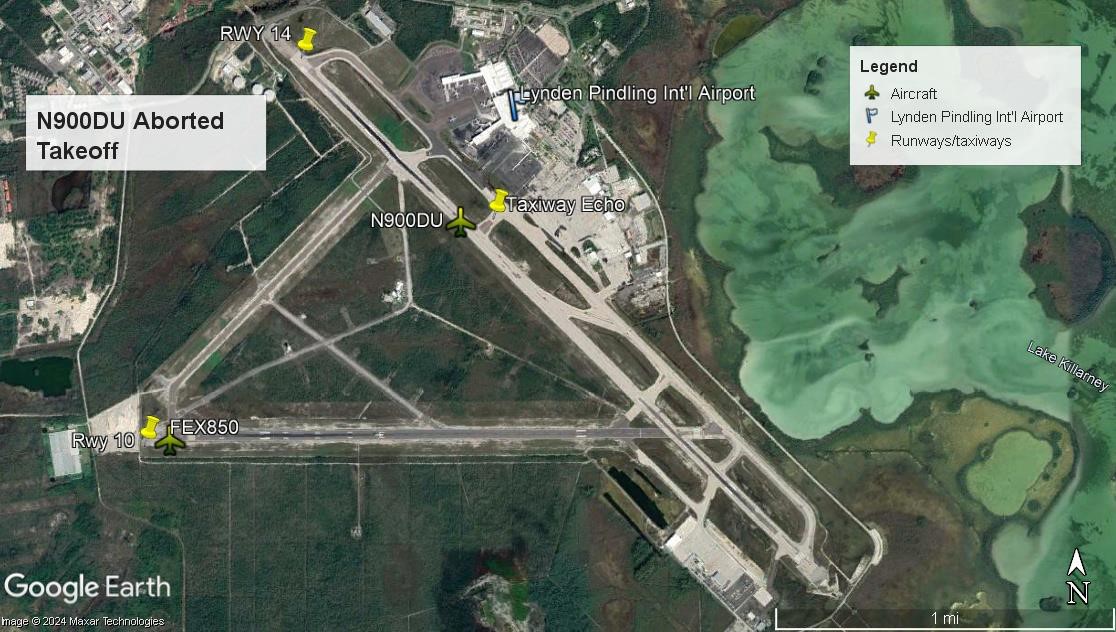
An annotated version of the Nassau Aerodrome diagram.
[Reproduced from the Official Report]
Why It Happened
The tower controller was working alone at the time the conflict. Although no technical issues were found with communication equipment, it was evident the controller had become overwhelmed at some point “within the last 5 - 6 minutes prior to the occurrence” when successive go-arounds were initiated by flights on approach to runway 10 “when landing clearances were not communicated to them in a timely manner." The report also noted a lack of coordination between the tower and approach controllers. This was indicated by the fact that vectoring of the Beech King Air 200 onto a runway 14 approach was not anticipated by the tower controller and that this had “only exacerbated the already deteriorating situation presented by the execution of two successive go-arounds from runway 10”.
The Investigation determined that the Probable Cause of the near miss was “the deterioration of separation minima between aircraft operating within the innermost core (5 nm radius) of the Nassau Control Zone which resulted in the necessary issuance of a cancel takeoff clearance to an aircraft (N900DU) on takeoff roll."
Two Contributory Factors were identified as:
- Inefficient (ATC) intra-facility coordination.
- Inefficient supervision within (an ATC) controlled environment.
Five Safety Recommendations were made as a result of the Investigation as follows: - that the Civil Aviation Authority Bahamas (CAA-B) conducts an assessment of the status of Air Traffic Controller licences and medicals held by employees of the Bahamas Air Navigation Services Authority (BANSA) to ensure compliance with CAA-B CAR-LIC Licensing Regulations Chapter 1 LIC.005 (b)(2)(ii) and CAR- LIC.1710 (b) Age and Medical Requirements. [SR2024-01]
- that the Bahamas Air Navigation Services Division (BANSA) conducts an internal review of the status of Air Traffic Controller licenses and medicals held by its employees to ensure compliance with CAA-B CAR-LIC Licensing Regulations Chapter 1 LIC.005 (b)(2)(ii) and CAR LIC.1710 (b) Age and Medical Requirements. [SR2024-02]
- that the BANSA conducts an assessment of its standard operating procedures (SOPs) relative to conducting simultaneous runway operations (when one runway is used specifically for arrivals and the other used specifically for departures) to identify any potential deficiencies that may exist. [SR2024-03]
- that the BANSA formulates a plan of action to ensure that there is a tower supervisor present in the control tower during periods of peak or complex operations. [SR2024-04]
- that the BANSA implements a mechanism to ensure that air traffic controllers are systematically and continuously provided with opportunities to undergo training for emergency and non-routine situations. [SR2024-05]
Response to Safety Recommendations
Recommendations SR2024-01, SR2024-02 and SR2024-05 were noted to have been actioned prior to the completion of the Final Report and were assigned “Closed-Acceptable Action." Recommendations SR2024-03 and SR2024-04 noted as having been accepted as stated but with action pending were there given the intermediate classification “Open-Acceptable Response."
The Final Report of the Investigation was dated 2 December 2024 and subsequently published online.