B752, en-route, northwest of Sacramento CA USA, 2024
B752, en-route, northwest of Sacramento CA USA, 2024
Summary
On 19 September 2024, a Boeing 757-200 making its initial descent to San Francisco was approaching its interim cleared level of FL 310 with the seat belt signs on prior to beginning descent from FL380 when a TCAS ‘CLIMB’ RA was annunciated. The type-inexperienced first officer’s response manoeuvre was abrupt enough to cause serious injury to two unsecured passengers and minor injuries to two unsecured cabin crew. Flight data showed that a 3° pitch up had been made within one second resulting in a vertical load factor of over 2g.
Flight Details
Aircraft
Operator
Type of Flight
Public Transport (Passenger)
Flight Origin
Intended Destination
Take-off Commenced
Yes
Flight Airborne
Yes
Flight Completed
Yes
Phase of Flight
Descent
Location
General
Tag(s)
Copilot less than 500 hours on Type
HF
Tag(s)
Inappropriate crew response - skills deficiency,
Manual Handling
LOC
Tag(s)
Aircraft Flight Path Control Error
Outcome
Damage or injury
Yes
Non-aircraft damage
No
Non-occupant Casualties
No
Occupant Injuries
Few occupants
Off Airport Landing
No
Ditching
No
Causal Factor Group(s)
Group(s)
Aircraft Operation
Safety Recommendation(s)
Group(s)
None Made
Investigation Type
Type
Independent
Description
On 19 September 2024, a Boeing 757-200 (N12125) operated by United Airlines on a scheduled domestic passenger flight from Newark to San Francisco as UA2428 was descending in day visual meteorological conditions (VMC) with the first officer acting as pilot flying (PF) when a TCAS ‘CLIMB’ Resolution Advisory (RA) occurred. The required autopilot (AP) disconnection was followed immediately by an abrupt pitch up, which resulted in two serious and two minor injuries to unsecured occupants in the cabin. The flight to destination was continued, and the flight arrived just under half an hour late and those with serious injuries were hospitalised.
Investigation
An accident investigation was carried out by the U.S. National Transportation Safety Board (NTSB). The flight data recorder (FDR) was downloaded and relevant data obtained. Relevant recorded radar, ADS-B and ATC communications data were available. The 49-year-old Boeing 757 captain had a total of 16,899 hours flying experience, which included 1,440 hours on type. The 35-year-old first officer had a total of 2,646 hours flying experience, which included just 33 hours on type.
What Happened
The captain reported he had switched the seat belt signs on approximately five minutes before the descent from the cruise altitude of FL380, and that about 500 feet above the cleared initial descent altitude of FL310, a TCAS Traffic Alert had been quickly followed by a TCAS ‘CLIMB’ RA. The first officer reacted almost instantly and, having disconnected the AP as required, made an instant manual pitch up to meet the primary flight display (PFD) target.
FDR data (see the illustration below) showed that a 3°pitch up had been made in just one second with a consequent 2.3g increase in vertical acceleration. This upset caused serious injuries to two passengers who were in or exiting the aft toilets at the time (in one case a spinal injury and in the other a broken ankle) and minor injuries to two of the six cabin crew who were cleaning up in the forward galley after cabin service.
Why It Happened
The accident was a consequence of the first officer’s abrupt response, which was contrary to company, original equipment manufacturer (OEM) and regulatory guidance on the use of TCAS II current at the time. Such guidance included that any indicated change in vertical speed should be achieved smoothly within 5 seconds of an RA being first displayed. The same guidance also advised that manoeuvring in response to an RA should be limited to the minimum required to comply with the RA and that an excessive pitch response is not desirable due to risk of injury to occupants.
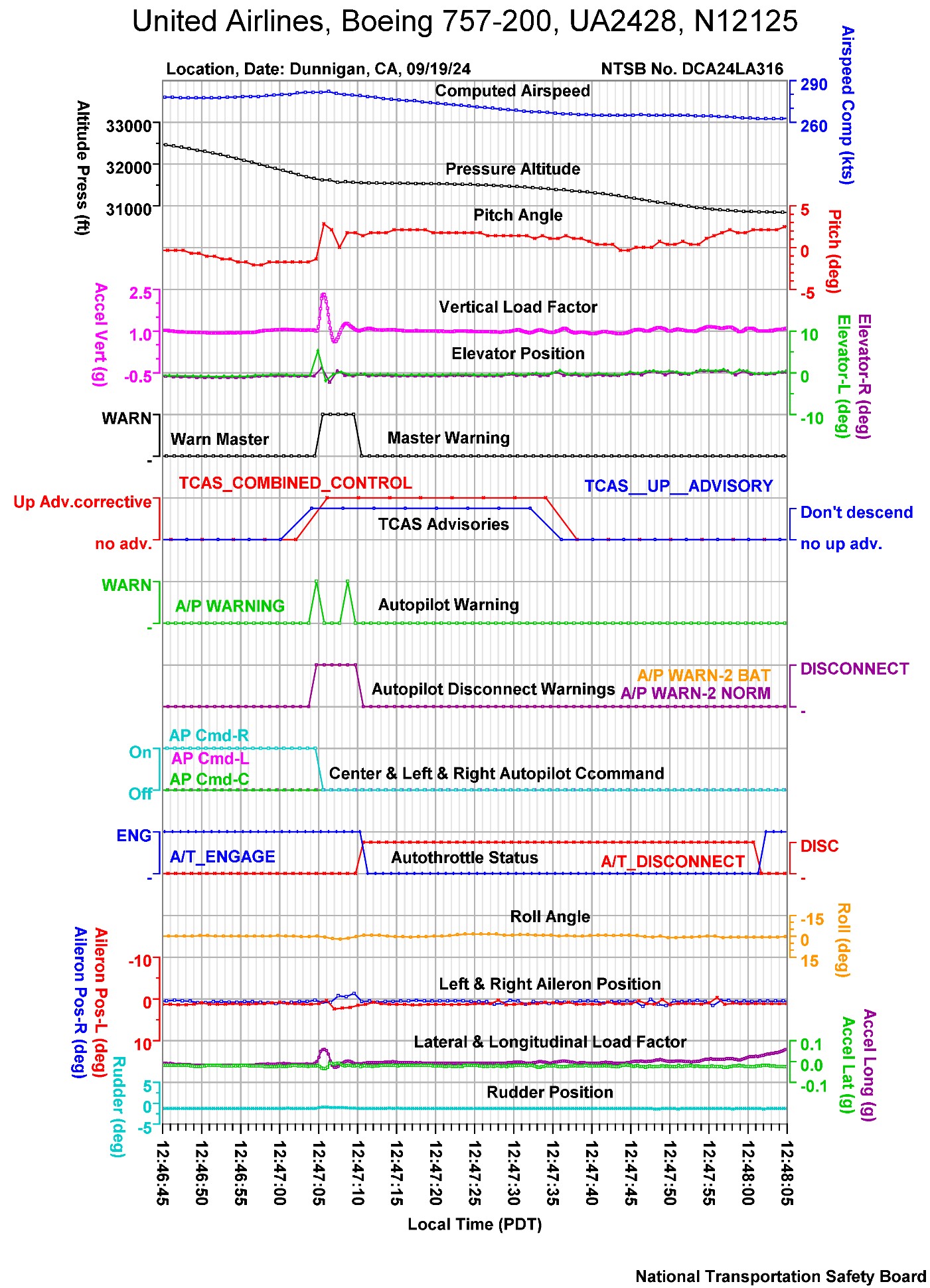
Selected FDR data for the 1 minute 20 second period which included the pilot-induced upset. [Reproduced from the Investigation Docket]
The Probable Cause of the accident was determined as “the abrupt pitch control input by the flight crew in response to a TCAS Resolution Advisory resulted in two serious passenger injuries."
The Final Report of the investigation was published on 27 March 2025. No Safety Recommendations were made.
Editor's Note: The information in the Final Report which was the primary source of the above summary was supplemented where deemed appropriate by reference to information in the event ‘Docket’ which if required is accessible via the link at the end of the final report.