B763, Houston Intercontinental TX USA, 2023
B763, Houston Intercontinental TX USA, 2023
Summary
On 29 July 2023, a Boeing 767-300 first officer mismanaged the de-rotation of the nose landing gear during touchdown in benign daylight conditions at Houston Intercontinental. A hard nose landing gear bounce followed main landing gear touchdown, and a further nose landing gear bounce followed after the thrust reversers were selected with the nose landing gear airborne. This resulted in the unarmed speedbrakes deploying. A momentary third bounce then completed full touchdown, and the captain took control. On arrival on the assigned gate, significant structural damage was found to have been caused to the forward fuselage structure.
Event Details
When
29/07/2023
Day/Night
Day
Flight Conditions
On Ground - Normal Visibility
Flight Details
Aircraft
Operator
Type of Flight
Public Transport (Passenger)
Flight Origin
Intended Destination
Take-off Commenced
Yes
Flight Airborne
Yes
Flight Completed
Yes
Phase of Flight
Landing
Location - Airport
Airport
General
Tag(s)
Copilot less than 500 hours on Type,
Flight Crew Training,
PIC aged 60 or over
HF
Tag(s)
Inappropriate crew response - skills deficiency,
Manual Handling
LOC
Tag(s)
Aircraft Flight Path Control Error,
Hard landing
Outcome
Damage or injury
Yes
Aircraft damage
Major
Non-aircraft damage
No
Non-occupant Casualties
No
Off Airport Landing
No
Ditching
No
Causal Factor Group(s)
Group(s)
Aircraft Operation
Safety Recommendation(s)
Group(s)
None Made
Investigation Type
Type
Independent
Description
On 29 July 2023, a Boeing 767-300 (N641UA) operated by United Airlines on a scheduled international passenger flight from Newark to Houston Intercontinental as UAL702 with the first officer as pilot flying (PF) proceeded normally with main gear touchdown until de-rotation of the nose landing gear was mismanaged. An initial hard bounce was followed by a second one aggravated by deployment of the thrust reversers, which automatically deployed the previously unarmed speedbrakes and an almost immediate final nose gear touchdown as the captain took control.
Investigation
An investigation was carried out by the U.S. National Transportation Safety Board (NTSB). Relevant data was downloaded from the flight data recorder (FDR). The 62-year-old training captain in command had been employed by United for 22 years, initially as a Boeing 757/767 first officer and then as a captain, and for the past ten years as a training captain. He had a total of approximately 23,000 hours flying experience, which included 15,000 hours in command and 5,500 hours on type.
The 41-year-old first officer had been employed by the operator for just over 5 months, during which time he had obtained a Boeing 757/767 type rating and logged 129 hours on type. After completing type simulator training, he had failed his Initial Simulator Line Oriented Evaluation on 28 April 2023 due to “deficiencies with takeoffs and aircraft control." He subsequently re-took the evaluation on 5 May 2023 and “obtained a satisfactory performance rating but received the minimum grade in three areas, one of which was landings," which resulted in his release for line operations training on a “short cycle." This required him to proceed with line training on the aircraft “but required him to be re-evaluated in 90 days rather than the normal period of 9 months." According to the training captain who completed the first officer’s second evaluation, the purpose of the short cycle was to ensure that his proficiency is up to standard given his previous “struggles."
What Happened
Both pilots were based at Newark and the accident flight was the first leg of a two-sector flight duty Newark-Houston-Newark. The three-hour flight proceeded normally with the first officer acting as PF. The Flap 30 ILS approach to runway 26L at Houston proceeded normally with the autopilot (AP) disconnected at around 800 feet agl. The aircraft was stabilised at the 500 feet agl call and the rate of descent was normal until the landing flare and main gear touchdown on runway 26L. The speed brakes were not armed for the approach.
Left and right main landing gear touchdown occurred simultaneously but after three seconds, the right main gear momentarily became airborne before runway contact was regained. Meanwhile, FDR data showed that the pitch attitude had become unstable, and just after the right main gear regained and remained on the runway surface, a pitch up then an excessive pitch down resulted in a hard nose gear bounce back into the air. A second hard nose gear touchdown was then followed by a smaller third bounce after a similarly hard third touchdown and finally by sustained nose gear contact with the runway. Thereafter the captain took over as PF and normal completion of the landing roll and taxi in followed.
Once at the assigned parking gate, the captain checked with the cabin crew to see if there had been any injuries and was advised not - although during taxi in, the cabin crew had proactively made an announcement for any concerned passengers to use their call buttons but none had done so. A subsequent cabin crew report stated that “the entire cabin experienced a rough landing and that some of the ceiling panels had come loose and we could hear gasps from the passengers."
The captain made a corresponding Technical Log entry and awaited the arrival of maintenance to also make a verbal report to explain that the main gear touchdown had been normal and only the nose gear had “come down hard." Subsequent inspection discovered “damage to the crown of the upper fuselage where the fuselage skin was buckled and fractured [see the illustration below] with damage to the underlying stringers and frames”.
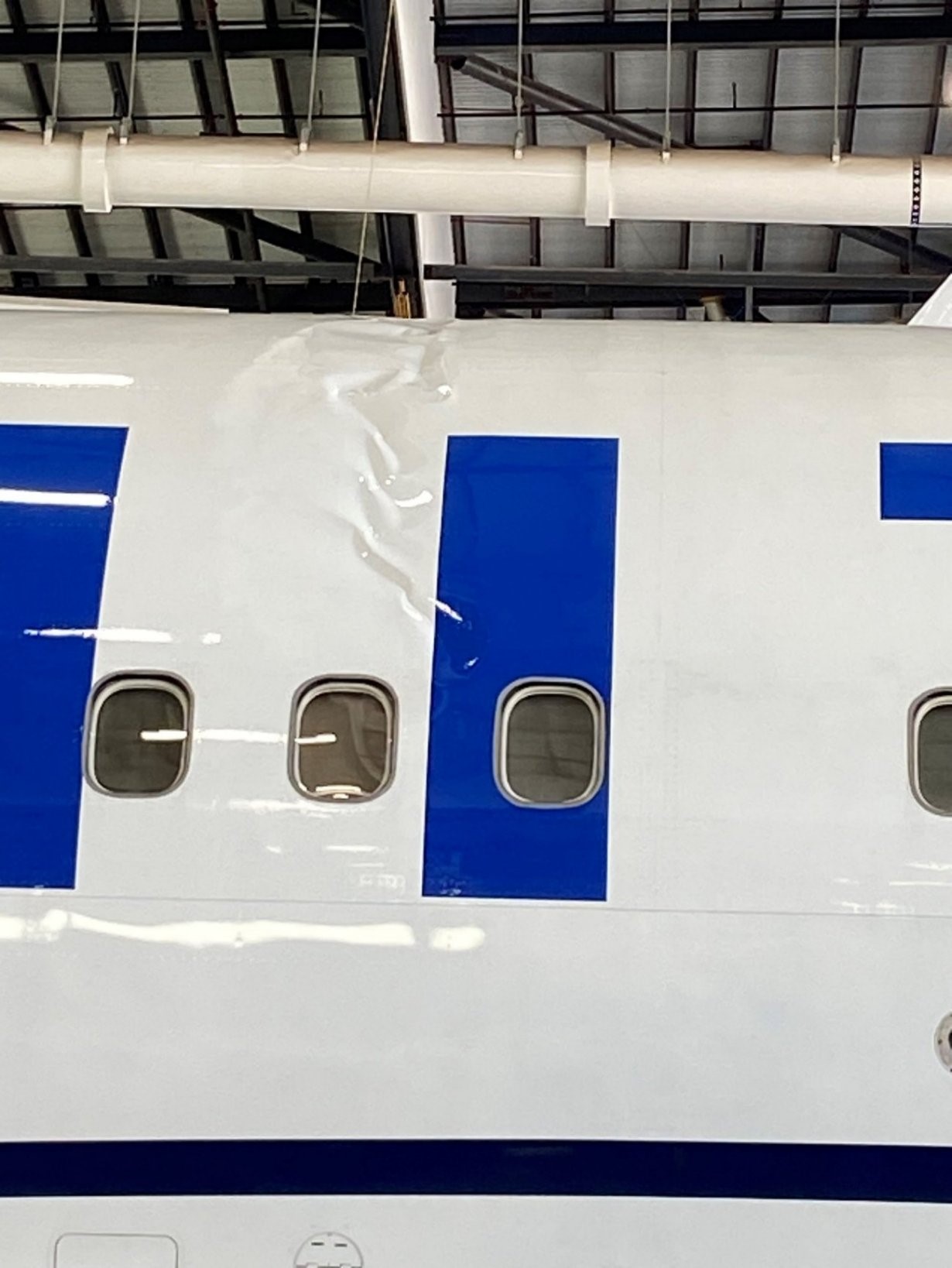
A view of damage to the left side of the forward fuselage. [Reproduced from the Official Report]
Why It Happened
Examination of the FDR data (see the illustration below) confirmed the captain’s account and confirmed that the speedbrakes had not been armed prior to landing. The FDR showed the speedbrakes had automatically deployed when the first officer selected the thrust reversers to reverse idle whilst the nose landing gear was still airborne following its first bounce. It was also clear from the data that after initial touchdown, the first officer’s control column inputs had varied between +5.71° and -4.75°. The initial hard runway contact by the nose landing gear was estimated to have occurred with a force equivalent to about 1.4g and the second and third contacts to have both occurred with a force equivalent to about 1.6g.
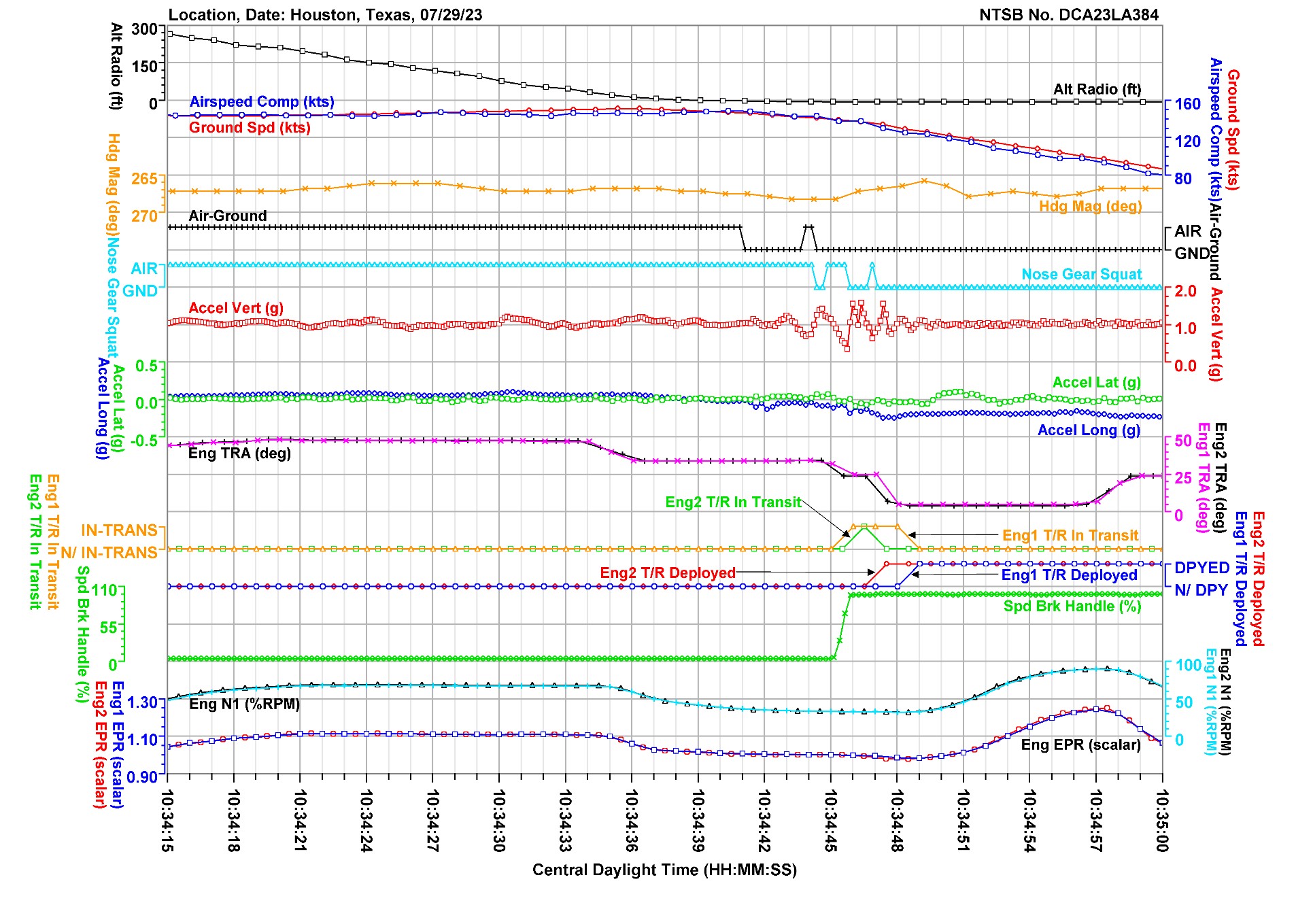
Selected FDR parameters around touchdown. [Part of an illustration included in the Official Report]
A review of previous Boeing 757/767 nose de-rotation accidents investigated by or with assistance from the NTSB noted seven which all occurred “when the pilots applied large nose-down control column deflections after main landing gear touchdown, which resulted in large nose-down pitch rates and high vertical velocities at the nose gear (and that) it was this combination of vertical velocity and pitch rate that resulted in compression loads that exceeded the design loads of the forward fuselage crown structure".
It was noted that the Boeing 767 Flight Crew Operating Manual (FCOM) said once the main landing gear is in full ground contact (i.e. not tilted) if either thrust lever is moved to the reverse idle detent, the speedbrake lever is driven to the up position and the spoiler panels are fully extended. The speedbrake lever does not need to be in the ‘ARMED’ position. This guidance was in contrast to that relating to direct manual selection of unarmed speedbrakes after main landing gear touchdown which stated “fly the nose wheels smoothly to the runway while slowly raising the speedbrake to the up position."
More generally, the Boeing 767 Flight Crew Training Manual was noted to provide, in part, the following landing procedure guidance:
“After main gear touchdown, initiate the landing roll procedure. Fly the nose wheels smoothly onto the runway without delay.......Control column movement forward of neutral should not be required. Do not attempt to hold the nose wheels off the runway. Holding the nose up after touchdown for aerodynamic braking is not an effective braking technique and results in high nose gear sink rates upon brake application and reduced braking effectiveness. To avoid possible airplane structural damage, do not make large nose down control column movements before the nose wheels are lowered to the runway.”
The Probable Cause of the Accident was determined as “the first officer’s improper control inputs after the airplane [main landing gear] touched down”.
A Contributory Factor to the severity of the damage was the flight crew’s lack of recognition that the speedbrakes were not armed, which led to their delayed deployment.
It was noted that “due to the satisfactory performance rating after the first officer’s second (initial simulator training) evaluation, the Investigation was unable to determine if the first officer's training inconsistencies contributed to the accident".
The Final Report of the investigation was published on 16 January 2025. This summary also draws on the corresponding published investigation docket. No safety recommendations were made.