B772, London Gatwick UK, 2024
B772, London Gatwick UK, 2024
Summary
On 28 June 2024, a Boeing 777-200 was on the takeoff roll from London Gatwick when the first officer responded to the preset automated ‘V1’ call by retarding the thrust levers instead of moving his left hand to the control column. He then briefly re-advanced them before finally rejecting the takeoff from above V1. The aircraft stopped with about 700 metres of runway remaining and after a brake fire had been extinguished, the passengers were disembarked to buses and the aircraft towed clear. The type-experienced first officer expressed surprise at his action and could not identify a reason for it.
Flight Details
Aircraft
Operator
Type of Flight
Public Transport (Passenger)
Flight Origin
Intended Destination
Take-off Commenced
Yes
Flight Airborne
No
Flight Completed
No
Phase of Flight
Take Off
Location - Airport
Airport
FIRE
Tag(s)
Landing Gear Overheat
HF
Tag(s)
Procedural non compliance
RE
Tag(s)
RTO decision after V1
Outcome
Damage or injury
Yes
Aircraft damage
Minor
Non-aircraft damage
No
Non-occupant Casualties
No
Off Airport Landing
No
Ditching
No
Causal Factor Group(s)
Group(s)
Aircraft Operation
Safety Recommendation(s)
Group(s)
None Made
Investigation Type
Type
Independent
Description
On 28 June 2024, a Boeing 777-200ER (G-VIIT) operated by British Airways on an international passenger flight from London Gatwick to Vancouver as BA2279 with the first officer as pilot flying (PF) began retarding the thrust levers in day visual meteorological conditions (VMC) in response to the standard V1 call. The first officer then briefly restored takeoff thrust before finally rejecting the takeoff and coming to a stop with just under 700 metres of runway remaining. A right main gear brake fire broke out and was extinguished before the 347 occupants were disembarked to buses and the aircraft was towed clear of the only runway.
Investigation
An investigation was carried out by the UK Air Accident Investigation Branch (AAIB). Relevant data were recovered from the aircraft cockpit voice recorder (CVR) and quick-access recorder (QAR). The 56-year-old captain had a total of 22,374 hours flying experience which included 18,616 hours on type. The first officer had a total of 6,156 hours flying experience which included 2,700 hours on type. The flight under investigation occurred 14 days after his previous flight due to taking annual leave. It was also noted that all his commercial flying had been as a first officer.
What Happened
On hearing the automatic V1 callout, the first officer “inadvertently began retarding the thrust levers, instead of removing his hand from them to continue the takeoff." Simultaneously, the captain called ‘rotate’ as the airspeed continued to increase above VR and the first officer “vocalised the error and momentarily advanced the thrust levers again” before then commencing a rejected takeoff. The aircraft came to a stop just before intersection ‘GR.’ The airport rescue and firefighting services (RFFS) attended promptly and extinguished a fire at the right main landing gear which had resulted from overheated brakes. The initial thrust reduction did not lead to any recorded air speed drop, and the aircraft's inertia caused the speed to increase to 7 knots above V1. The aircraft was around 20 tonnes below its maximum takeoff weight (MTOW).
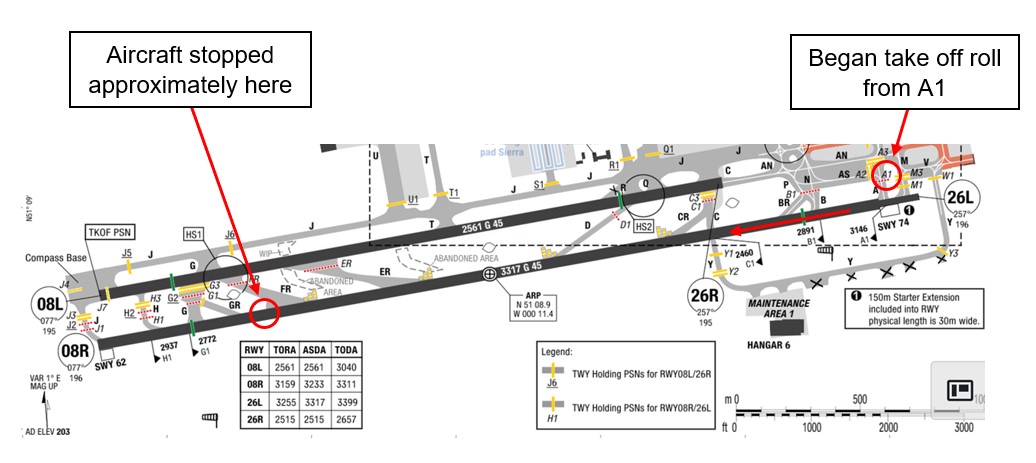
The aircraft start and stop positions on runway 26. [Reproduced from the Official Report]
Bearing in mind that performance calculations allow for taking off with one engine failed after V1 and that both engines were operating, alternative potential outcomes were not evaluated. It was noted that given the “somewhat benign performance conditions," the aircraft had stopped “some distance before the end of the runway surface." CVR data showed that whilst the captain had not had sufficient time to fully assess the situation before the aircraft began stopping, he had responded to the situation “calmly and methodically” and that the rejection and subsequent actions were handled effectively.
Why It Happened
The first officer stated that he had been “well-rested and feeling fine” and had “expressed surprise in himself over the inadvertent thrust reduction” and been unable to identify a reason for it. He described instinctively pushing the thrust levers forward again before becoming concerned about restoring takeoff thrust when farther along the runway. The uncertain takeoff performance implications led him to commit to the rejected takeoff. He added that “in another situation he might have continued the takeoff using takeoff/go-around (TO/GA) thrust.
No obvious reason for the first officer to have acted as he did was identified - he had, for example, not recently changed aircraft seat or type, nor had he been in a simulator practicing landings or rejected takeoffs. His incorrect action was characterised as an “action slip” defined as "an action which is not performed as intended and arises in routine or highly learned motor action sequences." It was noted that the aircraft operator had “already reviewed its standard operating procedures relating to movement of critical controls and found that absence of cognitive thought and speed of execution commonly featured during action slips." Four days before the event, the operator had issued an ‘Operational Safety Notice’ that said “pause before execution and cognitively consider what the required action is” before methodically executing the action and confirming it is correct. The operator also noted its “cautious approach to publicising specific incidents to its crew, given industry experience suggesting that the act of discussing mis-selections might actually prime crew towards, rather than against making them."
The aircraft operator’s flight crew training manual (FCTM) stated the normal response on hearing the V1 call and defined the term V1. Its subsequent ‘Cognitive Task Analysis Report’ on the event found that the morning concerned had otherwise been “unremarkable for the crew, with no obvious distraction or workload issues before the incident."
Discussion
It was considered that the event evidences an “ongoing challenge for operators and crew in attending to control selections." It was noted that pilots perform a series of motor actions during a normal takeoff whilst also having prepared themselves mentally for the possibility of a rejected takeoff. It was noted that as well as participating in relevant multi-crew and emergency briefings, “pilots can improve their individual performance by mentally rehearsing what might seem like routine parts of an operation, especially after time away from flying," an activity sometimes described as “armchair flying”.
The formal narrative Conclusion of the Investigation was as follows:
By way of an action slip, the first officer began retarding the thrust levers at airspeed V1. He (then) instinctively advanced them again, before initiating the rejected takeoff around 2 knots later. The rejected takeoff was performed effectively and, in benign performance conditions, the aircraft stopped some distance before the end of the runway surface.
Preventing “action slips” is an ongoing challenge for operators and crew. This operator had published guidance on methodical control selections and has promoted the human factors topic of ‘focus’ in training and briefing material. The report considers why even experienced pilots may benefit from mentally rehearsing the takeoff roll and other routine procedures, especially after returning from time off.
The Final Report was published on 8 May 2025. No Safety Recommendations were made.