B77L, Shanghai Pudong China, 2020
B77L, Shanghai Pudong China, 2020
Summary
On 22 July 2020, a Boeing 777F main deck cargo fire warning was annunciated as the aircraft was preparing for departure from Shanghai. Fire service was requested and a MAYDAY declared to expedite this. All crew evacuated as the main deck cargo main door was being opened. Smoke appeared immediately and flames followed. The fire took almost three hours to extinguish and resulted in major damage. The investigation concluded that the fire had resulted from spontaneous ignition of a shipment of chlorine disinfection tablets loaded as undeclared dangerous goods, due a combination of high ambient humidity and temperature.
Flight Details
Aircraft
Operator
Type of Flight
Public Transport (Cargo)
Flight Origin
Intended Destination
Take-off Commenced
No
Flight Airborne
No
Flight Completed
No
Phase of Flight
Parked
Location - Airport
Airport
General
Tag(s)
Inadequate Airport Procedures
FIRE
Tag(s)
Dangerous Goods,
Fire-Cargo origin
HF
Tag(s)
Procedural non compliance
GND
Tag(s)
Dangerous Goods
EPR
Tag(s)
Emergency Evacuation,
MAYDAY declaration,
RFFS Procedures
Outcome
Damage or injury
Yes
Aircraft damage
Hull loss
Non-aircraft damage
No
Non-occupant Casualties
No
Off Airport Landing
No
Ditching
No
Causal Factor Group(s)
Group(s)
Aircraft Operation
Airport Operation
Safety Recommendation(s)
Group(s)
Aircraft Operation
Aircraft Airworthiness
Airport Management
Investigation Type
Type
Independent
Description
On 22 July 2020, a Boeing 777F (ET-ARH) with Ethiopian Airlines was about to depart on a scheduled cargo flight from Shanghai Pudong to Addis Ababa as ET3739 when a main deck cargo compartment fire warning occurred. Rescue and firefighting service (RFFS) was requested. Daytime visual meteorological conditions (VMC) prevailed. When the required attendance was unexpectedly delayed, a MAYDAY call was made. Once the RFFS arrived, all five crew members were able to evacuate via air stairs. As they did so, the cargo main door was opened, smoke appeared, and four minutes later, flames were seen. The fire was eventually extinguished but by this time it had burnt a large hole at the centre of the rear fuselage crown. The fire also caused lesser damage to the crown further forward and extensive damage to the main cargo deck interior and the aft pressure bulkhead.
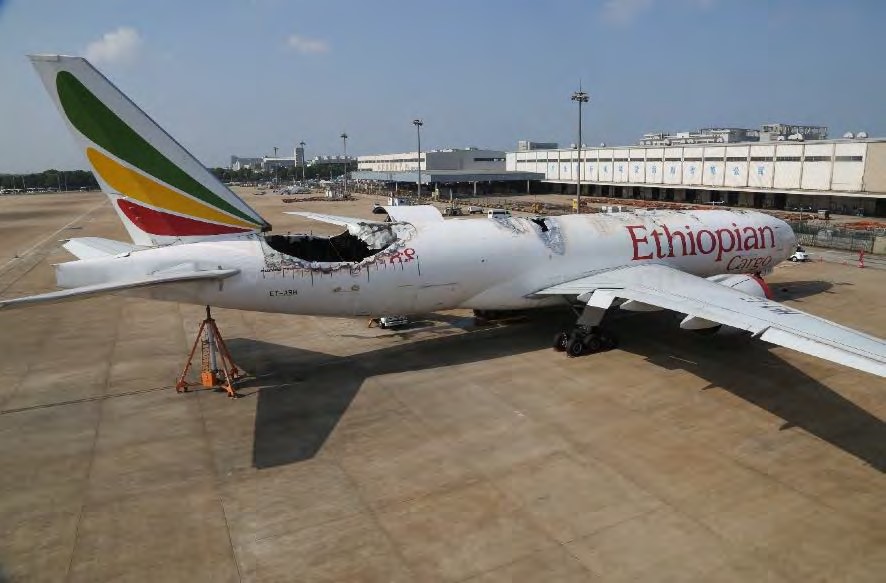
Fire damage to the Upper Fuselage. [Reproduced from the Official Report]
Investigation
An Annex 13 Accident Investigation was carried out by the Eastern Regional Administration of the Civil Aviation Administration of China (CAAC). No data was available from either the flight data recorder (FDR) or the cockpit voice recorder (CVR) because both require at least one engine in start mode or running when the aircraft is on the ground. Quick-access recorder (QAR) data was, by design, only recorded for the start of the auxiliary power unit (APU).
The 42-year-old captain had a total of “about 15,000 hours” flying experience, which included 3,000 hours on type. The 30-year-old first officer had a total of 2,500 hours flying experience, which included 1,000 hours on type. Both operating pilots held ICAO Level 5 English Language certification. A Relief captain was also included in the flight crew and he had a total of 28,500 hours flying experience, which included 5,000 hours on the B777. He held ICAO Level 6 English Language certification. All three pilots were Ethiopian nationals. A 29-year-old flight engineer rated on the B777-200/300 was also on board, as was a 29-year-old loadmaster.
The Air Traffic Control tower supervisor had 14 years controller experience, the clearance delivery controller had 2 years controlling experience, the ground controller had almost 5 years controlling experience, and the ATC coordinator had 11 years controlling experience. All four controllers held ICAO Level 4 English Language certification. Apron control at Shanghai was responsible for “overseeing aircraft pushback, engine start, taxiing, engine ground test and the towing of aircraft." The airport apron manager held a corresponding licence and had 2 years experience, and the airport apron controller also held a corresponding licence and had 6 years experience. Both held ICAO Level 4 English Language certification. The airport apron coordinator had one year’s experience and was certificated accordingly.
What Happened
The crew boarded the aircraft to prepare for departure as loading of 69,370kg of cargo was nearly complete. This load was mainly contained on 22 main deck pallets, each occupying one of the 27 main deck loading positions - one pallet was loaded with 1,750 kg of unused pallets. A further 10,170kg of cargo was loaded onto 6 pallets in the forward and aft lower deck holds, and 540 kg was loaded into the bulk cargo compartment. According to Dangerous Goods documentation, 4 of the 85 waybills referred to electronic products with lithium batteries, with no other declared dangerous goods loaded. Two of these pallets were recorded as having been loaded to main deck positions, one at the very front and one at the very back of the available space.
The main deck fire warning (see the illustration below) was annunciated fourteen minutes after loading had been completed, by which time the five crew members had been on board for about 35 minutes. One of the flight crew immediately advised clearance delivery that a fire truck was required. This was then followed four minutes later by a request for a set of passenger airstairs to be positioned at door 1L to allow the crew to evacuate the aircraft. When the requested response did not occur, a MAYDAY FIRE call was made. However, after “Apron Control failed to [accurately and completely] relay" the emergency status and fire information to the Airport Operations Centre, it was a further 9 minutes before the first fire truck arrived. Eight minutes after this, all five crew members disembarked the aircraft.
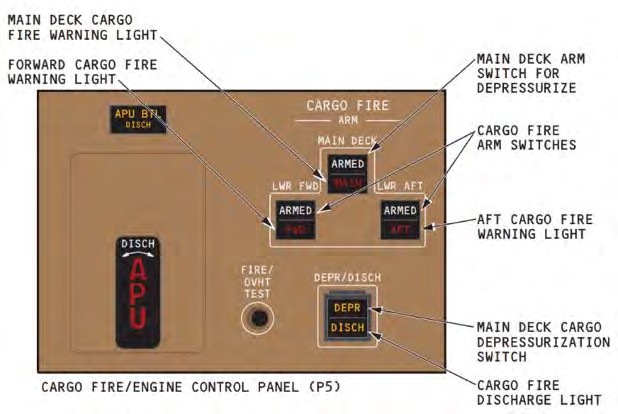
The flight deck APU/Cargo Fire Warning Panel. [Reproduced from the Official Report]
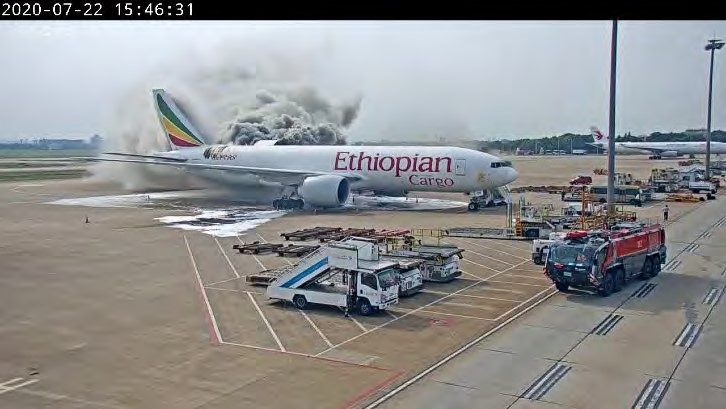
The scene on CCTV eleven minutes after fire extinguishant application had commenced. [Reproduced from the Official Report]
When the RFFS initially arrived at the aircraft, there was no external sign of smoke or fire. Shortly after this, door 1L was opened and the crew began to evacuate. The main deck external cargo door was then opened and smoke was emitted. Within a few minutes flames were visible inside not far from the door and discharge of fire extinguishant was commenced by the initial fire appliance. Further assistance was called for but the second and third appliances did not arrive until 17 minutes had elapsed, followed by a fourth 9 minutes after that. Together, these four appliances sought to extinguish the fire at the rear of the aircraft where it had started and prevent the worst of the fire from advancing forwards. The airport was temporarily closed and support from firefighters from outside the airport was sought as contingency, with the first three of these backup appliances arriving at the airport soon after the fourth RFFS appliance had reached the aircraft. However, it was still over 90 minutes before the flames were eventually extinguished.
The airport was closed just over an hour after the fire had been confirmed, before being partially reopened after 50 minutes and then completely reopened after another hour.
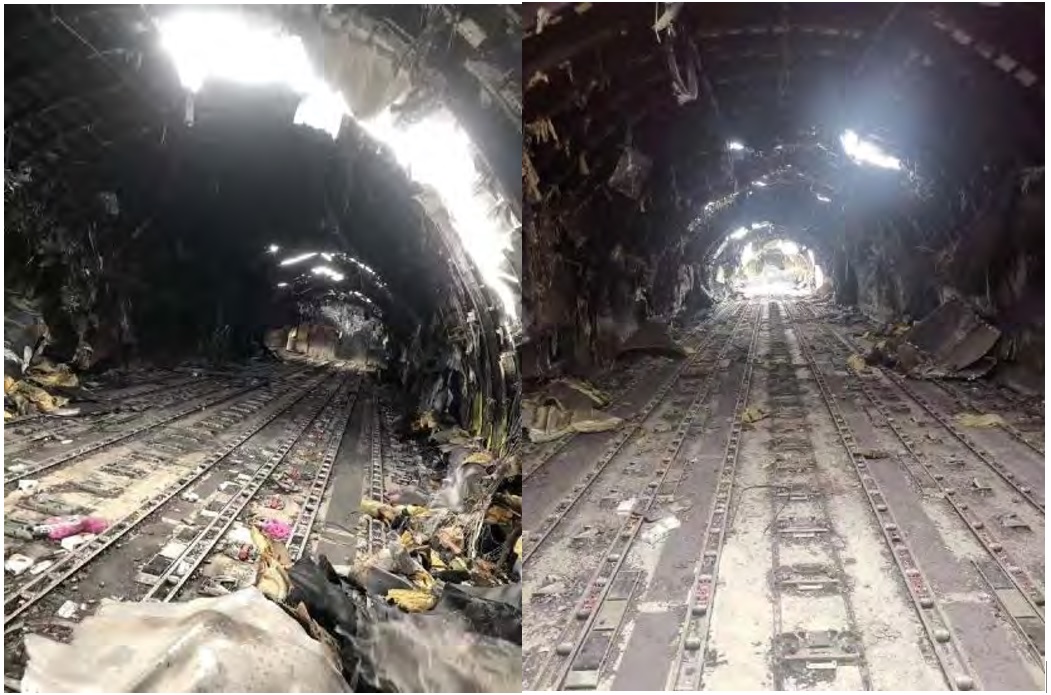
The main deck cargo compartment interior looking forward (left) and aft (right). [Reproduced from the Official Report]
Damage to the aircraft was extensive, with the main deck cargo compartment, as the seat of the fire, especially affected with a large hole in the upper fuselage above the area of the compartment. Most of its components installed along the top of it - ceiling panels, heat insulation cotton, smoke/fire detectors, light assemblies, sidewall panels, air conditioning ducts, wiring harnesses (including the main cables to the APU, wire mounting brackets and electrical plugs) were burnt out, as was the interior lining of the main deck cargo door. The door structure itself was “severely heated” and could not be manually closed. The floor in front of the remains of the aft pressure bulkhead and the rigid cargo barrier at the rear of the compartment were also extensively damaged.
It was noted that the main deck cargo compartment was designated as ‘Class E’ cargo compartment with no guidance on how to respond to a ground (as opposed to in-flight) fire provided in the Boeing Aircraft Flight Manual (AFM). It was also noted that it was prohibited to open the access to the front of the main deck cargo compartment in the event of fire.
Why It Happened
The origin of the fire was found to be the pallet loaded into the main deck loading ‘PR’ position located at the rear of the main cargo deck on the right side. This position - see the illustration below - was directly below the main hole burnt through the fuselage crown.
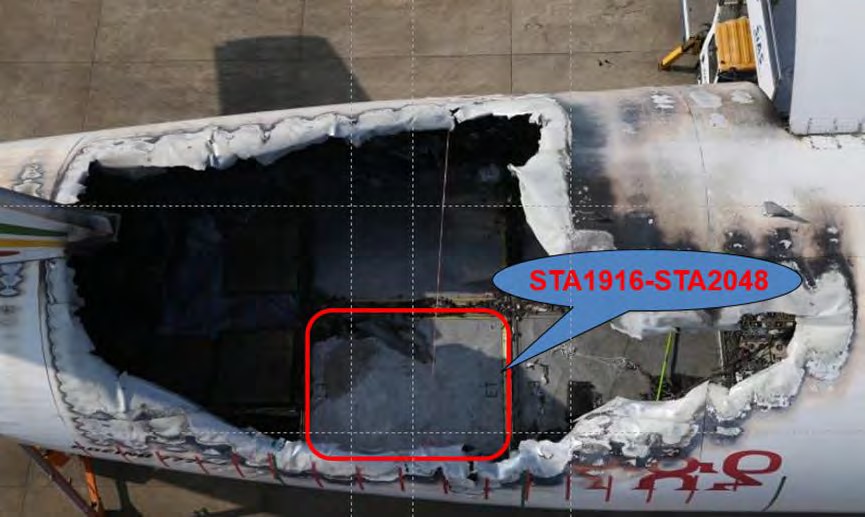
A birds-eye view of the PR pallet-loading position. Reproduced from the Official Report]
All other potential origins of the fire were carefully eliminated and it was concluded that it had originated in one or more of the packages on the pallet stowed at that position. This pallet was one of four pallets which included declared dangerous goods contained in products powered by lithium batteries. One of the others was close to the PR position but on examination, the products on it could be shown to have ignited from outside.
Lithium battery-sourced ignition of declared Dangerous Goods on the PR position pallet was similarly eliminated, but an undamaged chlorine dioxide gas detector which was not included on the pallet air waybill was then found at the PR position.
The pallet air waybill was examined and found to include items described as “chlorine dioxide air disinfection machines” and “nano slow-release disinfection material." Close examination of the fire debris at the PR position then found the remains of a consignment of 100 bags (1kg per bag) of chlorine dioxide disinfection tablets. Both the disinfection material and the tablets were classified as Dangerous Goods but had not been declared.
The shipment including these materials was destined for Santiago, Chile, which was the final destination of the flight after Addis Ababa. A simulation under meteorological conditions like those which had prevailed showed that the temperature inside bags of the same tablets, covered with plastic film, was much higher than the ambient temperature, and condensation was observed to occur inside the film. This was assessed as having created unfavourable conditions for heat dissipation, which would have provided sufficient condition for spontaneous combustion of the tablets. It was therefore concluded that the chlorine dioxide disinfection tablets had been the source of the fire, having been vulnerable to spontaneous combustion after exposure during the loading process to a combination of unusually high temperature and humidity.
It was also observed that premature opening of the main cargo door by the loadmaster using a switch on the door control panel at door 1L after an instruction to do so from the captain could have caused a large amount of air to enter the main deck cargo compartment and accelerated the growth of the fire. This action was noted to have been directly contrary to an QRH instruction applicable to the situation which stated that “Warning! Inform ground personnel NOT to open any cargo door until all supernumeraries and crew have exited the airplane and fire fighting equipment is nearby.: The crew also did not shut down the APU before evacuating the aircraft as also required as an applicable QRH action. However, it was noted that the Boeing 777 Flight Crew Operating Manual (FCOM) did not contain any “further instructions or procedures for protective settings of the aircraft system before the evacuation of the crew."
Significant Findings of the investigation in respect of the immediate origin of the fire were, in summary, as follows:
- The fire was the result of spontaneous combustion of a consignment of undeclared dangerous goods - chlorine dioxide disinfection tablets - packed in aluminium foil bags which could be expected to ignite at 150°C. All the foil bags were shrink-wrapped onto one specific pallet in an identified loading position near the rear of the cargo compartment.
- During storage at the airport, goods can be affected by high temperature and moisture in the environment, and this had been the situation at Shanghai airport at the time the aircraft was being loaded.
The Probable Cause was formally given as “the initial fire area was in the main deck cargo compartment located between STA1790 and STA2129. The origin of the fire was located between station STA1916 and STA2048 (the ‘PR’ loading position), on the right side of the main deck cargo compartment. The chlorine dioxide disinfection tablets loaded in the cargo compartment spontaneously combusted in the high temperature and moisture environment and caused the fire."
A Total of Five Safety Recommendations were made as follows:
- that the ICAO should, as the global (Covid) pandemic has not ended and the market demand for disinfection products containing chlorine dioxide is huge, undertake further research, refine the air transportation conditions for disinfection products with different contents of chlorine dioxide and revise relevant items into the Technical Instructions for the Safe Transport of Dangerous Goods by Air so as to facilitate better and safer air transportation.
- that Shanghai Pudong Airport should enhance the application of standard terminology regarding the relay of information so as to ensure an accurate and smooth relaying of emergency information.
- that Ethiopian Airlines should enhance the emergency response capability of the flight crew to ensure that all procedures in the Flight Crew Operation Manual (FCOM) and the Company Operations Manual (OM) can be completed correctly.
- that the Boeing Company highlight the sign which reads "In the Event of Smoke or Cargo Fire, Do Not Open" on the B777F rigid cargo barrier in a prominent manner and consider clarifying it in the FCOM and FCTM.
- that the CAAC avoid or reduce the risk of dangerous goods boarding the aircraft in violation of laws or regulations by improving and refining existing regulations and standards related to the air transport of dangerous goods and by adopting new technology in security inspection.
The 113 page Final Report was completed on 30 December 2021.
Related Articles
- Dangerous Goods
- Operational Fires
- Aircraft Hold Fire Risks
- Quick Reference Handbook (QRH)
- Ground Operations
Further Reading
- Protecting Aircraft and Passengers from Cargo Fires, Airbus, 2018