B788, en-route, northern UK, 2023
B788, en-route, northern UK, 2023
Summary
On 21 December 2023 a Boeing 787-8 crew inbound to Manchester on a day of significant weather-related flight disruption over northern England decided to divert to their nominated alternate East Midlands. When a landing there was denied, the flight proceeded to the nearest available alternate, Birmingham. After a windshear-related missed approach and subsequent low fuel MAYDAY declaration, a second approach led to a successful landing but with significant use of final reserve fuel. The operators of East Midlands and Birmingham airports subsequently revised their procedures for determining and communicating capacity for diversions and prioritising flights declaring low-fuel emergencies.
Flight Details
Aircraft
Operator
Type of Flight
Public Transport (Passenger)
Flight Origin
Intended Destination
Actual Destination
Take-off Commenced
Yes
Flight Airborne
Yes
Flight Completed
Yes
Phase of Flight
Landing
General
Tag(s)
Destination Diversion,
Inadequate ATC Procedures,
CVR overwritten,
PIC aged 60 or over
LOC
Tag(s)
Environmental Factors
WX
Tag(s)
Strong Surface Winds,
Low Level Windshear
EPR
Tag(s)
MAYDAY declaration,
Fuel Status
Outcome
Damage or injury
No
Non-aircraft damage
No
Non-occupant Casualties
No
Off Airport Landing
No
Ditching
No
Causal Factor Group(s)
Group(s)
Aircraft Operation
Air Traffic Management
Safety Recommendation(s)
Group(s)
None Made
Investigation Type
Type
Independent
Description
On 21 December 2023 a Boeing 787-8 (G-TUIB) operated by TUI Airways on an overnight international scheduled passenger flight from Cancun, Mexico, to Manchester, England, as BY173 entered the hold to await an approach to destination. The crew was advised of an undetermined delay due to significant crosswinds. After finding East Midlands would be unable to accept their potential diversion, it was confirmed that the flight could be accepted at Birmingham, and it diverted there. However, on short final, a windshear warning was annunciated and - as procedurally required - the crew commenced a go-around. During the climb, a MAYDAY FUEL was declared following which the flight was radar-vectored on a 25-nm track to a second approach. The aircraft subsequently landed with 1,250 kg of fuel remaining, over 650 kg below final reserve fuel.
Investigation
A Serious Incident investigation was carried out by the UK Air Accident Investigation Branch (AAIB). Relevant recorded data from both the cockpit voice recorder (CVR) and the flight data recorder (FDR) had been overwritten as a result of the aircraft continuing in service but the quick-access recorder (QAR) data was provided by the operator. Recorded air traffic control (ATC) radar and voice communication data were also available.
The 62-year-old captain who was acting as pilot flying (PF) for the sector had a total of 23,499 hours flying experience, which included 2,964 hours on type. No age or experience information was given for the first officer.
What Happened
The crew departed Cancun aware from the latest 12-hour terminal aerodrome forecast (TAF) for Manchester that strong winds and a significant crosswind component were likely to affect their destination approach early in the morning but “mistakenly believed these would dissipate after 0600." Nevertheless, they decided to load almost a tonne of discretionary additional fuel in case of a weather-related approach delay, which would be sufficient to allow for one missed approach before diverting to their nominated alternate, East Midlands.
On being directed to join a holding pattern at FL090 on nearing Manchester, the flight was advised that the adverse wind conditions for an approach had resulted in delays and that seven other aircraft were ahead in the sequence to land with no EAT (Expected Approach Time) available. The minimum diversion fuel required to commence a diversion to East Midlands was calculated as 3,217 kg, which included ‘destination alternate fuel’ and the ‘final reserve fuel’. The operational flight plan (OFP) also gave fuel requirements to divert to other airports - a diversion to Birmingham would only require an additional 149 kg. It was also noted that the discretionary additional fuel loaded would provide about 15 minutes additional flight time. What happened for the remainder of the flight is summarised on the illustration below and described in more detail in the following text.
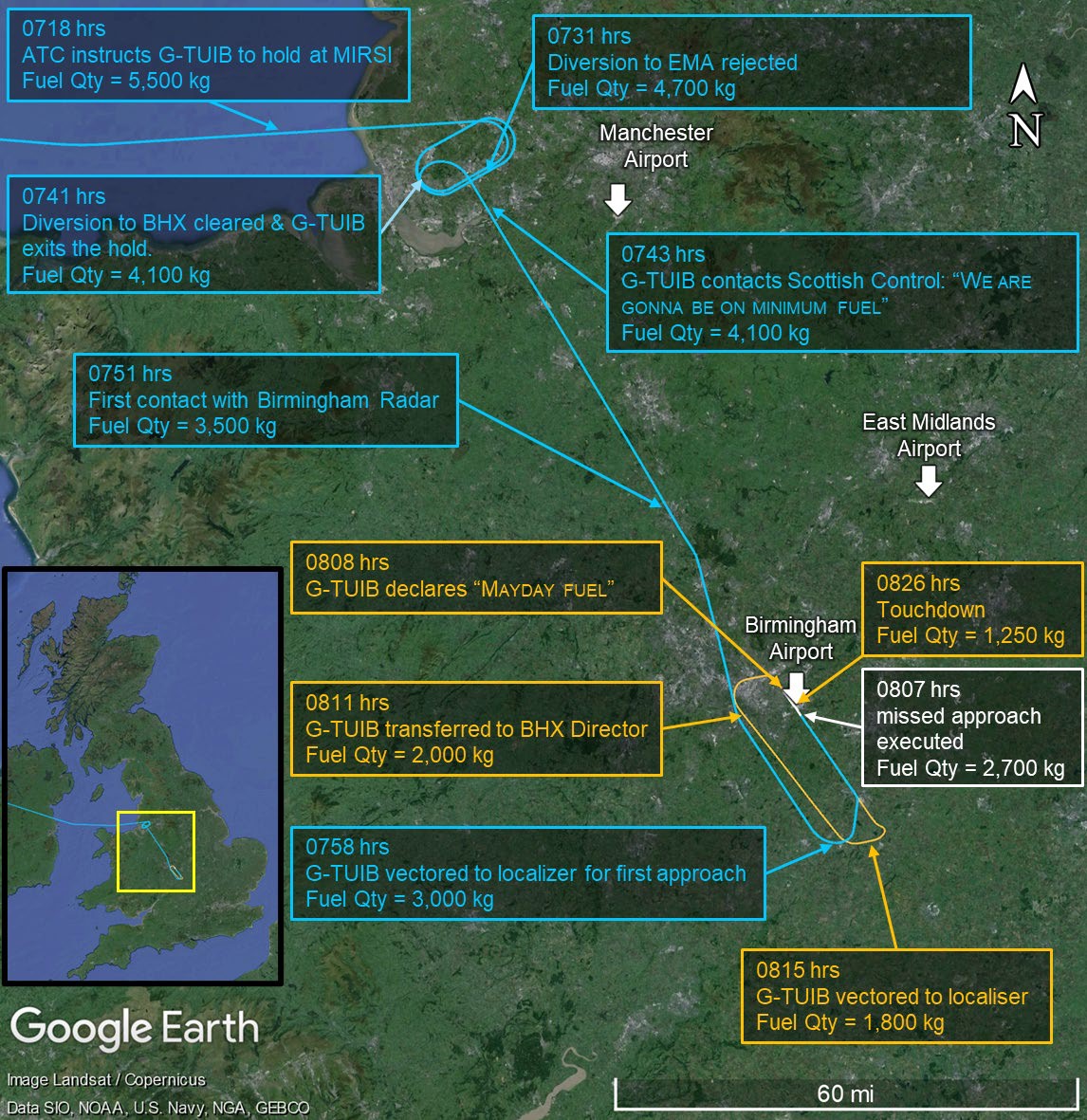
An annotated flight track of the diversion sequence. [Reproduced from the Official Report]
The crew called their preferred diversion, East Midlands, to advise that they may need to divert there but were advised that “an aircraft of their size could not be accepted” so made a similar call to Birmingham and were advised they could be accepted there if necessary. After about 20 minutes in the Manchester hold and no nearer to an approach, it was decided to divert to Birmingham with 4,100 kg of fuel remaining. During the transit, an EICAS ‘INSUFFICIENT FUEL’ message displayed and the corresponding checklist was run. The crew discussed the consequences of the low fuel situation during the approach brief for runway 33 in respect of any further delay or a missed approach.
On transfer to Birmingham Radar, the flight was advised that it had 33 nm to run and was subsequently vectored onto the Runway 33 ILS localizer and intercepted the glide path with 2,900 kg of fuel remaining. A landing clearance followed but at 240 feet agl and 1 nm from touchdown, an on-board automated windshear warning occurred. In accordance with applicable procedures, a missed approach was commenced with 2,700 kg of fuel remaining.
On transfer to Birmingham Radar during the climb, a MAYDAY FUEL was declared and the controller responded by instructing the aircraft to climb to 4,000 feet QNH and advised that radar vectoring back to the ILS would be provided and would involve a 25 nm track. With the aircraft downwind, an EICAS ‘FUEL QTY LOW’ was annunciated and the corresponding checklist was run. Meanwhile, ATC vectored another aircraft, an A321, for its approach to land ahead of the MAYDAY flight which eventually landed with 1,250 kg of fuel remaining, 661 kg below the OFP final reserve fuel of 1,911 kg.
In respect of this sequencing, it was noted from the recorded radar data that the A321 had not already established on the ILS LOC and had flown through it before becoming established at a range of 18 nm. This failure to prioritise MAYDAY traffic was found to have added to the track miles flown by it above the original 25 nm stated by ATC - “from the point of the missed approach to the point of landing, the actual track distance flown was 53 nm, and 1,450 kg of fuel was used." The Investigation estimated that approximately 400 kg of fuel had been required to fly these additional track miles.
It was noted that internal reviews of the event had been carried out by both East Midlands and Birmingham ATC. The East Midlands review found that prior to the aircraft’s call anticipating the possibility of diversion to the nominated alternate, an ATC Assistant had been advised by the airport’s ’Airfield Operations Unit’ “that the airport could only accept two Boeing 737-800 or equivalent size and anything else would be dependent upon the ground handling agent capacity at the time of the request." On receipt of the subsequent request to divert there by the 787, the controller was told of the restriction on inbound diversions and, on that basis, advised that a diversion could not be accepted. Five minutes later, the ATC Assistant spoke to the airport’s “Centre Control Room (CCR)” which was responsible for the allocation of aircraft stands and had “established that the airport could accept a Boeing 787." This information was then passed to the controller but they were “unable to contact the aircraft." ATC concluded that “the channels used to establish what the airport could accept had not resulted in a clear and effective understanding” and this resulted in a “clarification” that “the airport’s CCR was responsible for communicating the type and number of aircraft that the airport can accept to ATC and that any requests for additional or larger aircraft were to be passed to the CCR for a decision”.
The Birmingham ATC review found that when the MAYDAY was declared, multiple aircraft in the approach sequence had resulted in the opening of the Birmingham Director position located alongside the Birmingham Radar position. This additional controller was found to have sequenced the A321 ahead of the B788 because it had already been on frequency when the MAYDAY traffic was also transferred to them and had missed the opportunity to prioritise it. ATC therefore issued a ’Safety Bulletin’ to emphasise that when an aircraft has declared an emergency, controllers must ensure it has an uninterrupted approach, and controllers must rearrange the traffic pattern if necessary. The bulletin also said when an emergency aircraft is committed to landing at the airport, sterilisation of the landing runway shall be considered.
Why It Happened
It was considered that given the reported wind at Manchester relative to the landing runway, the likelihood of windshear on final approach was high, and the same was true at Birmingham. On the other hand, the reported surface wind velocity at the nominated alternate of East Midlands relative to the landing runway was such that it would have been “substantially more into wind."
It was noted that prior to determining the appropriate fuel load for the flight, the 787 flight crew had correctly identified a threat of high winds and the potential for delays on arrival at Manchester but had then incorrectly believed that the winds would have dissipated prior to their ETA there. Whilst the captain had loaded extra fuel above that specified on the OFP, this was only enough for about an additional 15 minutes flight time whereas given the aircraft weight, there had been an option to load significantly more extra fuel.
It was noted that the nomination of an alternate on the OFP is not a guarantee that an aircraft will be automatically accepted unless an emergency has been declared. The denial of East Midlands as a diversion airport was “a result of ATC speaking directly to the airport Airfield Operations Unit instead of the Airport CCR” and the consequence of this denial was “an approach to an airport with significant crosswind and a possibility of windshear on final approach."
It was noted that following the missed approach at Birmingham, the crew had declared a ‘MAYDAY FUEL’ “in accordance with the escalation process for ‘Protecting Final Reserve Fuel’" but that thereafter, they had not prefaced any further radio calls with the status MAYDAY whereas the guidance material in UK CAA CAP 413 “indicates it is permissible for crews to do so where it is judged that this would have a beneficial effect on the outcome." Nevertheless, whilst it was concluded that “the absence of the use of the callsign prefix by the crew had little material effect with regards to their interactions with ATC....it did mean that crews of other aircraft on frequency would have been unaware of the aircraft’s low fuel status." However, in respect of the extended track which resulted, the aircraft had “used more fuel than anticipated by flying an extended track” and “the consequential reduction in fuel remaining had the effect of reducing the options available to achieve a safe landing, if the aircraft had encountered windshear on the second approach."
Safety Action as described above was taken by both East Midlands and Birmingham ATC Units in response to the findings of the Investigation.
The formal narrative Conclusion of the Investigation was recorded as follows:
This Serious Incident was the result of strong winds generating difficult conditions at the time of the arrival of the flight into the UK. The aircraft had departed Cancun with 15 minutes of additional fuel, although significant extra capacity was available. Having diverted from Manchester to Birmingham, the aircraft made a missed approach due to a windshear warning on final approach. This was followed by an extended track flown for a further approach because an opportunity to prioritise the flight for an expeditious landing was missed. Safety Action was taken to clarify the process for determining and communicating airport capacity for diversions and for the prioritisation of aircraft that have declared an emergency.
The Final Report was published on 13 February 2025. No Safety Recommendations were made.
Related Articles
- Fuel - Preflight Planning
- Fuel - Flight Planning Definitions
- Diversion
- Fuel - Diversion to Weather Alternate
- Fuel Emergencies: Guidance for Controllers
- Missed Approach
- Low Level Wind Shear
- Cross Wind Landings
Further Reading
- CAP 413 - Radiotelephony Manual, UK CAA, June 2020