B788, vicinity Ahmedabad, India, 2025
B788, vicinity Ahmedabad, India, 2025
Summary
On 12 June 2025, a Boeing 787-8 lost all engine thrust when fuel starvation occurred because both engine fuel cutoff switches transitioned from RUN to CUTOFF immediately after the aircraft became airborne from Ahmedabad, India. Incomplete disclosure of flight recorder evidence shows that one pilot asked the other why he had selected fuel cutoff and was told that he had not. Fuel feed was restored but not enough time remained to get a complete restart of the engines. The aircraft crashed, killing all but one of the 242 occupants and causing 19 deaths and 67 injuries to those on the ground.
Flight Details
Aircraft
Operator
Type of Flight
Public Transport (Passenger)
Flight Origin
Intended Destination
Take-off Commenced
Yes
Flight Completed
No
Phase of Flight
Climb
Location - Airport
Airport
LOC
Tag(s)
Loss of Engine Power,
Flight Management Error
Outcome
Damage or injury
Yes
Aircraft damage
Hull loss
Non-aircraft damage
Yes
Non-occupant Casualties
Yes
Number of Non-occupant Fatalities
19
Occupant Injuries
Few occupants
Occupant Fatalities
Most or all occupants
Number of Occupant Fatalities
241
Off Airport Landing
No
Ditching
No
Causal Factor Group(s)
Group(s)
Aircraft Operation
Safety Recommendation(s)
Group(s)
None Made
Investigation Type
Type
Independent
Description
On 12 June 2025, a Boeing 787-8 (VT-ANB) powered by two GE GEnx-1B engines, operated by Air India on a scheduled international passenger flight from Ahmedabad to London Gatwick as AI 171, crashed soon after takeoff in day visual conditions (VMC). The aircraft was destroyed by a combination of the impact and a consequential fuel-fed fire. All but one of the 242 occupants and 19 others on the ground were killed, but the surviving passenger suffered only minor injuries and was able to evacuate the aircraft without assistance before the fire took hold. A total of 67 people were injured on the ground but the extent of their injuries has not yet been recorded. The investigation found an interruption to the fuel flow to both engines happened as a consequence of both fuel cutoff switches transitioning from RUN to CUTOFF position within one second. This resulted in a loss of thrust at a height above the ground which was too low for engine restart and restoration of thrust. Impact began at less than one nm from the departure runway upwind threshold.
Investigation
An accident investigation has been commenced by the Indian Aircraft Accident Investigation Bureau (AAIB) with technical assistance from the U.S. National Transportation Safety Board (NTSB). Both the (damaged) enhanced aircraft flight recorders (EAFRs) were recovered from the accident site and data was successfully downloaded from the forward unit after the necessary specialist equipment had been provided by the NTSB. The data from this recorder has been subjected to initial analysis and further detailed analysis is continuing. It was noted that relevant data from the aft recorder after the initial loss of electrical power when both engines ceased operating is likely to have been lost whereas the forward recorder was fitted with a recorder independent power supply (RIPS) and continued to record until impact. The advanced surface movement guidance and control system (A-SMGCS) record of the flight and relevant airport CCTV recordings were also available.
The Flight Crew
The two-pilot flight crew consisted of a 56-year-old captain with a total of 15,638 hours flying experience, including 8,596 hours on type (all except 336 of which had been in command) and a 32-year-old first officer with a total of 3,403 hours flying experience, including 1,128 hours on type. The first officer had previous experience in that rank on the Airbus A320 after qualifying as a commercial air transport pilot.
What Happened
The aircraft made a normal takeoff from the 3,505 metre-long runway at takeoff weight of 213 tonnes - close to the allowable maximum takeoff weight (MTOW) of 218 tonnes - shortly after the applicable 155 kt VR had been called and liftoff followed. Three seconds later, the position of both the Engine 1 and Engine 2 fuel cutoff switches (see the illustration below) were changed from RUN to CUTOFF within one second of each other. Both engines’ N1 and N2 indications began to decrease from their takeoff values as the engine fuel supply ceased.
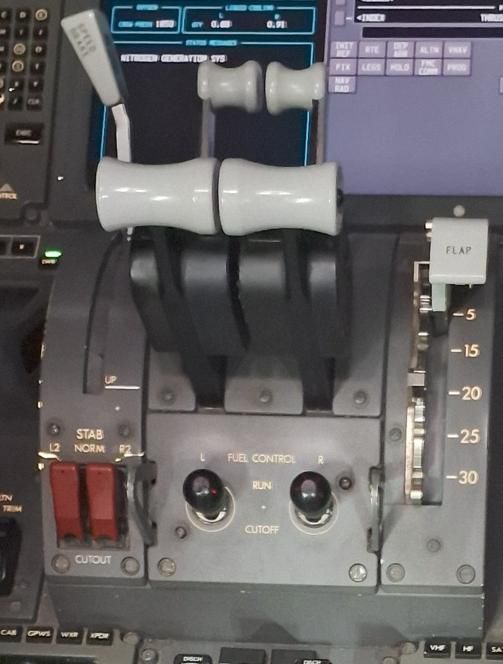
The engine fuel switches located on the central pedestal
[Reproduced from the Official Report]
Almost immediately, the cockpit voice recording showed that one of the pilots had asked the other “why did he cutoff” and received the response that “he did not do so”. Which pilot spoke in each case was not given in the report.
EAFR data showed that the ram air turbine (RAT) automatically deployed as a result of the engine-driven generators ceasing to function and “this data also showed that as both engine N2 values reduced below minimum idle speed, the RAT hydraulic pump began supplying hydraulic power” approximately eight seconds after lift-off. CCTV data showed that the aircraft had already begun to lose altitude before it crossed the airport perimeter wall (see the illustration below).
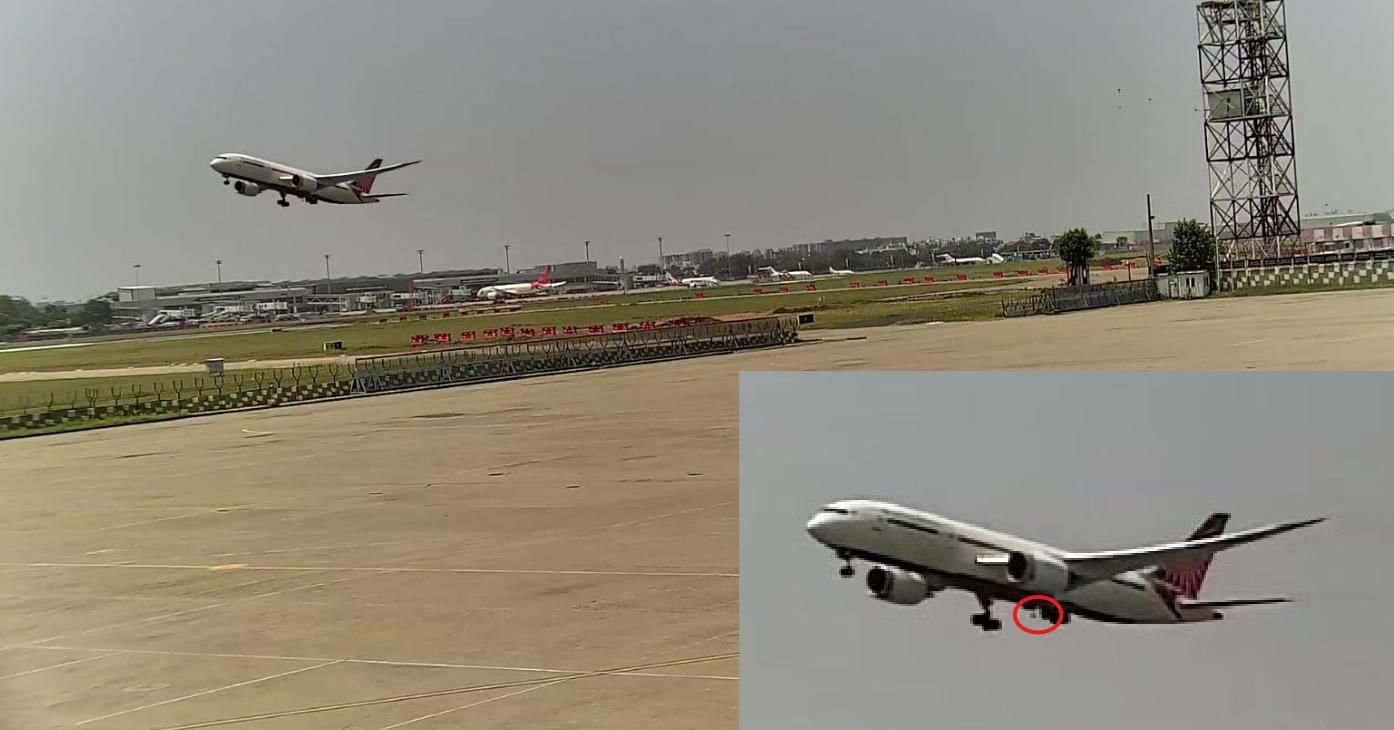
A still from recorded airport CCTV showing the RAT deployed soon after takeoff
[Reproduced from the Official Report]
Approximately thirteen seconds after liftoff, the Engine 1 fuel cutoff switch position changed from CUTOFF to RUN and after two further seconds, the auxiliary power unit (APU) inlet door began opening which indicated the APU auto start logic. The Engine 2 fuel cutoff switch position then also changed from CUTOFF to RUN.
Engine control system design was noted to mean that “when fuel control switches are moved from CUTOFF to RUN while the aircraft is in-flight, each engine’s full authority digital engine control (FADEC) automatically manages a relight and thrust recovery sequence of ignition and fuel introduction."
The data showed that once fuel feed was restored, both engines’ exhaust gas temperature (EGT) had begun to rise, indicating that the auto-relight had commenced. However, whilst “Engine 1’s core deceleration stopped, reversed and started to progress to recovery” the Engine 2 relight did not initially arrest core speed deceleration and the relight process repeatedly re-introduced fuel to increase core speed acceleration and recovery.
Thirteen seconds after the Engine 1 fuel feed had been restored, one of the pilots made a MAYDAY call without adding the callsign. After receiving the call, the tower controller looked up and “observed the aircraft crashing outside the airport boundary." At the same time, flight data recording on the recovered EAFR was found to have ceased.
The aircraft crashed onto a series of five buildings located close to the extended centreline of runway 23 approximately one mile from the departure threshold of that runway. All impacted buildings suffered major structural damage (and in some cases also fire damage) and wreckage from the aircraft and the affected buildings was distributed over an area approximately 300 metres long and 120 metres wide.
The investigation is continuing and at this stage it has been concluded that no recommended actions are judged appropriate for other operators of the aircraft type.
The Preliminary Report on which this summary is based was published on 12 July 2025.