C208, en-route, north of Dili, Timor-Leste, Indonesia, 2019
C208, en-route, north of Dili, Timor-Leste, Indonesia, 2019
Summary
On 5 December 2019, the first officer of a Cessna 208 on a scheduled Indonesian domestic passenger flight close to Timor-Leste became physically ill during normal unpressurised cruise at 10,000 feet during conversation about a family health issue. When he briefly lost consciousness, the captain declared a MAYDAY and diverted to Dili. The first officer recovered and when hospital checks were passed, the flight to the intended destination was completed. An in-depth medical investigation found no evidence of physical illness and concluded that unmanaged emotional stress had led to hyperventilation followed by a temporary incapacitation.
Flight Details
Aircraft
Type of Flight
Public Transport (Passenger)
Flight Origin
Intended Destination
Actual Destination
Take-off Commenced
Yes
Flight Airborne
Yes
Flight Completed
Yes
Phase of Flight
Cruise
Location
Approx.
32 nm north of Dili
General
Tag(s)
Copilot less than 500 hours on Type,
En-route Diversion,
Inadequate Aircraft Operator Procedures,
Delayed Accident/Incident Reporting
HF
Tag(s)
Flight Crew Incapacitation,
Stress
LOC
Tag(s)
Flight Crew Incapacitation
EPR
Tag(s)
MAYDAY declaration
Outcome
Damage or injury
No
Non-aircraft damage
No
Non-occupant Casualties
No
Off Airport Landing
No
Ditching
No
Causal Factor Group(s)
Group(s)
Aircraft Operation
Safety Recommendation(s)
Group(s)
Aircraft Operation
Investigation Type
Type
Independent
Description
On 5 December 2019, a Cessna 208B (PK-BVN) operated by Susi Air on a scheduled Indonesian domestic passenger flight from Kisar to Kupang as SQS6161 was in the cruise unpressurised at 10,000 feet in day visual conditions (VMC) when the first officer felt anxious and suffered breathing difficulty. His condition worsened, and when he lost consciousness for around 20 seconds, the captain declared a MAYDAY. A diversion to Dili was approved and completed with the first officer immediately taken to a nearby hospital for tests. These proved normal, and the flight to Kupang was resumed. The first officer was then grounded pending a more comprehensive medical assessment.
Investigation
An investigation was carried out by the Indonesian National Transportation Safety Committee (NTSC) [the Komite Nasional Keselamatan Transportasi (KNKT). The aircraft was not fitted with a cockpit voice recorder (CVR) or a flight data recorder (FDR) and was not required to be. However, the aircraft operator had contracted a flight-following service provided by ‘Blue Sky Service’ which was able to capture and transmit several parameters from each of the airline’s aircraft including altitude, heading, airspeed and position at regular intervals. For the aircraft involved, this interval was every four minutes until above 5,000 feet and then every eight minutes. The system also had a ‘Quick Position’ function to be selected in a distress or urgency situation, which reduced the position signal interval to 15 seconds and activated an aural alert in the airline’s operations control centre (OCC).
All passenger flights in the aircraft type were flown not above 10,000 feet. Although supplemental oxygen was normally available for use as required, it was not available for the investigated flight, a fact that both pilots were aware of.
The 27-year-old captain had a total of 2,170 hours flying experience, of which all but 300 hours were on type. He was an Uruguayan national who held an Uruguayan CPL (commercial pilot licence). The report says this licence had expired in 2014 but had been validated by the Indonesian CAA and endorsed with a rating to fly as a single-engine land (SEL) pilot and to do so in the Cessna 208 aircraft type. The 23-year-old first officer had a total of 599 hours flying experience of which 153 hours were on type. He was a South African national and held a current South African CPL endorsed for SEL flight which had been validated by the Indonesian CAA. His first class medical certificate from the South African CAA had been issued on 6 August 2019 with an expiry date of 28 February 2020. His Indonesian medical had been issued on 22 May 2019 and was valid for six months. This was his last medical exam before the incident.
What Happened
Prior to the incident, there was no evidence to indicate the first officer was not fully fit. This continued to be the case during the first three sectors (legs) of a four-sector duty day, and those three sectors totaled three hours and 30 minutes. The fourth sector was a return to the crew home base at Kupang. The flight departed the island of Kisar with 12 passengers and climbed uneventfully to 10,000 feet - the maximum permitted for unpressurised flight - with the first officer acting as pilot flying (PF). The planned route was as shown in the illustration below.
About 15 minutes after departure, the flight reached the planned cruise altitude of 10,000 feet and a little later, the pilots began a discussion about news the first officer had received about a health issue affecting his family and friends. This news had already caused him to feel anxiety and lose sleep when off duty. This discussion resulted in the first officer becoming anxious, and this was followed by shortness of breath. When he recalled that there was no supplemental oxygen on board, he became more anxious. The captain recognised the situation and requested descent but was told to stand by. The first officer then began to feel dizzy and evidenced shortness of breath before reporting that he was experiencing tunnel vision. This was followed by a blackout and then a loss of consciousness, which was reported to have lasted for about 20 seconds.
The captain decided to divert to Dili, which was in his view preferable to continuing as planned to Kupang. He advised air traffic control (ATC) that his first officer had experienced a heart attack and declared a MAYDAY. A descent was commenced, and the first officer regained consciousness and drank water. The captain activated the ‘Quick Position’ function to increase the rate of position reporting from the aircraft and as the descent continued, the first officer recovered. Eight minutes after descending through 6,000 feet, the aircraft landed at Dili. The first officer was taken to a hospital near the airport for a medical examination.
The medical examination established that four key markers for an underlying abnormal physical health condition - blood sugar level, blood pressure, oxygen levels in blood and heart rate - were all within normal limits. The first officer, now fully recovered, therefore declined a detailed physical examination as he considered that it would be better carried out in Kupang. The flight departed Dili for Kupang and after an uneventful flight cruising at 6,000 feet, landed there after an hour airborne.
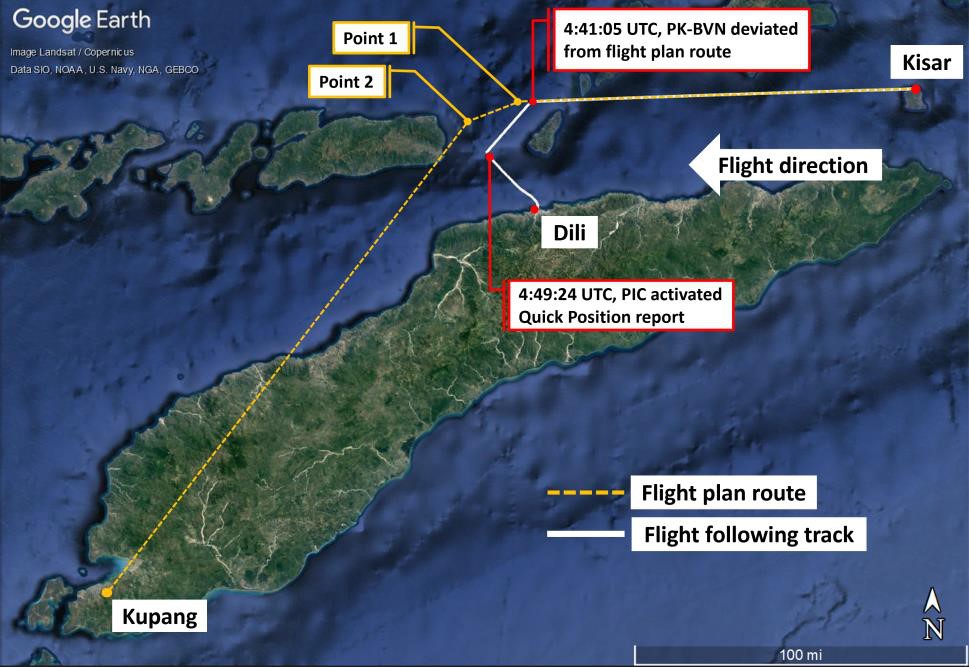
The planned track direct to Kupang and the actual diversion track to Dili. [Reproduced from the Official Report]
Why It Happened
The aircraft operator required a full medical examination, and the first officer was hospitalised. A chest X-ray was normal whilst a CT brain scan showed evidence of a slight swelling of the brain indicative of “an accumulation of fluid in the brain substance." The first officer was allowed to leave the hospital the next day and was recommended for further examinations in Jakarta. Six days later, having arrived in Jakarta, he underwent a series of medical examinations which included an MRI, a resting ECG, echocardiography, and electroencephalography, none of which found significant health issues that could have contributed to the conditions experienced during flight.
Two weeks later, the first officer was required to report to the government Aviation Medical Centre for a re-evaluation of his medical fitness. The outcome of this appointment was a referral for advanced examinations by an ear, nose and throat specialist, a neurologist, and a psychiatrist. The first two specialists made no significant finding and considered the first officer fit to return to flying duties. The psychiatric examination included the psychiatrist asking the first officer “to repeatedly discuss the same health issue topic which had been discussed during the occurrence flight." The first officer “stated to the psychiatrist that he had since been able to manage his emotions while discussing the same health issue." Based on this psychiatric examination, the psychiatrist concluded that the first officer was “mentally fit for flying duty” and in the light of these assessments, this was approved.
The investigation noted that whilst the operator’s documentation (and the relevant Indonesian DGCA Regulations) included the requirement to report any serious incident to the KNKT “as soon as possible," the KNKT had remained unaware of the event until it received a report from the Ministry of Foreign Affairs five days after it had occurred. Susi Air was then contacted but took a further three days to officially report what had happened. It was also observed that the operator’s documentation on reporting did not provide its employees with guidance on what constituted a serious incident even though such guidance, (based on ICAO Annex 13) was provided in the relevant DGCA content.
The Key Findings of the investigation in respect of the first officer’s transient incapacitation were recorded as:
- Emotional stress such as anxiety was followed by hyperventilation. The shortness of breath during hyperventilation in a reduced air density environment then caused the first officer to experience tunnel vision and loss of consciousness.
- The unmanaged emotional stress which led to this hyperventilation whilst flying in a reduced air density environment appeared to have led to his temporary incapacitation.
The Conclusion of the Investigation was that “the unmanaged emotional stress which led to hyperventilation while flying in a lower air density environment might have caused the [first officer] to become incapacitated”.
Two Safety Recommendations were made at the conclusion of the Investigation as follows:
- that Susi Air, in the absence of any notified safety actions taken in response to a safety recommendation made to the company in the interim report published on 22 January 2020 detailing progress with the investigation, should - as originally recommended - “review and amend the procedure for occurrence reporting to ensure that a serious incident can be identified and reported to the KNKT by the most suitable and quickest means available” and detail the action taken. [04.O-2019-30.01]
- that Susi Air make its flight crew aware that an unmanaged emotional stress condition while flying in a (reduced) air density environment could lead to hyperventilation which might lead to pilot incapacitation. [04.O-2019-30.02]
The Final Report of the investigation was published on 30 March 2023.