CRJ9, Toronto International Canada, 2025
CRJ9, Toronto International Canada, 2025
Summary
On 17 February 2025 a Mitsubishi (formerly Bombardier) CRJ-900LR was on final approach to Toronto International and touched down at a high rate of descent on the right main landing gear, which collapsed inwards. This caused the right wing to break from the fuselage, which then rolled inverted, detaching the tailplane. The fuselage slid for some distance before stopping, complicating the evacuation. A fuel-fed fire immediately ignited around the right wing/fuselage attachment point but all 80 occupants escaped, almost all using just two exits. There were only two serious injuries and 19 minor injuries.
Flight Details
Aircraft
Operator
Type of Flight
Public Transport (Passenger)
Flight Origin
Intended Destination
Take-off Commenced
Yes
Flight Airborne
Yes
Flight Completed
No
Phase of Flight
Landing
Location - Airport
Airport
General
Tag(s)
Approach Unstabilised after Gate-no GA,
Copilot less than 500 hours on Type
CFIT
Tag(s)
IFR flight plan
FIRE
Tag(s)
Post Crash Fire
HF
Tag(s)
Inappropriate crew response - skills deficiency
LOC
Tag(s)
Hard landing
RE
Tag(s)
Off side of Runway
EPR
Tag(s)
Emergency Evacuation,
RFFS Hazard to Evacuees,
Evacuation Injuries
Outcome
Damage or injury
Yes
Aircraft damage
Hull loss
Non-aircraft damage
No
Non-occupant Casualties
No
Occupant Injuries
Many occupants
Occupant Fatalities
None
Off Airport Landing
No
Ditching
No
Causal Factor Group(s)
Group(s)
Aircraft Operation
Safety Recommendation(s)
Group(s)
None Made
Investigation Type
Type
Independent
Description
On 17 February 2025 a Mitsubishi (formerly Bombardier) CRJ-900LR (N932XJ) operated by wholly-owned Delta Air Lines subsidiary Endeavor Air on a scheduled Delta Connection passenger flight from Minneapolis-Saint Paul to Toronto as DL4819 crashed on landing following an instrument landing system (ILS) approach in day instrument meteorological conditions (IMC). The aircraft was destroyed by impact forces and fire. With difficulty, all 80 occupants managed to escape through useable exits in the inverted fuselage with two seriously injured and 19 sustaining minor injuries.
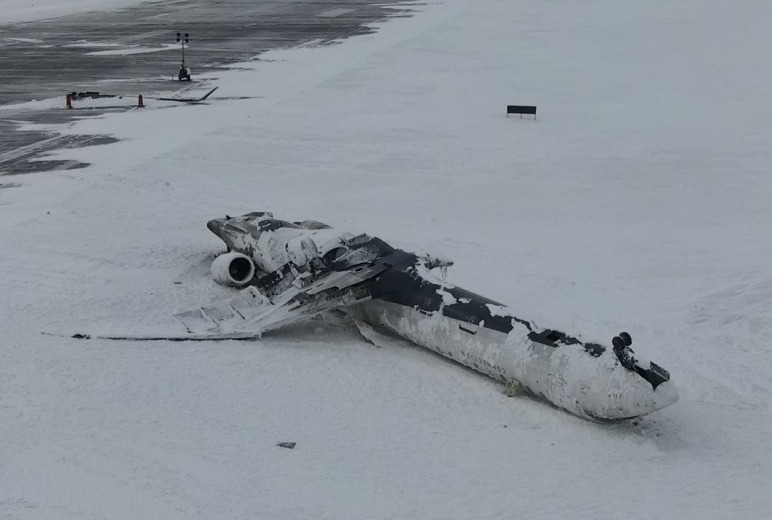
The aircraft wreckage with the detached wing in the background on Runway 23
[Reproduced from the Preliminary Report]
Investigation
An Accident Investigation by the Transportation Safety Board (TSB) of Canada has commenced and relevant data have been recovered from both the flight data recorder (FDR) and the cockpit voice recorder (CVR). Work is continuing to extract useful data from the non-volatile memory (NVM) of the following equipment:
- The quick-access recorder (QAR)
- The central maintenance computer (CMC)
- The Enhanced Ground Proximity Warning System (EGPWS)
- The Stall Protection Computer
- The CVR g-switch
- The radio altimeter components including the antennae
- The two spoiler stabiliser control units
- The two flap/slat control units
- The proximity sensor electronic unit
The captain had a total of about 3,570 hours flying experience, of which 764 hours were on type and was acting as pilot monitoring (PM) for the accident flight. The PF first officer had a total of 1,422 hours flying experience, of which 418 hours were on type and she had flown 56 hours over the previous 30 days.
What Happened
The flight proceeded normally until the final stages of the ILS approach to destination Runway 23. The VREF for the approach was 139 knots, which meant that according to CRJ operating procedures, the final approach speed should be VREF+5 which was set correctly. It was noted that “when operating in gusty wind conditions," which had applied to the approach, the approach speed must be increased by half of the gust factor to a maximum of 10 knots. The approach reference speed used was therefore 149 knots, which was coincident with the top of the speed bug when set to 144 knots.
As the aircraft descended through 500 feet agl on the ILS glide slope, the recorded airspeed was 150 knots and groundspeed was 121 knots. Thrust was remained at approximately 64% N1, and the rate of descent was 720 fpm. Five seconds later, the PF disconnected the autopilot (AP). Twenty five seconds later, as the aircraft descended through 175 feet agl, data showed a 672 fpm rate of descent at 144 KCAS with the thrust unchanged.
However, four seconds later, as the aircraft descended through 153 feet agl, the airspeed increased to 154 KCAS. Over the following five seconds, the PF responded by significantly retarding the thrust levers from 64% N1 to approximately 43% N1 where they remained for almost 9 seconds until touchdown. At 50 feet agl, with just under 4 seconds to go until touchdown, airspeed was 145 KIAS but the rate of descent had increased to a recorded 1,114 fpm. One second after passing 50 feet agl - 2.6 seconds before touchdown - an EGPWS Mode 1 ‘SINK RATE' warning was annunciated and wings level changed to almost 5° right wing down. With just under 2 seconds to go until touchdown, the aircraft’s indicated airspeed was 136 knots, and its ground speed was 111 knots. The aircraft was slightly below the glide slope, the rate of descent was 1,072 fpm and right bank had reached almost 6°. Less than 1 second before touchdown, with the airspeed almost unchanged, the right bank had increased to 7° and rate of descent had reached over 1,100 fpm with a 1° nose up pitch. The right main landing gear then contacted the runway at a recorded vertical acceleration of 3g about 420 feet past the threshold with right bank now 7.5°.
The right main landing gear side-stay fractured and the gear folded inwards to the retracted position. As the wingtip touched the runway surface, “the wing root fractured between the fuselage and the landing gear and the wing detached from the fuselage” which released “a cloud of jet fuel," which immediately ignited (the fuel remaining in both wing tanks was approximately 6 tonnes). The aircraft fuselage began to slide along the runway and, minus the right wing, rolled to the right until it became inverted. Most of the tail structure was detached during this roll, and the fuselage departed the runway to the right and crossed a snow-covered grass area. The fuselage came to a stop on the intersecting Runway 15L near its intersection with Runway 23 and about 23 metres beyond the right edge of that runway (see the illustration below).
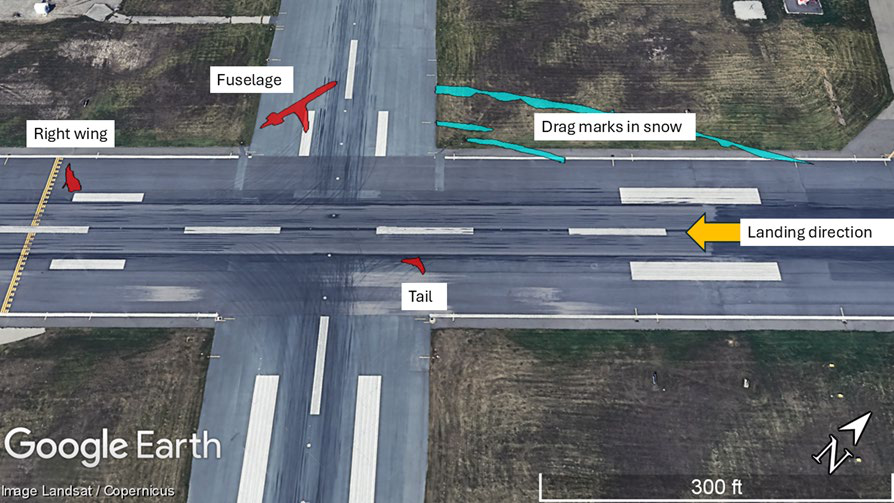
The fuselage trajectory and final position after the right wing detached and it rolled inverted also showing the resting positions of the tail and right wing
[Reproduced from the Preliminary Report]
The emergency locator transmitter (ELT) was armed but did not activate, and the transmitter and associated components will be the subject of further examination during the Investigation.
The Emergency Evacuation
Airport rescue and firefighting services (RFFS) vehicles reached the site “approximately 5 minutes after the accident." The inverted fuselage meant that everyone was “hanging upside down in their seats” suspended by their seat belts, with many of the carry-on baggage and other items on the aircraft ceiling. Some passengers found it difficult to undo their seat belts and having done so, some were injured as they fell to the cabin ceiling.
Passengers and cabin crew in the rear of the aircraft had already begun evacuating. One passenger tried to use the forward emergency overwing exit on the starboard side of the fuselage at seat 12D, but fuel was flowing over that exit door. Most rear-fuselage occupants evacuated through the exit adjacent to seat 13D - whilst those further forward escaped through the forward right exit. Some of those exiting via the 13D exit “got covered in fuel” whilst others were “sprayed by fire retardant foam from an RFFS vehicle”.
The two pilots were unable to open the flight deck door due to “deformation of the forward fuselage” and the position of the cabin crew jump seat position. As a result, they used the escape hatch in the flight deck ceiling. The inverted position of the fuselage meant the escape hatch opening was close to the ground and partially obstructed (see the illustration below). However, with help from a passenger, the pilots were both able to exit.
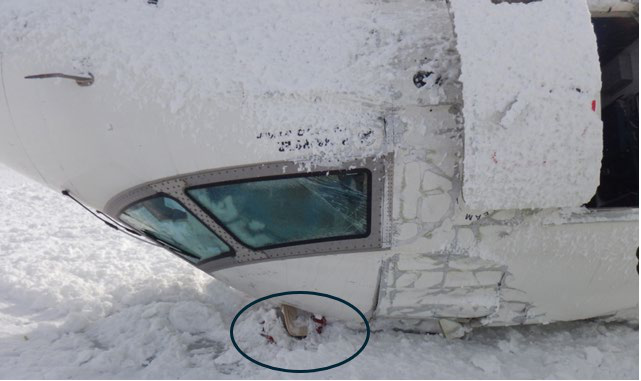
The partially blocked flight deck escape hatch
[Reproduced from the Preliminary Report]
The recorded surface wind direction at the airport for 13 minutes before the accident was 270°T. and the wind speed was 28-35 knots.
To date, no pre-existing abnormalities have been found with the landing gear, flight controls, wing structure or engines. However, as the Investigation continues, the following non-exhaustive list of subjects (which may be extended) represents “the current areas of focus”:
- A metallurgical examination of the wing structure
- Certification (landing gear and wing structure)
- Evacuation / egress procedures
- Flight deck door structure and design
- Landing techniques, hard landings, and pilot training
- Cabin obstructions and impediments once inverted
- Flight deck secondary egress route
- Organisational and management factors
- Cabin crew training
- Coordination in emergencies
- The RFFS and emergency medical response
A Preliminary Report of the investigation so far was released 20 March 2025. The following caveat was included in it:
“Information on the progress of the Investigation contains facts ascertained up to the date of release. The information in the report may be incomplete or change in the course of the investigation and new information may be obtained after this Preliminary Report is published.”
Entirely separate from the investigation, an observer video of the final stages of the approach, touchdown and destruction of the airframe is available here.