E190, vicinity Honiara Solomon Islands, 2024
E190, vicinity Honiara Solomon Islands, 2024
Summary
On 23 February 2024, an Embraer E190 lost airspeed during initial climb after departing Honiara without either pilot initially noticing it. When one did notice, the response, a partial flap retraction, increased the loss of control risk. But the other pilot then realised what corrective action was required and took it. The origin of the problem was found to have been pilot error in preflight guidance panel setup, and delayed recognition of the consequences after takeoff. The underlying origin of the circumstances encountered was assessed as inappropriate preflight standard operating procedures and inconsistency in the content of two Embraer manuals.
Flight Details
Aircraft
Operator
Type of Flight
Public Transport (Passenger)
Flight Origin
Intended Destination
Take-off Commenced
Yes
Flight Airborne
Yes
Flight Completed
Yes
Phase of Flight
Climb
Location - Airport
Airport
General
Tag(s)
Deficient Crew Knowledge-automation,
Inadequate Aircraft Operator Procedures,
Inadequate Airworthiness Procedures
HF
Tag(s)
Pre Flight Data Input Error,
Inappropriate crew response (automatics),
Ineffective Monitoring,
Procedural non compliance,
Ineffective Monitoring - SIC as PF
LOC
Tag(s)
Flight Management Error,
Incorrect Aircraft Configuration
Outcome
Damage or injury
No
Non-aircraft damage
No
Non-occupant Casualties
No
Off Airport Landing
No
Ditching
No
Causal Factor Group(s)
Group(s)
Aircraft Operation
Safety Recommendation(s)
Group(s)
None Made
Investigation Type
Type
Independent
Description
On 23 February 2024, an Embraer ERJ 190 (VH-UYI) operated by Australian carrier Alliance Airlines for Solomon Airlines on a scheduled passenger flight from Honiara to Brisbane as IE700 lost airspeed during initial climb in day visual meteorological conditions (VMC) and in uncontrolled airspace without either pilot initially noticing. When one of them did notice, the response, partially retracting the flaps, worsened the low-speed risk. The other pilot then recognised the source of the problem and acted accordingly to recover the aircraft from a low-speed state.
Investigation
An investigation was carried out by the Australian Transport Safety Bureau (ATSB). Data from the quick-access recorder (QAR) was available to support the accounts given by the flight crew. The captain had 17,000 hours flying experience, and the first officer 13,000 hours, but aircraft type experience was not given for either pilot.
What Happened
The operator’s preflight procedures required the captain to set the speed knob to manual mode. (These procedures were required to be completed ahead of the ‘Before Start’ procedures). This defaulted the system to a target speed setting of 80 knots. Before beginning the ‘Before Start’ checklist, the pilot monitoring (PM) captain was then required to action the 'Before Start' flow. This included setting the speed mode to the recommended flight management system (FMS) mode, which the crew intended to use once the flight director (FD) was activated. However, setting of the FMS speed mode was unintentionally omitted. This went undetected by both pilots, which meant the speed mode selection remained in manual.
(On the ERJ 190, the speed mode selector is a two-position circular switch mounted as a "ring" assembly around the speed set knob. The two mode selections are FMS and MAN. In FMS mode, speed selections change automatically based on FMS data, and this setting is most commonly used on takeoff.)
A flaps 4 takeoff using takeoff/go-around (TO/GA) thrust from the 2,200 metre-long runway followed, with the FMS takeoff mode armed so that the first officer could view the required pitch attitude to follow during rotation and initial climb. Once the aircraft rotated, the control logic automatically changed the target speed to V1, which was 125 knots. This speed was displayed on the primary flight displays (PFDs) but was not detected by either pilot. The first officer manually followed the FD guidance for pitch attitude, and the aircraft initially maintained an airspeed of approximately V2 + 10 (144 knots).
However, when the first officer engaged the autopilot (AP) passing approximately 1,000 feet, followed by selecting the 'Vertical Flight Level Change' speed mode when passing approximately 1,200 feet, the FD began to pitch for the manual target speed, which was still 125 knots. A few seconds later, the aircraft began a 25° left turn in accordance with the standard instrument departure (SID) at about the same time as the first officer reduced the power from TOGA power to CLIMB power. At this time, the captain reported having “diverted their attention to visually assessing weather on the departure route and monitoring the TCAS for other aircraft." For the next 20 seconds, the speed gradually reduced whilst the captain made a departure broadcast on the common traffic advisory frequency (CTAF).
The captain subsequently recalled that the aircraft had felt ‘draggy,’ which led the crew to check their PFDs and see that the airspeed was around 134 knots and that the aircraft was not accelerating. The captain instructed the first officer to roll out of the turn to reduce drag. This instruction was not followed, possibly because the FO assumed the call to roll out was related to the weather ahead, which the FO was not concerned about.
The captain then told the first officer the aircraft was “not accelerating.” Not yet realizing the source of the speed problem, the captain retracted the flaps from 4 to 3 (which also takes the slats from 25° to 15°) to further reduce drag. The first officer remembered that the captain had announced selecting flap 3 but saw that the speed had continued to drop. The first officer stated that they had the noticed the amber pitch limit indicator and alerted the captain. The FO then decided to change the speed mode from ‘FMS’ to ‘Manual’ in order to increase the airspeed. But when the FO was about to do this, they saw that the speed selector knob was already in manual mode and so changed it to ‘FMS’ mode. This action occurred 21 seconds after the flap setting was changed from 4 to 3. Once the speed mode was set to ‘FMS’, the aircraft began to accelerate to the correct target speed of 190 knots.
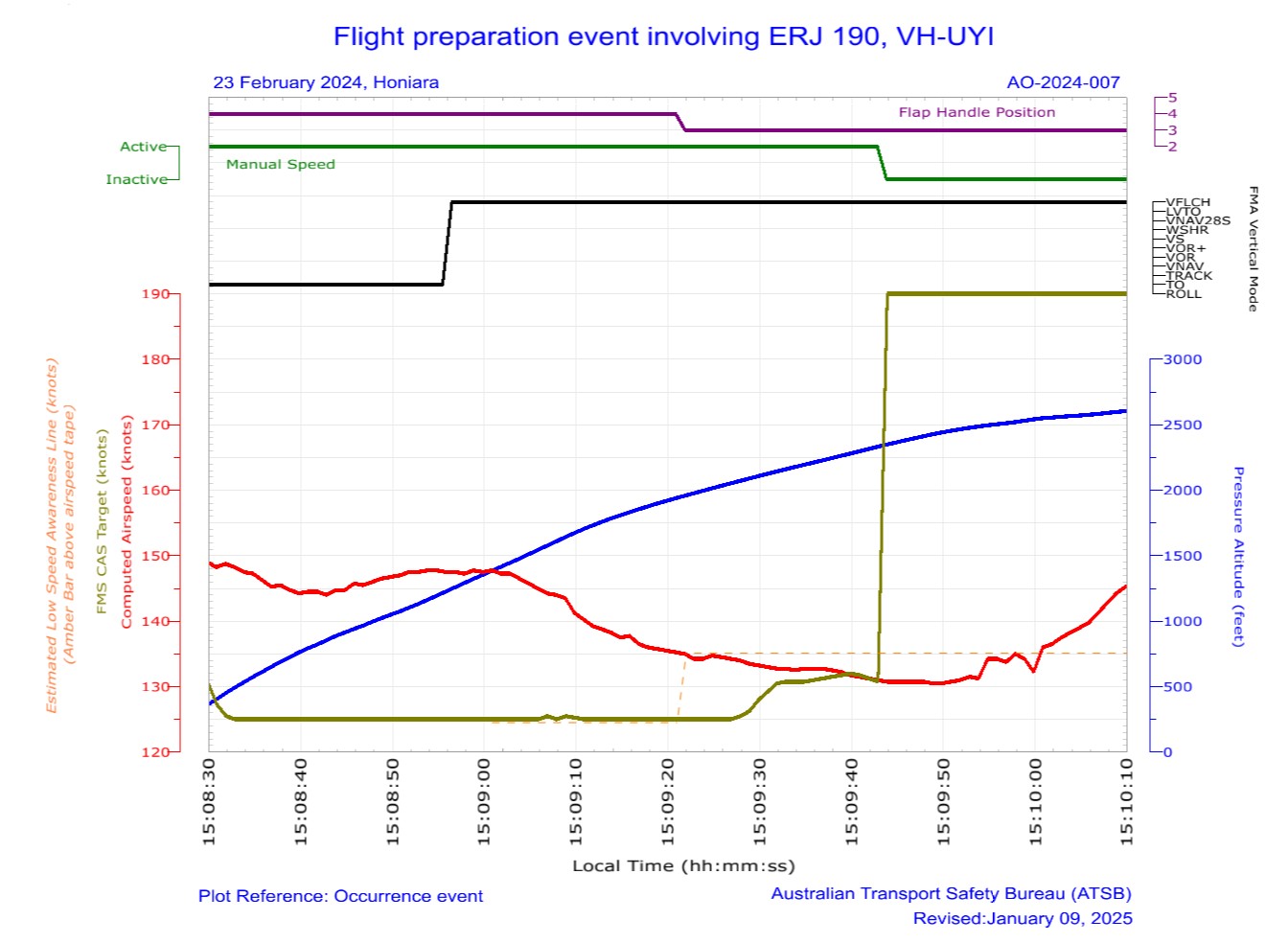
The loss of airspeed consequent upon incorrect speed mode setting. [Reproduced from the Official Report]
It was found that a number of parameters of potential interest to the investigation were not recorded on the QAR. These included stall speed, the low-speed awareness (LSA) indicator, and the pitch limit indicators (PLIs), but Embraer provided equivalent calculations based on the QAR data. These data showed that prior to the flap lever retraction from 4 to 3, the top of the amber band on the LSA was 124.5 knots. When the slats retracted 20 knots prior to the target speed (F-bug), the upper value of the amber LSA indicator had increased to 135.1 knots.
Why It Happened
The underlying origin of the problem was identified as the aircraft operator’s mode selection procedures. Embraer had provided two relevant guidance documents, the aircraft operating manual (AOM) and the standard operating procedures manual (SOPM). These stated that “the intention of the AOM is to gather all the information related to the operation of the aircraft," while SOPM “is generated to provide operational guidance (it is our way of operating the aircraft)." Embraer stated that “as long as the AOM or SOPM is followed in full, no undesirable results will occur." However, Embraer also stressed that since an operator must produce their own operating procedures and receive regulatory approval for their use, the SOPM is provided as a starting point and not necessarily an end point. This means that operators can “add or change some points using information from the AOM, or even mix some internal operational information” before seeking approval.
It was found that “unlike the AOM, the SOPM did not have a requirement to set the speed selector knob to manual in the Before Start procedures." The first SOPM reference to the speed selector knob was in the ‘Shortly Before Start Procedures’ which required the left seat pilot to set it at pilot’s discretion whilst recommending FMS speed. Embraer advised that there was “no need to set the speed to MANUAL preflight, because once the necessary data is entered into the FMS, the correct speed target will be automatically set, provided that the selector is in FMS SPEEDS." They also noted that the AOM reference to setting the speed selector to manual “is not included in our SOPM and is not taught in our original equipment manufacturer (OEM) training because SOPM procedures are followed instead."
Alliance Airlines had chosen to split the ‘Before Start’ procedures into separate ‘Preflight’ and ‘Before Start’ procedures and “alignment with the manufacturer’s AOM, meant that their preflight procedures required the speed selector knob to be set to manual mode." Alliance reportedly “understood this step was required to clear any previously set FMS speeds.” However, the avionics OEM advised the investigation that there was no mandatory requirement to set the speed selector to manual and that doing so does not reset the previous autospeed target, rather “the previous flight information is cleared two minutes after landing."
A review of the aircraft operator’s procedures found that “they did not have a requirement for the speed mode to be set to manual during Preflight, Before Start or Shut Down procedures” which if followed would have meant that the speed mode would remain in FMS speed mode for all flight phases. This corresponded to the situation at another E190 operator whose procedures were examined. It was also found that the operator had included a verbal check of speed settings (FMS or Manual) in the operations manual (OM) as part of their FMS Performance Review prior to every flight.
QAR data collected by Alliance Airlines was used to inform a review of all flights operated in manual speed. The data showed that over a 30-month period, 254 flights were identified where manual speed was used. In 76 of these events, the crew changed the speed selector setting during the takeoff run, increasing the risk of distraction during a critical phase of flight. The airline also said that in a review of the last 50 events where speed had not been set correctly, 38 individual captains were involved, operating from a range of different bases.
A “Safety Analysis” was made of the operator’s pilots’ practices in respect of the setting and monitoring modes, speeds, and flap retraction speeds with reference to both Embraer and Alliance Airlines documentation including examining similar occurrences at the airline.
This work led to the identification of the following six Contributing Factors to the investigated event and their formal documentation. Three of these factors were additionally classified as safety issues and are identified as such:
- During the Before Start procedure, the captain unintentionally left the speed selector knob in manual mode instead of flight management system mode, with no manual speed set. This incorrect manual speed mode selection was not then detected by either pilot prior to takeoff, which resulted in the aircraft decelerating after the vertical flight level change mode was engaged.
- While the captain was monitoring traffic, weather and making a radio broadcast, the first officer was not effectively monitoring the airspeed and, as a result, did not initially detect the aircraft decelerating.
- Having assessed that the low airspeed was due to excessive drag, the captain retracted one stage of flap while below the minimum flap target speed, resulting in the aircraft entering a low-speed state.
- Embraer's Aircraft Operations Manual was inconsistent with its Standard Operating Procedures Manual regarding speed mode selection. This increased the risk of flights departing with the manual speed mode unintentionally selected. [Safety Issue AO-2024-007-SI-06]
- Alliance Airlines’ preflight procedure, which was consistent with Embraer's Aircraft Operations Manual, required pilots to unnecessarily initially set the speed knob to ‘manual.' This increased the risk of the aircraft departing with the incorrect speed mode selected. [Safety Issue AO-2024-007-SI-05]
- Alliance Airlines’ ‘Before Start’ procedures and the review of the ‘Pre-takeoff Brief’ were not being performed effectively enough to ensure the speed selector knob was correctly set and checked, which increased the risk of a low-speed event after takeoff. This was likely due to a training deficiency. [Safety Issue AO-2024-007-SI-04]
Two Other Factors That Increased Risk were also formally documented, one of which was classified as a Safety Issue and is identified below:
- Alliance Airlines’ right-seat pilot shutdown flow was undocumented and not in accordance with the manufacturer’s guidance.
- Alliance Airlines’ flight crews were regularly changing the speed selector knob setting during the take-off run. This was contrary to Embraer's guidance and Alliance Airlines’ own Standard Operating Procedures Manual. This increased the risk of distraction during a critical phase of flight. [Safety Issue AO-2024-007-SI-03]
Three of the above-identified Safety Issues were noted as having already been addressed and were therefore closed prior to the publication of the Investigation Report. In respect of the fourth (AO-2024-007-SI-06), Embraer advised that it intended to harmonise the contents of the Aircraft OM and its SOP Manual in the first half of 2025 which, when completed, would be accepted by the ATSB as a satisfactory closure of the corresponding Safety Issue.
It was determined that the overall Safety Message from the investigation was how important continuous attention to the modes displayed on the PFD is to situational awareness. It was noted that an ICAO Safety Advisory Circular on the subject of Mode Awareness and Energy State Management Aspects of Flight Deck Automation states that “loss of mode awareness and mode confusion have been identified as factors in several major accidents around the world." It was noted that mode confusion can often result in flight crew mismanagement of an aircraft energy state, such as the low-speed state that occurred in this event. The referenced ICAO Circular recommends that at any time an aircraft does not follow the desired vertical or lateral flight path or airspeed, flight crew should adapt the level of automation in use to the task and/or circumstances or revert to hand flying or manual thrust/throttle control, if required. The same circular also identified inadequate training and systems knowledge as a key factor contributing to mode confusion. In the case of this investigated event, it is considered that training in the quick identification of mode indications, including speed display colours during pre-takeoff checks, would reduce the likelihood of a similar occurrence.
The Final Report was published on 3 April 2025. No Safety Recommendations were made.
Related Articles
- Loss of Control
- Standard Operating Procedures (SOPs)
- Upset Prevention and Recovery Training (UPRT)
- Flight Management System
- Pre-flight Preparation
Further Reading
- Mode Awareness and Energy State Management Aspects of Flight Deck Automation, ICAO RASG-PA, November 2022