E75L, Yamagata, Japan, 2019
E75L, Yamagata, Japan, 2019
Summary
On 23 April 2019, the captain of an Embraer E170 which had just begun its standing takeoff at Yamagata, Japan, was unable to correct a deviation from the centreline and initiated a rejected takeoff at around 50 knots. This action was not immediately followed by maximum braking as required by company procedure for a rejected takeoff. The aircraft departed the side of the runway and continued on grass for almost 400 metres before stopping. The nose wheel steering system was found to be defective.
Flight Details
Aircraft
Operator
Type of Flight
Public Transport (Passenger)
Flight Origin
Intended Destination
Take-off Commenced
Yes
Flight Airborne
No
Flight Completed
No
Phase of Flight
Take Off
Location - Airport
Airport
HF
Tag(s)
Inappropriate crew response (technical fault),
Procedural non compliance
RE
Tag(s)
Off side of Runway,
Ineffective Use of Retardation Methods
AW
System(s)
Landing Gear
Contributor(s)
Component Fault in service
Outcome
Damage or injury
Yes
Aircraft damage
Minor
Non-aircraft damage
Yes
Non-occupant Casualties
No
Off Airport Landing
No
Ditching
No
Causal Factor Group(s)
Group(s)
Aircraft Operation
Aircraft Technical
Safety Recommendation(s)
Group(s)
None Made
Investigation Type
Type
Independent
Description
On 23 April 2019, an Embraer E170-200LR (JA11FJ) operated by Fuji Dream on a scheduled domestic passenger flight from Yamagata to Nagoya as JH386 departed the side of runway 19 in day visual meteorological conditions (VMC) after an unsuccessful attempt to correct a deviation from centreline. The rejected takeoff was initiated at around 50 knots and was not followed by braking, so the aircraft departed the side of the runway and continued for almost 400 metres on grass until it came to a stop abeam a point 660 metres from the start of the 2,000 metre-long runway. The aircraft nose landing gear and the lower fuselage were damaged, and the aircraft struck one of the four lights of the precision approach path indicator (PAPI).
Investigation
After prompt notification, the Japan Transport Safety Board (JTSB) began a serious incident investigation the following day. Recorded data from the quick-access recorder (QAR) and cockpit voice recorder (CVR) were downloaded and contained useful information. Relevant meteorological data and recorded radio communications between the flight crew and the airport air/ground officer on duty were also available. It was noted that the 41-year-old captain, who was acting as pilot flying (PF), had a total of 5,222 hours flying experience, all but 248 hours on type. The 49-year-old first officer had a total of 8,534 hours flying experience, including 6,444 hours on type.
What Happened
The captain received the surface wind as 070° at 13 knots and decided that, with the slight tailwind component when using the 2,000-metre-long 45-metre-wide runway 19, the runway would meet performance requirements.
Taxiing from the apron to join the runway and then backtracking before making a 180° turn at the runway end was uneventful, and the nosewheel steering system functioned normally. Once lined up, the captain increased engine thrust up to 40% N1 against the brakes and, having confirmed both engines were stable, released the brakes and set the thrust levers to the required takeoff position.
Soon after the aircraft began to move, it began to track away from the runway centreline. The captain reported that he thought the aircraft might be subject to a weathercock effect due to the small left crosswind component and tried to correct the direction by pressing the right rudder pedal. However, this had no effect even at maximum rudder pedal input. After checking the engine instruments to confirm that the takeoff thrust had been set normally, the first officer saw the aircraft was deviating to the left and when the captain called “rudder," the first officer found the rudder pedal was already at full travel but had no effect.
Approximately eight seconds after beginning the takeoff with the aircraft having travelled just over 130 metres with the airspeed increasing through 50 knots, the captain moved the thrust levers to reverse but no braking followed despite the aircraft’s continuing towards the runway edge. The captain subsequently explained that he did not apply the brakes “because he judged that running off the runway would be unavoidable and he was afraid the aircraft’s attitude might be unstable after running off." After a further eight seconds (see the illustration below) the aircraft then departed the runway and collided with one of the four PAPI lights located just under 400 metres from the beginning of the runway which, with no functioning nosewheel steering, could not be avoided. The aircraft came to a stop after 42 seconds from the start of the takeoff 65 metres to the left of the runway centreline at a position 660 metres from the beginning of the runway.
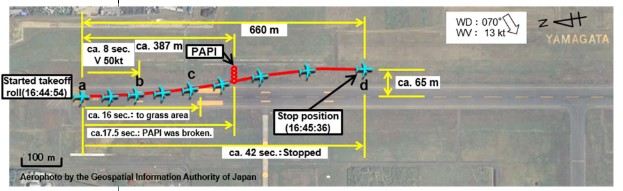
The aircraft ground track before and after it left the runway
[Reproduced from the Official Report]
Why It Happened
With directional control unavailable using rudder pedals, the only way to make the required correction was differential braking or differential thrust but neither was attempted. Maximum braking was not applied. Embraer advised that the distance required to bring the aircraft to a stop when accelerating through 50 KIAS and adding maximum braking and full reverse thrust would have been approximately 85 metres on a hard surface whereas the actual distance travelled from that point was approximately 140 metres.
On the E170, handle steering mode is activated by pressing down on the nose wheel steering handle. Rudder pedal steering is normally activated when the steering handle is released.
QAR data showed that although the steering handle had been released from the push-down position (see the steering system controls illustrated below) after the aircraft had been turned through 180° at the end of the runway, the steering system had remained in handle steering mode. The report noted that there is no direct indication to notify the pilots of whether steering is in the handle mode or pedal mode.
The reason why the release of the push-to-use steering handle did not automatically re-activate rudder steering mode was found to be because the microswitch in the handle which actions this change had failed. Use of a digital microscope to examine the disassembled microswitch showed that “very small amounts fine metal particles and (nearby) fibrous material were observed near the contact points."
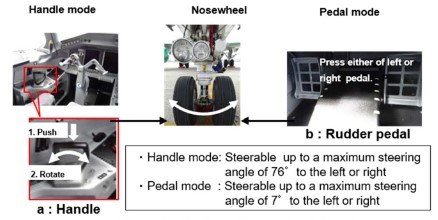
The nose wheel steering system
[Reproduced from the Official Report]
The investigation noted that the Embraer-prepared rejected takeoff training scenario did not specify from what point (i.e. speed) this scenario should begin, but the airline had used only the high-speed case on the basis of “training effectiveness." However, it was also noted that in the airline’s supplementary “Operating Information” it was stated that “flight crew can certainly recognise abnormality of the steering mode....before starting (the) takeoff roll by confirming the aircraft will not move to the left and right while rotating the handle to (the) left and right without pushing down on it." However, it was recognised by the investigation that “the workload of flight crew just before a takeoff would likely be increased by this additional procedure."
The Probable Cause of this serious incident was recorded as an inability to control nosewheel steering with pedal mode during the start of the takeoff roll. The report also said, "it is highly probable that because there was an abnormality in the microswitch inside the handle, the steering mode stayed in the handle mode." The report added, "the cause of the microswitch failure could not be determined."
Safety Action taken as a result of the event and known to the investigation included but was not limited to the following:
Fuji Dream Airlines
- Provided their pilots with information on the design of the steering system and the necessary response if an abnormality should occur.
- Added ‘rejected takeoff at low speed’ to recurrent pilot training.
Embraer revised the procedure for the operational check of the flight control system to add a requirement to confirm that the EICAS message ‘STEER OFF’ is displayed after pushing the steering disengage switch to disengage rudder steering mode before beginning the check.
The Final Report was adopted by the JTSB on 8 October 2021 and published on 28 October 2021. No Safety Recommendations were made.
Related Articles