EC225, vicinity Dokdo South Korea, 2019
EC225, vicinity Dokdo South Korea, 2019
Summary
On 31 October 2019, an Airbus Helicopters EC225LP departing a helipad at Dokdo, South Korea, at night crashed into the sea after the pilot became spatially disoriented and did not respond to alerts from both the travelling engineer and the copilot to the unintended descending flight path. All seven occupants were killed and the helicopter was destroyed. The absence of a departure briefing was assessed as contributory. However, findings on the underlying context for the accident involved procedural and training issues regarding the operational regime for emergency medical flights.
Flight Details
Type of Flight
Public Transport (Non Revenue)
Take-off Commenced
Yes
Flight Airborne
Yes
Flight Completed
No
Phase of Flight
Climb
Location
General
Tag(s)
Copilot less than 500 hours on Type,
Helicopter Involved,
Inadequate Aircraft Operator Procedures,
PIC less than 500 hours in Command on Type
CFIT
Tag(s)
Into water,
No Visual Reference,
Vertical navigation error,
VFR flight plan
HF
Tag(s)
Inappropriate crew response - skills deficiency,
Inappropriate crew response (automatics),
Manual Handling,
Procedural non compliance,
Spatial Disorientation
Outcome
Damage or injury
Yes
Aircraft damage
Hull loss
Non-aircraft damage
No
Non-occupant Casualties
No
Occupant Fatalities
Most or all occupants
Number of Occupant Fatalities
7
Off Airport Landing
No
Ditching
No
Causal Factor Group(s)
Group(s)
Aircraft Operation
Safety Recommendation(s)
Group(s)
Aircraft Operation
Airport Management
Investigation Type
Type
Independent
Description
On 31 October 2019, an Airbus Helicopters EC225LP (HL9619) operated by Korean National 119 Rescue Headquarters had just taken off from the Dokdo Helipad for Daegu in night visual meteorological conditions (VMC) after picking up a casualty and an accompanying colleague for transport to a hospital when it impacted the sea and was destroyed. All seven occupants were killed.
Investigation
An investigation was carried out by the Korea Aviation and Railway Accident Investigation Board (ARAIB). The combined voice and flight data recorder (CVFDR) was submerged in the wreckage at a depth of 250 feet and was eventually recovered three weeks after the accident along with the enhanced ground proximity warning system (EGPWS). Both were sent to the French BEA for data extraction and analysis. All wreckage was also recovered to support the investigation.
The 46-year old pilot held a CPL (commercial pilot licence) and had 3,827 hours flying experience including 444 hours on type, of which four hours had been flown in the 30 days prior to the accident. After joining the National 119 Rescue Headquarters in May 2015, his initial type training had been on the AS65. The following year, he had then received type training on EC225 provided by the aircraft manufacturer in France and in February 2019 had also received ‘Safety Training for Private/Public Helicopter Operations’ from the Korean Air Force. The 39-year-old copilot also held a CPL and was rated on type. He had 2,666 hours flying experience, including 307 hours on type of which two hours had been flown in the 30 days prior to the accident. A 45-year-old aircraft mechanic, a 31-year-old rescue worker and a 29-year-old paramedic, all fully trained and qualified, were onboard as rear crew.
What Happened
Two-and-a-half hours prior to the accident, the police post on one of Dokdo’s two main islands (Dongdo - East Island and Seodo - West Island - aerial view below) received a call from a fishing vessel. The vessel had an injured crew member who needed to be hospitalised after accidently amputating one of his fingers. A long overwater night flight would be required by a helicopter based at the rescue agency’s base at Yeongnam, Daegu, and the accident helicopter and five-person crew were despatched (see the second illustration below).
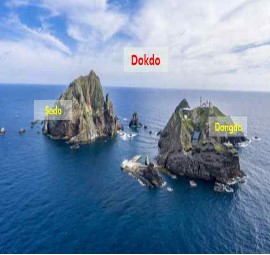
The two islands making up Dokdo. [Reproduced from the Official Report]
After engines-running refueling at a naval base on the island of Ulleungdo, the flight continued to Dokdo with the pilot flying (PF) conducting an automatic takeoff by selecting ‘go-around’ on the collective. The expected flight time to the Dokdo helipad was just over 20 minutes, and the flight was conducted using the autopilot (AP). As the flight neared the helipad, the copilot was recorded as saying that he could “see well outside with the [night vision goggles] NVG” to which the pilot replied “I cannot." The copilot turned on the searchlight at the pilot's request. Shortly after the helicopter was positioned for an approach, the pilot was recorded saying that they were too high. Shortly after this, the over-torque warning occurred and the mechanic said loudly, "what is wrong, what is wrong, what is wrong?" and the pilot said, "the altitude is too high, it's turning left, dizzy” and decided to begin a go-around to the left. Once in level flight, he was recorded as saying “What is wrong with the bank?" and the coilot responded by saying “it seems you felt that the helicopter was banked" implying that the pilot had momentarily experienced a visual illusion which the copilot then similarly appeared to experience.
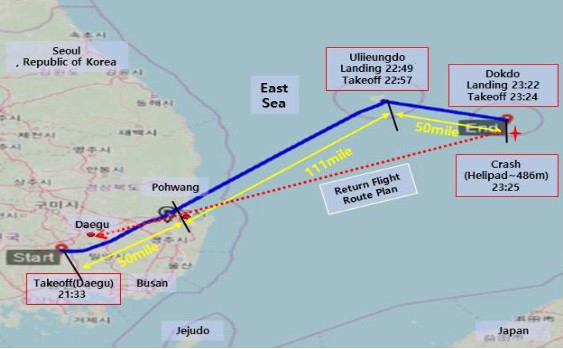
The routing of the rescue mission flight over the East Sea (Sea of Japan). [Reproduced from the Official Report]
It was assessed from listening to the full CVR recording of the initial approach that the pilot may have thought the lighthouse lights were beacon lights, which did not exist at the helipad. It was also assessed that the movement by a police officer of a portable searchlight to identify the helipad location (see the illustration below) may have been noticed by the pilots. The landing was made after repositioning, and during the two-minute engines-running boarding of the casualty and an accompanying colleague, the two pilots were recorded discussing the problems on approach.
Preparation for the departure, with the pilot continuing as PF, did not include a pre-takeoff briefing to cover takeoff direction, task sharing of the of AP operation, or any other takeoff procedures. A normal takeoff rather than a steep or ‘maxi’ takeoff was then commenced. The pilot did not activate the go-around mode. He then turned the aircraft 180° and set off in a south south-westerly direction over the sea, having initially “believed that the helicopter was ascending as expected."
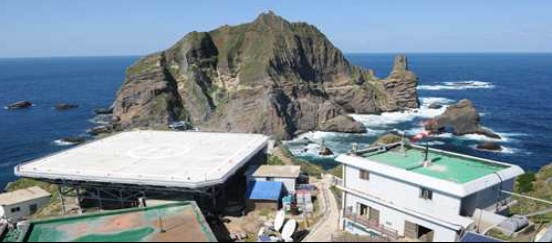
The Dokdo Helipad with the island of Seodo in the background. [Reproduced from the Official Report]
On realising that the GA button had not been pressed, the pilot asked the copilot to press the altitude acquisition button (ALT.A) but the report says it appears the copilot pressed the [altitude hold] button instead. The pilot continuously pushed the cyclic forward, resulting in the ALT selection being overridden. As this was happening, the helicopter left the area of the “well-lit” helipad, and the pilot encountered a sudden change to the dark sea ahead. At this time, the mechanic called “Head up." The copilot immediately followed this with “altitude, altitude, altitude” as an EGPWS ‘DON’T SINK, TERRAIN’ warning began and almost immediately, the helicopter was flown into sea just 14 seconds after it had taken off from the Dokdo helipad. An annotated depiction of both approaches and the departure is shown in the illustration below.
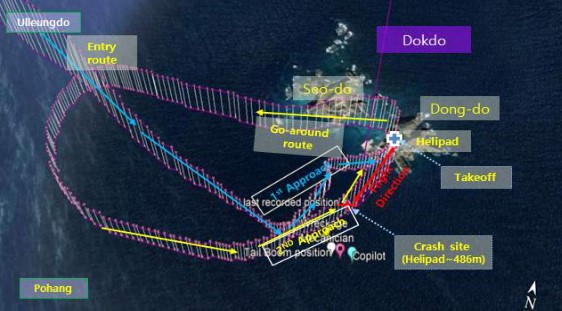
A composite of the two approaches and the departure and accident site. [Reproduced from the Official Report]
Why It Happened
The investigation concluded that the cause of the accident was spatial disorientation, "in which the pilot failed to recognize [the aircraft's] attitude change while entering the dark sea across a slope (cliff) from the well-lit Dokdo helipad."
Contributing factors were as follows:
- The crew did not conduct a preflight briefing at the National 119 Rescue Headquarters nor a pre-takeoff briefing in detail at the Dokdo helipad on their duty distribution.
- The pilot believed he was using GA mode while taking off from Dokdo. Also, while increasing the aircraft's speed, the descending attitude was misidentified as ascending.
- Thus, the pilot continuously pushed the cyclic forward, which resulted in the AP override and an increase in speed and descent rate.
- The pilot experienced illusions created by various lights during the approach to the Dokdo helipad, and it also affected the takeoff.
Nine Safety Recommendations were issued based as follows:
- that the National Fire Agency prepare and implement fatigue management programmes in preparation for emergency dispatch. [In particular, pilots' emergency flights at night should secure safety through fatigue management and rest.] [AAR-1903-1]
- that the National Fire Agency secure and enhance training with a flight simulator in preparation for takeoff and landing at night, severe weather, aircraft malfunctions, and flight illusions. [AAR-1903-2]
- that the National Fire Agency establish heliport approach and outbound procedures and training programs to fly in inexperienced areas, under severe weather, or at night, and provide recurrent night flight training. [AAR-1903-3]
- that the National Fire Agency enhance aviation safety awareness by regularly training the responsible persons in safety management (the Special Rescue Unit commanders, Squad leaders) about safety issues and operating the Squads. [AAR-1903-4]
- that the National Fire Agency establish NVG operating procedures and conduct recurrent training on wearing NVG, takeoff and landing in confined areas, and elevated helipads. [AAR-1903-5]
- that the National Fire Agency be capable of (delivering) a specialised aviation system, including flight management, maintenance and training within the National Fire Agency. [AAR-1903-6]
- that the National Fire Agency provide pilots with periodic training for manual flight and flight with the autopilot engaged and in respect of Crew Resource Management. [AAR-1903-7]
- that the Korean National Police Agency establish and implement inbound and outbound flight and helipad procedures for the Dokdo helipad. [AAR-1903-8]
- that Airbus Helicopters issue a Safety Information Notice on Automatic Flight Control System operations to secure safe piloting of their helicopters and disseminate it to operators. [Noted that Airbus Helicopters issued Safety Information Notice No. 3558-S-22 ‘Autoflight use of 4-axis digital AFCS’ on 3 December 3, 2020.] [AAR-1903-9]
The Final Report of the Investigation was published on 14 November 2023.