MD11, vicinity Louisville KY USA, 2025
MD11, vicinity Louisville KY USA, 2025
Summary
On 4 November 2025, the flight crew of a Boeing MD-11F departing Louisville lost control of their aircraft after the left engine and pylon separated from the aircraft shortly after it rotated for takeoff. Fire ignited in both the detached engine and the left wing, the aircraft failed to gain height, and the left main landing gear impacted structures close to the airport perimeter before it crashed into buildings approximately 1,000 metres beyond it and was destroyed by fire. Pending progress with the Investigation, the aircraft operator has grounded its MD-11F fleet. FAA has issued related emergency Airworthiness Directives grounding MD-11s, MD-11Fs, and DC-10s until specified inspections and corrective actions have been performed.
Flight Details
Aircraft
Operator
Type of Flight
Public Transport (Cargo)
Flight Origin
Intended Destination
Take-off Commenced
Yes
Flight Airborne
Yes
Flight Completed
No
Phase of Flight
Take Off
Location - Airport
Airport
General
Tag(s)
Extra flight crew (no training)
FIRE
Tag(s)
Post Crash Fire,
Fire-Wing
LOC
Tag(s)
Airframe Structural Failure,
Loss of Engine Power,
Unintended transitory terrain contact
AW
System(s)
Airframe
Contributor(s)
Corrosion/Disbonding/Fatigue
Outcome
Damage or injury
Yes
Aircraft damage
Hull loss
Non-aircraft damage
Yes
Non-occupant Casualties
Yes
Number of Non-occupant Fatalities
11
Occupant Fatalities
Most or all occupants
Number of Occupant Fatalities
3
Off Airport Landing
No
Ditching
No
Investigation Type
Type
Independent
Description
On 4 November 2025, shortly after a Boeing MD-11F (N259UP) being operated by United Parcel Service (UPS) on a scheduled domestic cargo flight from Louisville to Honolulu as UPS 2976 had rotated during a day VMC takeoff from runway 17R, its left GE CF-6 engine and pylon separated from the wing. A fuel-fed fire immediately began in the wing as the aircraft continued to track the runway extended centreline but it was unable to gain height. The subsequent impact with buildings outside the airport perimeter led to its destruction by impact and fire. All three crewmembers and 11 people on the ground were killed, and 23 others on the ground were injured.
Investigation
The U.S. National Transportation Safety Board (NTSB) has completed an initial assessment of the accident and has issued a preliminary report. NTSB is continuing work to establish why the engine separation occurred. The aircraft FDR and CVR have been recovered from the wreckage and their data successfully downloaded for analysis. In addition, an airport surveillance video recording of the takeoff has been obtained.
The Captain had approximately 8,613 hours flying experience of which 4,918 hours were on type. The First Officer, who was acting as PF for the sector, had approximately 9,200 hours flying experience of which 994 hours were on type. A Relief Officer who was also rated on type and occupying a supernumerary crew seat on the flight deck had approximately 15,250 hours flying experience of which 8,775 hours were on type and a Loadmaster was also on board.
What Happened
After being cleared for takeoff, the aircraft commenced its takeoff roll on runway 17R at Louisville and it proceeded normally until immediately after the aircraft had rotated and became airborne. At this point the airport surveillance video showed the left engine and its pylon separating from the wing and initially rising - on fire - above the aircraft before dropping to the ground. At the same time as the engine detached, a fuel-fed fire started in the damaged wing and flames spread rearwards in the slipstream as the aircraft began to climb (see picture 3 below).
It was found that although the aircraft initially climbed, FDR data confirmed that it did not get higher than about 30 feet agl. It cleared the blast fence beyond the end of the runway but the left main landing gear then impacted the roof of a warehouse at the southern edge of the airport. After continuing for around 900 metres at low level, it finally crashed in a storage area impacting additional buildings. One of these buildings was a petroleum recycling facility and the remainder of the aircraft was then “mostly consumed by fire”. The final impact occurred approximately 90 seconds after the start of the takeoff roll.
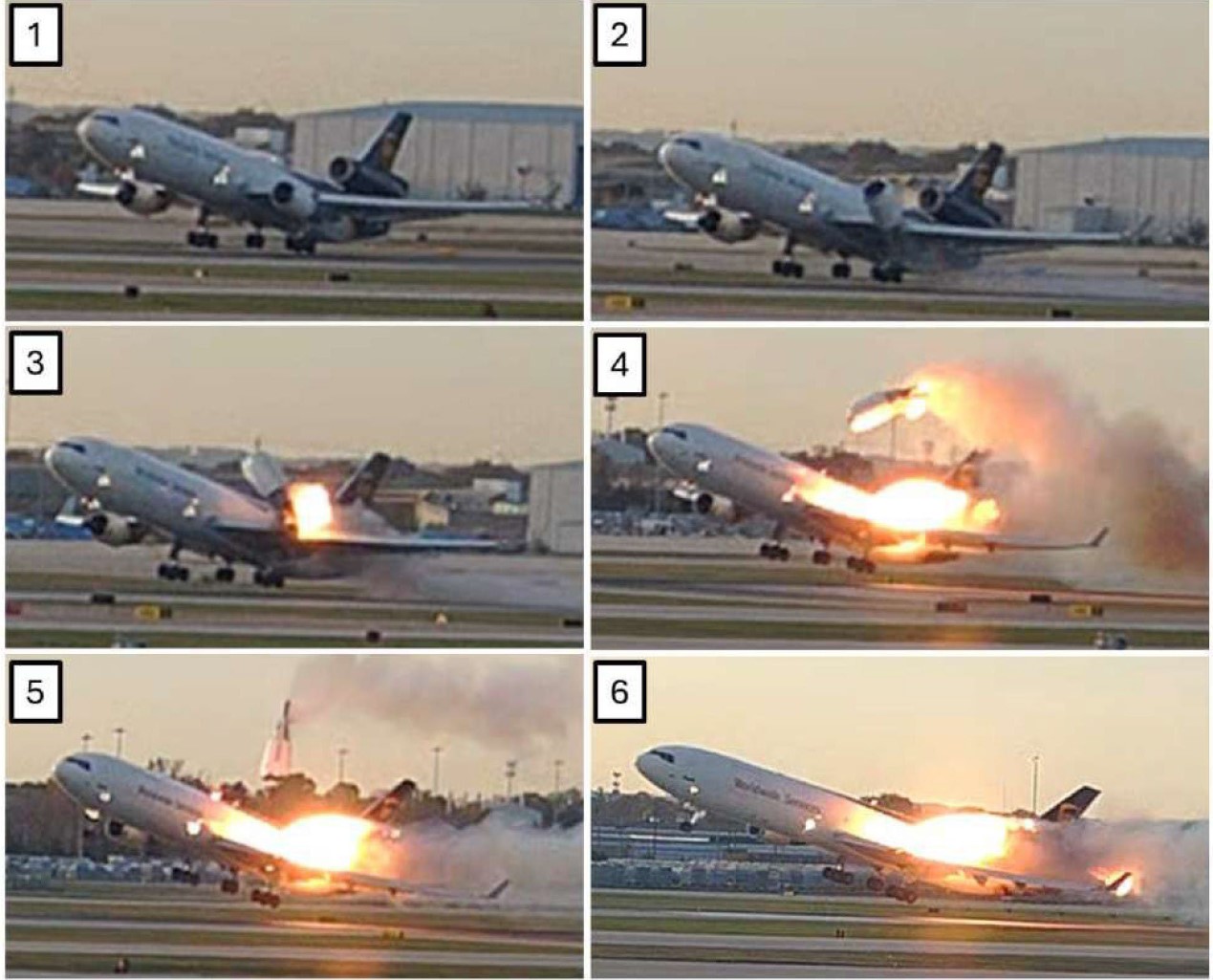
A sequence of stills from the retrieved airport surveillance camera recording.
[Reproduced from the Preliminary Report]
The Investigation has examined the recovered left engine pylon-to-wing-attachment system, which consisted of a forward mount bulkhead, a thrust link assembly and an aft mount bulkhead. The forward mount contains two vertically aligned spherical bearings (upper and lower) which are attached to the wing. The thrust link assembly, located immediately behind the forward mount's lower spherical bearing, primarily transmits thrust loads and the pylon aft mount consists of two separate fittings bolted together which each have forward and aft lugs which house a single spherical bearing. The pylon aft mount is connected to the underside of the wing by a clevis (a two pronged metal connector to which another part can be fastened using a bolt or pin passing through the ends of the connector).
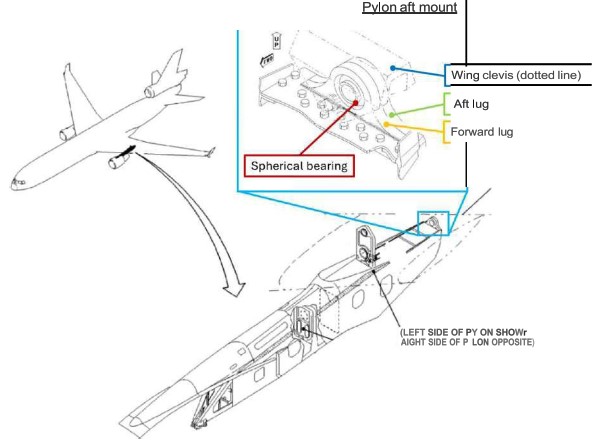
The pylon-to-wing mounting system with (inset) the pylon aft mount connection to the wing clevis.
[Reproduced from the Official Report]
An initial examination of the fractured single spherical bearing on the left pylon aft mount (see the illustration below) “found evidence of fatigue cracks in addition to areas of overstress failure” on both (adjacent) lugs. On the aft lug, fatigue cracks were observed on both the inboard and outboard fracture surfaces where the bore met the forward face and on the forward lug, fatigue cracks were observed along the lug bore inboard fracture surface. However, the forward lug's outboard fracture surface “consisted entirely of overstress with no indications of fatigue cracking”. The fractured parts of the spherical bearing have been removed from the wing clevis for further evaluation.
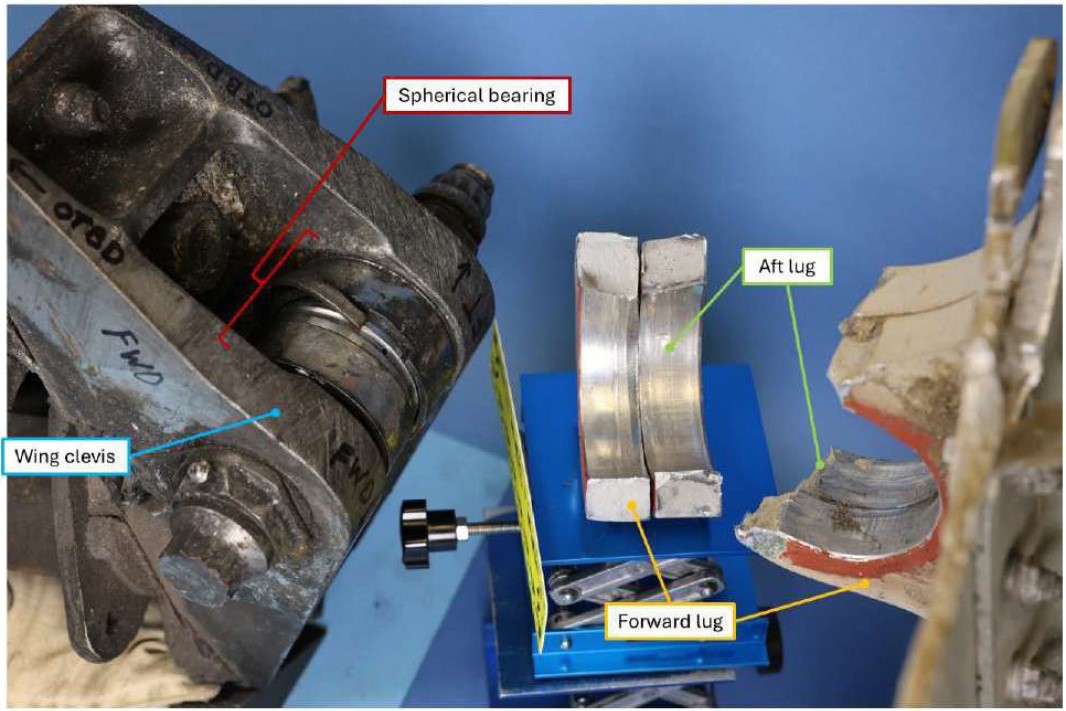
The left pylon aft mount showing the fractures and separated lugs and the wing clevis containing the attachment hardware and fractured spherical bearing.
[Reproduced from the Official Report]
A review of the applicable maintenance schedule requirements for the various failed pylon/wing attachment components found that all relevant requirements had been met. It was found that the next Special Detailed Inspection (SDI) of the left pylon aft mount lugs would have been due at 29,200 cycles and that the SDI for the left wing clevis support would have been due at 28,000 cycles with neither due - the aircraft had only reached 21,043 cycles.
It was noted that on 8 November 2025, the FAA had issued an emergency Airworthiness Directive prohibiting any further flight of MD-11 and MD-11F aircraft until inspection and “all applicable corrective actions” specified by the Agency had been performed. This AD was then replaced by a new Emergency AD on 14 November which extended the previously-specified actions to all DC10 aircraft due to their similar design.
It was also noted in the Preliminary Report that a similar fatal accident had occurred to an American Airlines Douglas DC10 in 1979 as it rotated for takeoff at Chicago O’Hare which the NTSB had investigated and concluded that the separation had been attributable to “improper maintenance procedures”. However, as yet no evidence of similar cause has been found and currently is not suspected.
A Preliminary Report detailing the initial findings of the continuing Accident Investigation was published on 11 November 2025.