PA46, en-route, southwest of Narsarsuaq, Greenland, 2024
PA46, en-route, southwest of Narsarsuaq, Greenland, 2024
Summary
On 29 July 2024, a Piper PA46 Malibu making an eastbound transatlantic flight via Narsarsuaq was descending southwest of the airport when the engine failed. A successful ditching occurred, and the two occupants evacuated into a life raft. Rescue occurred without significant delay due to the fortuitous presence of military airborne and marine assets in the vicinity. The cause of the engine failure could not be determined but there was no evidence that it could have been foreseen prior to flight. Proper continuing airworthiness-related actions had been taken ahead of the flight departure.
Flight Details
Aircraft
Operator
Type of Flight
Private
Flight Origin
Intended Destination
Take-off Commenced
Yes
Flight Airborne
Yes
Flight Completed
No
Phase of Flight
Descent
Location
General
Tag(s)
PIC less than 500 hours in Command on Type,
Root Cause Not Determined
LOC
Tag(s)
Loss of Engine Power
EPR
Tag(s)
MAYDAY declaration,
PAN declaration
AW
System(s)
Engine - General
Outcome
Damage or injury
Yes
Aircraft damage
Hull loss
Non-aircraft damage
No
Non-occupant Casualties
No
Occupant Injuries
None
Occupant Fatalities
None
Off Airport Landing
No
Ditching
Yes
Causal Factor Group(s)
Group(s)
Aircraft Technical
Safety Recommendation(s)
Group(s)
None Made
Investigation Type
Type
Independent
Description
On 29 July 2024, a Piper PA46-310P Malibu (D-EOSE) flown by the two joint owners on a private flight from Goose Bay to Narsarsuaq was descending through FL160 over open water when the cabin altitude suddenly began to increase and engine low oil pressure was indicated. A PAN was declared and soon afterwards, a serious engine malfunction became apparent and a MAYDAY was declared. Both occupants were fully prepared for a potential ditching and, after passing through an overcast layer, emerged at 700 feet asl in day visual meteorological conditions (VMC) and the aircraft was successfully ditched. Following the occupants’ evacuation to their life raft, they were subsequently picked up by a rescue team. The aircraft remained afloat for approximately two hours.
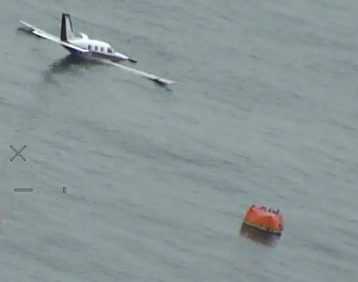
D-EOSE in the water. The 2 pilots can been seen waving from the nearby liferaft [Source: RDAF, reproduced from the official report]
Investigation
An accident investigation was carried out by the Danish Accident Investigation Board (AIB). Recorded communications between the aircraft and ATC were available as were recordings of all other relevant radio and telephone communications. Photo and video recordings made by the crew of the military surveillance aircraft which located the descending aircraft shortly before it ditched and by the crew on board the rescue boat and its parent survey ship were also available. The aircraft was not recovered but it had a ‘Primary Engine Monitor’ installed which recorded selected engine and flight data. The investigation obtained copies of the most recent downloaded data which covered two flights made a month previously which “were of good quality and useful to the Investigation."
The 56-year-old Pilot in Command held an ATPL (Airline Transport Pilot's Licence) which included an SEP/IR rating and had a total of 17,802 hours flying experience which included 107 hours on type. The passenger was, with the pilot, the joint owner of the aircraft involved and was an aeronautical engineer holding a PPL(A) with a total of 963 hours flying experience which included 131 hours on type.
What Happened
The preflight Inspection prior to departure from Goose Bay was completed by the pilot, including confirming an oil level indication of ‘full’, without any findings requiring attention. The flight then departed and was initially cleared to climb to FL210 for the cruise but after a short time, was instructed to descend to FL180.
The cruise power was set to 65% (26.5 inches of manifold pressure) and 2,400 rpm, and the pilot leaned the fuel flow to 14 USG per hour with a turbine inlet temperature (TIT) of 50° lean of peak. The weather en route was mostly visual meteorological conditions (VMC) with the outside air temperature (OAT) at FL180 between -10°C and -15°C.
The pilot contacted Nuuk Information when the aircraft entered the Nuuk Flight Information Region (FIR) and subsequently advised them that he was commencing descent from FL180 to 11,000 feet inbound to the IFR reporting point ‘SIMNI’ which was located on the Greenlandic coastline, 45 nm southwest of Nuuk. The descent was initiated with a 500 fpm rate of descent and with the cruise power setting at 65% maintained.
While passing FL 160, both occupants briefly noticed an “unusual, electrical, and not very strong smell”. The cabin altitude was observed to begin increasing at 3,000 fpm and the pilot reported having realised that “something was wrong." The cabin altitude soon reached 10,000 feet and the corresponding warning light illuminated. But as the aircraft was below 15,000 feet QNH, the pilot considered that given the applicable time of useful consciousness as the descent continued, it was not necessary for the occupants to don oxygen masks.
Twelve minutes after starting the descent, a PAN was declared to Nuuk Information because of an unexplained air conditioning problem and a low oil pressure indication. The manifold pressure dropped from 26 inches to 17-18 inches and the pilot found that moving the throttle lever forward had no effect on this reading. All cylinder head temperatures (CHTs) indicated “normal and balanced” but when the mixture control was moved fully forward to the rich position, the engine almost stopped, and the mixture control was returned to its previous position. The aircraft pitch attitude was then adjusted to obtain the best glide airspeed of 90 knots.
Only a minute after declaring the PAN, whilst the aircraft was descending through 12,000 feet QNH, it was then upgraded to a MAYDAY and Nuuk Information was advised that they would “try to make it to the shore." The emergency locator transmitter (ELT) was then activated.
A Danish Air Force surveillance aircraft and a Danish Navy inspection ship which were both on patrol in the area were tasked to provide assistance.
As the aircraft descended through 7,000 feet QNH, the propeller speed increased to 3,000 rpm and 30 seconds later the oil pressure indicated zero. The pilot retarded the mixture control to the idle/cutoff position and stopped the engine to avoid major mechanical damage. He then reported having observed from his knee-mounted tablet that the predicted gliding distance of the aircraft now meant it would not reach the coastline.
Nine minutes after declaring a MAYDAY, the pilot informed Nuuk Information that the predicted ditching position was 60° 30´N 46° 45´W. Both occupants prepared for the ditching by checking the location of the life raft in the cabin, zipping up their survival suits (both were already wearing these up to their waists) and tightening their seat belts. Three minutes after advising the expected ditching position as the aircraft was descending through 3,300 feet QNH, the surveillance aircraft crew spotted the aircraft gliding on a northeasterly course over a low overcast. As it passed 1,700 feet QNH, the disabled aircraft entered the cloud layer before subsequently emerging from it approximately 700 feet above the sea surface. The surveillance aircraft crew had lost sight of the aircraft as it entered the cloud layer and in order to safely descend below it themselves, they had to fly to the coastline and descend before flying back towards the expected ditching position clear of cloud.
Once below the cloud layer, the PA46 pilot noted that forward visibility was good and that the sea surface had only low swells. He selected flaps to 20°, slowed down the aircraft to minimum airspeed and flared straight ahead. The aircraft bounced slightly on the sea surface before impacting it a second time and then decelerating fairly abruptly - a sensation described by the occupants afterwards as “similar to hard braking in a car” – before coming to a stop in a wings-level position floating on the surface some 58nm southwest of Narsarsuaq.
The two occupants released their seat belts and then went into the aft cabin, and opened the top part of the aircraft entrance door, which was above the water level. They manoeuvred the life raft through the entrance door into the water and inflated it before throwing a few personal items into the raft and stepped directly from the aircraft into the raft. Six minutes later, the surveillance aircraft crew spotted the life raft and noted the position as 60° 34´N 46° 50´W. They then circled overhead the life raft to await the arrival of a rescue craft. Whilst waiting, the pilot made contact with Nuuk Flight Information by satellite telephone and a little over twenty minutes later, a rescue crew in a Rigid Hulled Inflatable Boat (RHIB) deployed from the naval inspection ship arrived and picked up the uninjured pilot and the passenger an hour and ten minutes after the ditching. At this time and when the naval inspection ship arrived on site, the aircraft was still afloat but it was assessed “not salvageable due to risk to personnel and subsequently sank just over an hour after the crew had been picked up. The depth of the sea at the ditching position was stated as ranging between 75 metres and 500 metres.
Why It Happened
The investigation noted that the aircraft’s Continental TSIO-520-BE2G piston engine was a fuel-injected six cylinder type equipped with dual turbochargers which provided compressed air to the cylinders and, through two sonic nozzles, to the aircraft cabin pressurisation system. Its oil system provided cooling and lubrication to both the engine and the turbochargers, and also provided oil for controlling the propeller governor and the waste gate by means of an engine-driven oil pump. The engine oil sump capacity was 8 US quarts, which according to the POH (Pilot's Operating Handbook), should always be fully utilised prior to a maximum endurance flight.
It was found that the engine had been rebuilt and installed in the aircraft by Continental in 2012 and at the time of the accident had been within the TBO (Time Between Overhaul) of 2,200 flight hours or 12 calendar years. From 2012 until the owners bought the aircraft in 2019, it had accumulated approximately 600 hours and from then until the accident, approximately a further 150 hours. The aircraft owners stated that in their experience, the oil consumption had always been “very low”. They advised that only 1 US Quart of oil had been used during the approximately 40 hours flown after departing from their home base at Itzehoe in Germany to Oshkosh and then to Goose Bay on the return trip. Prior to departing on the sector from Rimouski to Goose Bay, they advised having added 0.2 US Quarts to return the oil level to full and as the pre flight inspection prior to the accident flight found that the indicated oil level was still 8 US Quarts, no oil had been added.
Since purchasing the aircraft in 2019, the only unscheduled maintenance action on the engine had been a preventive replacement of six valve lifters in 2021 after they had received information from another aircraft owner about potential corrosion to these parts. The most recent scheduled maintenance action was a 50-hour inspection on 12 June 2024 which did not give rise to any remarks. The owners stated that the aircraft cylinder head temperature during the cruise was normally in the 290–340°F range with a power setting of 65% and a TIT of 50°F lean of peak. In respect of the accident flight, the pilot and the passenger observed that “we were well in the green range all the time and didn’t notice any deviations from normal engine behaviour at any time - both the Exhaust Gas and Cylinder Head Temperatures of the six cylinders were plausible and balanced all the time”.
Data useful to the Investigation from the Primary Engine Monitor installed in the aircraft had been downloaded for two flights made on 29 June 2024 shortly before the departure for the outbound transatlantic flight. These flights were from Itzehoe to Bornholm/Ronne and back and the data presented included engine power output, fuel flow and cylinder head temperature which were all within their normal operating ranges.
The Investigation was unable to determine the exact cause of the engine failure “with certainty” but it was considered possible that the origin of the engine failure was either a leak in the oil system or as a result of a single turbocharger failure causing an oil leak. It was considered that if there had been an oil leakage, the leaked oil was likely to have burned and/or evaporated internally within the engine, the exhaust, or the turbochargers since no external traces of oil were visible on the aircraft or on the sea surface following the ditching. It was also observed that the elapsed time between the first indication of a problem and the onset of the high propeller rpm which necessitated engine shutdown “pointed towards a seeping oil leakage." It was significant that once signs of an engine-related problem occurred neither occupant saw any unusual increase in engine vibration which indicated full integrity of the engine main components, i.e. no failure of the crankshaft, connecting rods, camshafts, valves, pistons, cylinders or crankcase.
Whether the “unusual, electrical smell” was the result of vapours from an oil leak or originated from elsewhere was difficult to determine. However, a turbocharger failure, “either as a result of loss of oil pressure or as a stand-alone turbocharger failure, would cause a loss of compressed air to both the aircraft cabin pressurisation system and the engine induction system." It was assessed that the observed drop in manifold pressure was probably an indication of turbocharger failure. It was also observed that “when the pilot then enriched the mixture, the fuel-to-air ratio at that altitude (had) possibly increased to a level that almost drowned the engine” given that the engine almost stopped, which if true would rule out fuel starvation as the cause.
A few minutes later, “loss of oil may have led to a lack of oil pressure in the propeller governor” which would have caused low propeller pitch and high propeller rpm with lack of oil/oil pressure leading to a total lack of (indicated) oil pressure forcing the pilot to shut down the engine. However it was not possible to determine if, how, or where an oil leakage occurred.
The formal Conclusion of the Investigation was that “an engine failure during descent resulted in a ditching off the southwest coast of Greenland (and although) the exact cause of the engine failure could not be determined, it was probably due to a seeping oil leak."
It was noted that the accident had been survivable because of a combination of factors:
- The pilot declared a PAN followed by a MAYDAY to Air Traffic Services and a nearby military surveillance aircraft obtained visual contact with the gliding aircraft.
- The pilot successfully landed the aircraft on calm sea.
- The pilot and the passenger wore survival suits and carried a life raft on board, which they boarded upon safely evacuating the aircraft.
- After 50 minutes, personnel from a nearby Danish Navy inspection ship arrived and rescued the pilot and passenger.
The Final Report was published on 10 April 2025.
Related Articles
- Loss of Control
- Engine Failure in Cruise
- Ditching: Fixed Wing Aircraft
- Cabin Altitude
- Aircraft Pressurisation System