S92, vicinity Maersk Invincible Platform North Sea, 2020
S92, vicinity Maersk Invincible Platform North Sea, 2020
Summary
On 24 February 2020, a Sikorsky S92 helicopter crew departing at night from an oil rig in the Norwegian sector of the North Sea in adverse weather temporarily lost pitch control after both pilots became spatially disorientated prior to reaching minimum speed for autopilot engagement. Recovery was successful and the remainder of the flight was uneventful. But the Investigation concluded that operator procedures were insufficiently robust, and that helicopters engaged in offshore operations could be equipped with low-speed flight modes to mitigate consequences of pilot spatial disorientation during low-level manoeuvring.
Flight Details
Aircraft
Type of Flight
Public Transport (Passenger)
Intended Destination
Take-off Commenced
Yes
Flight Airborne
Yes
Flight Completed
Yes
Phase of Flight
Take Off
Location
Approx.
vicinity of Maersk Invincible Platform, North Sea
General
Tag(s)
Helicopter Involved,
Inadequate Aircraft Operator Procedures,
Unplanned PF Change less than 1000ft agl
HF
Tag(s)
Manual Handling,
Procedural non compliance,
Spatial Disorientation,
Stress
LOC
Tag(s)
Aircraft Flight Path Control Error,
Environmental Factors,
Temporary Control Loss,
Extreme Pitch
WX
Tag(s)
Precipitation-limited IFV,
Strong Surface Winds
Outcome
Damage or injury
No
Non-aircraft damage
No
Non-occupant Casualties
No
Off Airport Landing
No
Ditching
No
Causal Factor Group(s)
Group(s)
Aircraft Operation
Safety Recommendation(s)
Group(s)
Aircraft Operation
Investigation Type
Type
Independent
Description
On 24 February 2020, a Sikorsky S92 (LN-ONT) operated by Bristow Norway on a North Sea offshore passenger transport flight from the Maersk Invincible Platform to Stavanger had just become airborne in night instrument conditions (IMC) in a strong gusting surface wind. Inappropriate control inputs resulted in a rearwards descending flight path past the side of the platform and below the level of the helideck. Enhanced Ground Proximity Warning System (EGPWS) alerts were activated as control was regained after a 40-second period out of control. The flight thereafter was without further event. There was no damage to the helicopter or injury to its 11 occupants.
Investigation
The occurrence was reported to the Norwegian Safety Investigation Authority the following day, and after a preliminary assessment, a Serious Incident Investigation was initiated on 19 March 2020. Crucial to the reconstruction of the flight profile was the flight data successfully downloaded from the Combined Voice and Data Recorder (CVFDR).
The 42-year-old captain had a total of 6,750 hours flying experience, which included 2,191 hours on type. Prior to joining Bristow Norway in 2014, he had 15 years experience as a military helicopter pilot, of which eight years had been as a maintenance test pilot and nine years as an instructor. He had flown in command of the operator's S92s since June 2015. The 39-year-old first officer had a total of 5,800 hours flying experience, which included 605 hours on type acquired during and since obtaining his S92 type rating nine months earlier. Prior to joining Bristow Norway in 2019, he had been a pilot on Bell 206 and Bell 407 single-engine helicopters for the Bristow US offshore platform service operation in the Gulf of Mexico. He informed the investigation that he had 84 hours experience on the S92 at night.
The same crew had begun their duty by operating a round trip from Stavanger to another offshore platform before commencing the 1 hour 20 minute outbound flight to the Maersk Invincible Platform. The first officer was designated as pilot flying (PF) on account of the helipad orientation (136°) relative to the reported surface wind direction (120°) and the operational requirement to commit to a touchdown at 50 feet above the helideck and descend at an angle of 45°. This flight was completed as planned, and after a rotors running ‘hot’ refuelling supervised by the captain, the first officer prepared to continue as PF for the takeoff due to the wind direction.
It was overcast at a reported 600 feet and raining hard, and all platform lighting was behind the helicopter as the first officer brought it to a five-foot hover above the helideck. Once the hover check was complete, the first officer moved the collective to 80% torque to start a vertical climb to the Takeoff Decision Point (TDP) (30 feet above the helideck) in accordance with the Operations Manual (OM) procedures for a Helideck Takeoff. Recorded flight data showed that a nose-up pitch of approximately 8° was maintained during this climb. When the captain called “TDP," the first officer responded by moving the cyclic gradually forward to achieve a 5° nose-down pitch and initiate horizontal acceleration. This pitch angle was in accordance with the operator’s procedures for a helideck departure at night or in the reduced horizontal visibility that prevailed.
Whilst accelerating, the torque varied between 70% and 79%. The Captain reported having focused his attention on the vertical speed indicator (VSI). When the VSI began to show a 100 fpm rate of descent, he called “we are descending” twice. Almost immediately a synthetic voice altitude alert was activated, indicating the helicopter was about to drop below the 260 feet minimum altitude set on the radio altimeter (the declared height of the helideck above sea level). The captain subsequently stated that after the voice alert, “he had got the feeling that the instrument readings did not match with what he expected and had felt that he had become disoriented."
A few seconds after this, when the helicopter had accelerated to approximately 35 knots and was at 306 feet amsl, the pitch attitude increased at a rate of 6.4° per second to more than 25°nose up - see the illustration below - as the indicated airspeed dropped to zero. Recorded data showed both engine torques dropping to 66% before increasing to 88%. The First Officer subsequently compared the sensation to being in a simulator with no sensory feedback.
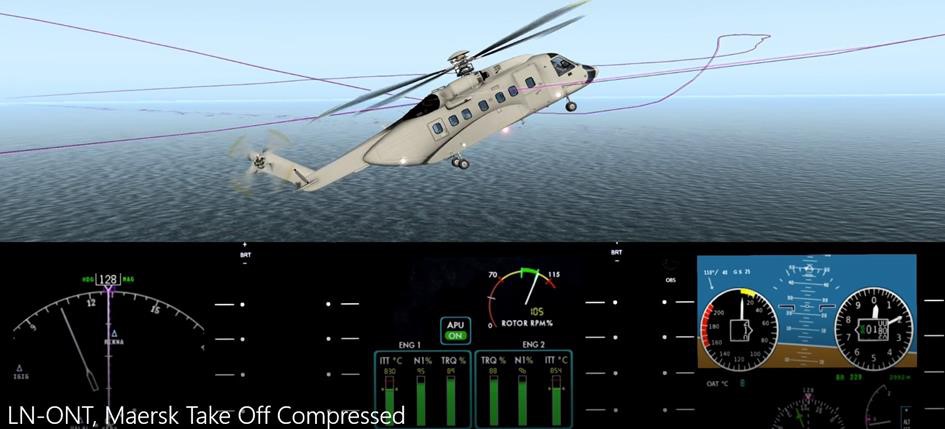
As the helicopter accelerated rearwards at almost 50 knots, the pitch attitude exceeded +25°. [Reproduced from the Official Report]
The helicopter then developed a nose-up pitch in excess of 20° for approximately 15 seconds whilst moving sideways to the left, after which it started to accelerate rearwards and downwards as the nose turned to the right, from 103° to 155°. With 89% torque set, the helicopter continued to descend at almost 400 fpm for 10 seconds as it travelled backwards with a ground speed of between 30 knots and almost 50 knots. Rearward flight occurred for approximately 210 metres to the north of the platform as separation gradually increased from a minimum of 201 metres (see the illustration below). The lowest radar altitude during this phase was 210 feet above sea level.
Recorded exchanges between the two pilots showed that when the helicopter was moving rearwards nose-up, the first officer had become confused about who was in control and “expressed uncertainty as to whether the Captain was operating the controls." Initially, he received a negative response, but once the captain saw the platform on his right ten seconds later, he regained situational awareness and took over control. As he acted to reset the flight trajectory, he stated that he had pressed the force trim release button in order to stabilise the helicopter. Half a minute had elapsed since the helicopter had begun what was supposed to be a climb on track to Stavanger. As the flight path was being transitioned to a recovery climb, EGPWS activations arising from a mode 3 ‘DON’T SINK’ Caution (active for a descent soon after takeoff) and then from a mode 2B ‘TERRAIN TERRAIN’ Warning (active for proximity to terrain) occurred. The minimum recorded height over the sea at this time was 175 feet and the helicopter reached a maximum nose-down pitch of 28° as the engine torques briefly dropped to 64% before they were corrected to 88% after which the forward airspeed gradually increased to 90 knots.
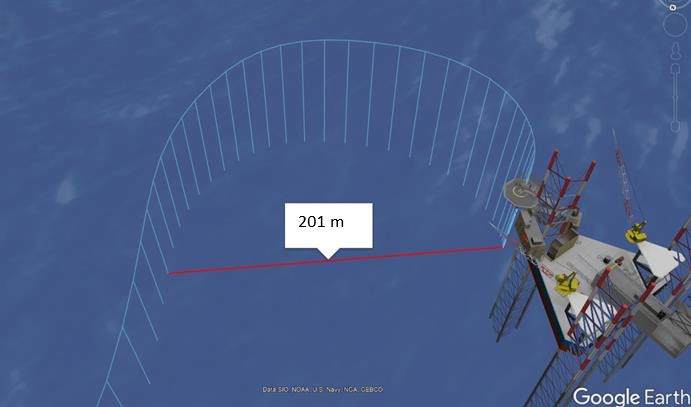
The trajectory of the flight based on recorded flight data showing the unintended track reversal and descent with the minimum separation from the platform. [Reproduced from the Official Report]
A stable 80-knot climb was then established and the autopilot (AP) was engaged. The remainder of the flight was completed at a cruising altitude of 1,000 feet without further event except that it took abnormal vibrations for the crew to realise that they had not retracted the landing gear.
Recorded voice data showed that both pilots had been “exposed to high acute stress levels during the period when the helicopter accelerated backwards and was out of control” which was suspected to have had its origins in spatial disorientation in the absence of visual references as the first officer sought to continue the departure from the TDP.
The investigation was informed that the operator’s scheduled simulator training programme included both Upset Prevention and Recovery Training (UPRT) and training in how to handle pilot (temporary cognitive) incapacitation. The UPRT training had a special focus on helideck take-offs. It was noted that both simulator training and proficiency checks were based on the following procedure for recovering from unusual attitudes:
- Establish a horizontal attitude (wings-level, roll attitude).
- Point the helicopter’s nose towards the horizon or just above (2-3° pitch-up).
- Adjust the collective to make corrections for loss of altitude or to climb to a safe altitude and establish correct airspeed according to the situation.
It was also established that the operator’s requirements for crew resource management (CRM) training were in accordance with regulatory requirements and all applicable guidance material, as were human factors and threat and error management (TEM)-related training.
Safety Action taken by Bristow Norway as a result of the findings of their internal investigation was noted to have included the addition to the OM Part ‘B’ of best practice guidelines in respect of the cyclic trim force release button during takeoff and landing.
The Conclusion of the Investigation was, in summary, as follows:
The loss of control occurred in challenging weather conditions before the minimum speed for engaging the autopilot had been reached during departure. No evidence of any relevant airworthiness issues was found and it was assessed that the PF first officer had likely been affected by spatial disorientation which led him to mishandle the flight controls causing the helicopter to deviate from a normal departure flight profile. Whether intentional or not, his failure to release the cyclic trim switch to set aircraft reference pitch attitude, to set the correct pitch-up attitude to climb, and to trim out the resistance in the cyclic probably aggravated the situation.
The captain was also affected by spatial disorientation for part of the time when control was lost, and this led to a “stressful situation” during which the captain described CRM “not working as expected." However, when the captain saw the platform on the right side of the helicopter above the height of the rearward-moving helicopter, he regained his situational awareness and took over control to establish the required departure climb away from the platform. It was recognised that if, as in this case, both pilots were for a period simultaneously subject to disorientation, “it is difficult to describe what would be effective CRM."
The investigation considered that:
- Enhanced TEM training could have contributed to an increased awareness of any safety threats during such a potentially challenging departure.
- The absence of an automated deviation call to alert the PF to an abnormal nose-up or nose-down position was noted and would probably have contributed to more effective inter-pilot communication.
- S-92A helicopters used for offshore passenger transport should be upgraded with low-speed modes including the ‘Rig Approach System’ which has departure modes which could make a significant contribution to improved safety during takeoff from a helideck in difficult conditions in the event of pilot disorientation.
Two Safety Recommendations were made based on the findings of the Investigation as follows:
- that the Norwegian Civil Aviation Authority (CAA-N) in its supervisory activities with offshore helicopter operators emphasise following up the operators' procedures and routines related to TEM, TEM training and how TEM is managed in daily operations. [2024/02T]
- that Bristow Norway AS extend their Standard Deviation Calls to also include deviation calls for pitch variations that exceed predefined limit values. [2024/03T]
The Final Report was published on 15 February 2024.