

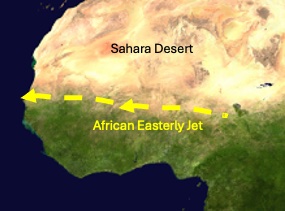



African easterly jet
Description
The African easterly jet is a prominent wind feature over northern Africa in summer.
The jet core is near 15°N on the west coast with a tendency for southward displacement inland. The jet maximum is around 25 kts at FL100
Formation
The jet is caused by the temperature contrast between the Sahara Desert (around 45°C) and the Gulf of Guinea (around 23°). The temperature contrast is maximum in the summer months.
The jet core moves north from around 5°N in January to 15°N in August. It is strongest in August when speeds reach 25 kts and weakens as the jet moves south in October and November.
Impact on weather
The African easterly jet plays an important role in the West African monsoon and helps form tropical waves that move westward across the Atlantic and eastern Pacific oceans in the summer and autumn. The jet exhibits both barotropic and baroclinic instability, which produces synoptic scale, westward-propogating disturbances in the jet known as African easterly waves or tropical waves. These instabilities, particularly in the presence of moist convection, cause intense lower-scale cyclonic vortices at the northern flank of the jet. a small numbr of storm systems embedded in these waves develop into tropical cyclones (Hurricanes) after they move from west Africa into the Atlantic., mainly during August and September.
Categories