





Anabatic Wind

Anabatic Wind

Text

Definition

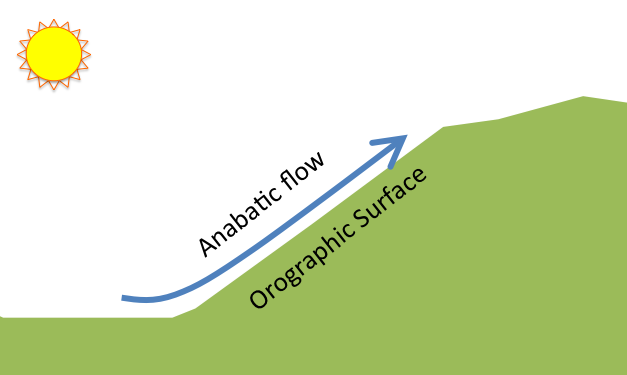
Air flow travelling up a facing slope of an orographic surface (eg. hill, mountain).

Description

Anabatic winds are mainly created by ultraviolet solar radiation heating up the lower regions of an orographic area (i.e. valley walls). Due to its limited heat capacity, the surface heats the air immediately above it by conduction. As the air warms, its volume increases, and hence density and pressure decreases. The air becomes relatively buoyant and rises up the orographic slope (orographic lift), resulting in the anabatic flow (or wind).

Simplistic diagram of anabatic flow as described in the text. Incoming solar radiation heats up the lower regions of the orographic surface and anabatic flow is created.

The relatively colder air is displaced, part of it travels downwards to “replenish” the valley floor, and the process of heating by conduction may begin anew.

Categories
The full content of this page is available to registered users only.

SKYbrary Partners:

Safety knowledge contributed by: