



Bird Strikes in Rotorcraft Operations
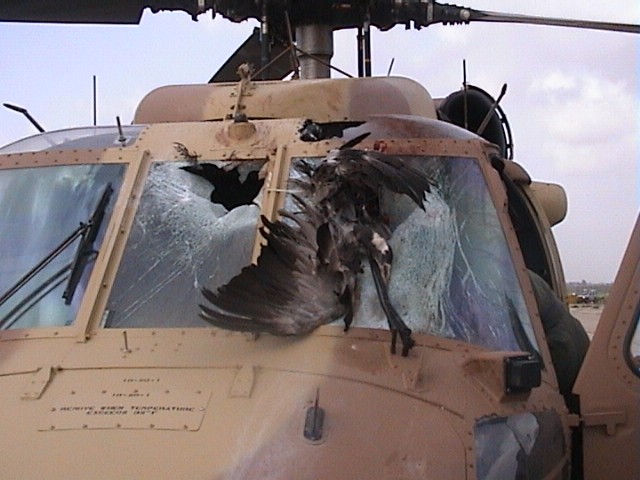
Blackhawk helicopter after collision with a migrating crane at 800 feet AGL [Source: wikicommons, Author: USAF, 28 December 2015]
Description
A number of factors, especially the amount of time spent in low-altitude operations, place rotorcraft at particular risk for bird strikes.
On July 9, 2022, a Bell 206 L-1, with only the pilot aboard, departed Cattai, New South Wales, Australia. According to the Australian Transport Safety Bureau, about nine minutes later, the helicopter broke up in flight and impacted terrain. The investigation found that a wedgetail eagle had hit the aircraft just below the front left windscreen. The report also said it was unlikely the pilot, who died in the crash, had time to see and avoid the eagle because of sun glare and a required radio frequency change. The report added that the pilot was probably startled by the bird strike, which resulted in an abrupt control input. This led to the main rotor blades hitting the tail boom and the subsequent in-flight breakup.
Although bird strikes have caused a number of fatal fixed-wing crashes, it's rare for impact with a single bird to result in a hull loss. This accident highlights the unique dangers posed to rotorcraft by bird strikes.
Rotorcraft Vulnerabilities
"Rotorcraft have a unique vulnerability to bird strike in comparison with other aircraft," the U.S. Federal Aviation Administration (FAA) said in Special Airworthiness Information Bulletin (SAIB) AIR-21-17R1. "Most rotorcraft flight profiles are in the low altitude environment below 3,500 feet AGL, an airspace that is also the most densely populated with birds," the SAIB noted. The document, issued in 2023, also said more than 90 percent of bird strikes occur in that airspace. "A bird strike may lead to a loss of control in flight, either through damage to a critical system component on the rotorcraft or by penetrating into the crew area and incapacitating the pilot," the document added.
In 1996, the FAA issued airworthiness standards to protect against bird strikes on transport category rotorcraft. But the SAIB said other categories of rotorcraft can also benefit from applying those enhanced design features. The document makes two recommendations:
- Consider design and equipment safety options outlined in the FAA's Rotorcraft Safety Promotion Concept (RSPC). (See paragraph below.)
- Consider operational risk mitigation options. They include:
- Learning about the local bird population and using that knowledge to plan and fly routes.
- Reducing airspeed when practical.
- Increasing altitude.
- Wearing personal protective equipment such as a helmet and visor.
Rotorcraft Safety Promotion Concept (RSPC)
The Rotorcraft Safety Promotion Concept (RSPC) is meant to inform rotorcraft owners and operators of voluntary design and equipment features that can be installed to enhance safety. For rotorcraft certified in the normal category (Part 27), those features include:
- Windshield material that is bird strike resistant up to a declared airspeed, based on successful testing.
- Bird strike deterrents, such as lights, audio features, and high-visibility rotors.
- Indicated airspeed limited to 80 knots by the Rotorcraft Flight Manual (RFM).
For rotorcraft certified in the transport category (Part 29), those features include:
- Windshield tested to specified requirements, OR
- Windshield not tested but all flight critical components forward of the main rotor mast were successfully tested.
Additional Risk Mitigation Options
A 2021 article in the European Union Aviation Safety Agency's (EASA) Community Network listed a number of ways rotorcraft pilots can reduce bird strike risk. They include:
- When possible, avoid areas of known bird concentration, such as wildlife sanctuaries, coastlines, and landfill sites.
- When possible, avoid transit over wetlands and inland water areas such as lakes and ponds.
- Cross coastlines at a 90-degree angle to minimize exposure to bird activity.
- Before takeoff, listen for bird warnings on the Automatic Terminal Information Service (ATIS).
- Report bird activity to Air Traffic Control (ATC).
- After takeoff, climb as quickly as possible and fly above 2,500 feet AGL.
- Use strobe lights, taxi lights, and/or landing lights when operating in or near bird activity.
- If on a collision course with a bird, maneuver with an upward vector, as most birds break downward when they see an object in their flight path.
- If a bird strike is known or suspected, land as soon as practical. A full inspection should be carried out.
Further Reading
- Special Airworthiness Information Bulletin (SAIB) AIR-21-17R1, U.S. Federal Aviation Administration, Oct. 3, 2023
- "Rotorcraft Birdstrikes," EASA Community Network, European Union Aviation Safety Agency, April 19, 2021.