


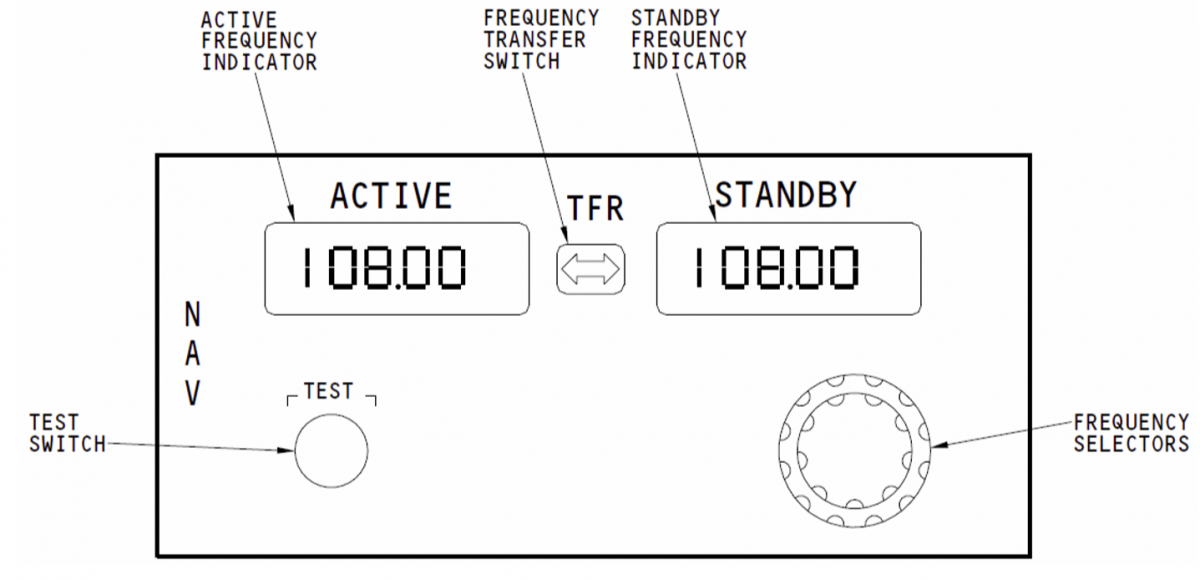



Manufacturers have increasingly equipped avionics and other systems with concentrically centered controls to conserve limited space in the instrument and control panels of aircraft. These are typically designed so that the larger outer knob closest to the face of the panel changes cursor position, selects information category, operating/display mode, or large value changes. The smaller inner knob is used to select among the information content, sub categories of the position selected with the larger outer knob, or fine value changes. The most familiar implementation of concentrically-centered control is probably in navigation and communication tuning heads (e.g., to set the frequency in the standby frequency indicator, turn the frequency selectors to set the frequency). The first digit is always 1. The outer knob sets the second two digits (10 MHz and 1MHz) in 1 MHz increments. The inner knob sets the fourth, fifth, and sixth digits (100 kHz, 10 kHz, and 1 kHz) in 25 kHz increments.