





A Last Point of Diversion may need to be calculated for the following conditions:
If the destination is an Isolated Airfield.
If there is any doubt over the ability of the aircraft to land at its destination or alternate airfield.
The LPD is the furthest point along track that the aircraft can fly and then divert to an en-route airfield, arriving with safe fuel reserves.
Graphical Solution
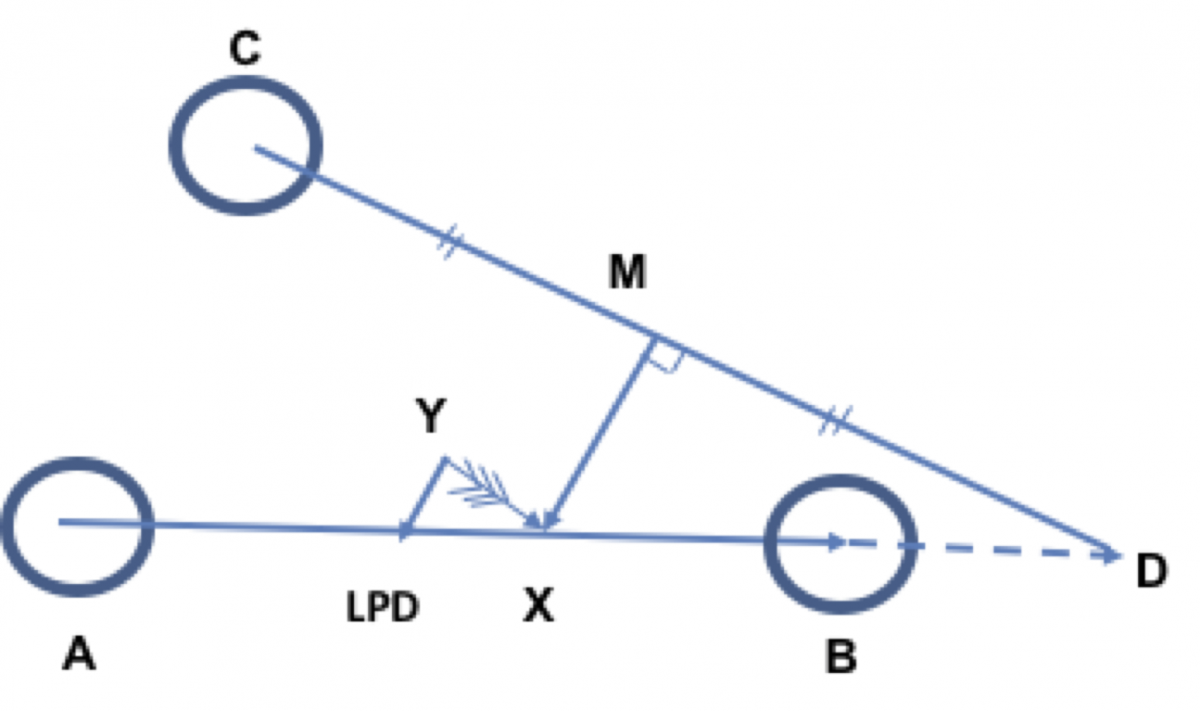
Graphical method for determining Last Point of Diversion
Step 1: Continue the track AB through destination B to a point D where safe fuel reserves are reached, (ie the fuel with which you would like to arrive at diversion C). Use TAS to give a still air distance – the wind will be considered at a later stage.
Step 2: Join C to D and construct the perpendicular bisector. This cuts track at X, which is then still-air LPD as DX = CX.
Step 3: Measure distance CX and divide by TAS to obtain time.