Movement Area
Movement Area



Definition
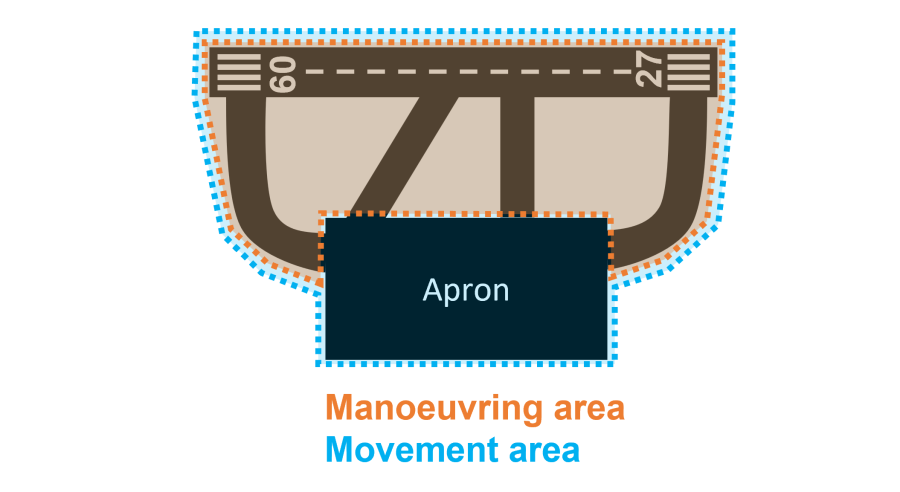
Movement area. That part of an aerodrome to be used for the take-off, landing and taxiing of aircraft, consisting of the manoeuvring area and the apron(s).
Source: ICAO Annex 14: Aerodromes
Description
The movement area of an aerodrome comprises:
- the runway(s), used primarily for take offs and landings
- the taxiway(s), providing links between different parts of the aerodrome, most often between the apron(s) and the runway(s)
- the apron(s), used primarily for aircraft parking, loading/unloading, refuelling and other ground services
The first two of the items listed above form the manoeuvring area.
CopyrightSKYbrary
The distinction between the movement area and the manoeuvring area is necessary because of the different procedures and responsibilities that apply. Generally, in order to ensure flight safety, entering the manoeuvring area is subject to certain restrictions and conditions. Examples of these are the requirement for radio communication with the Tower (or Ground) ATS unit and the need for an ATC clearance. Prevention of collision between aircraft, and also between aircraft and obstacles on the manoeuvring area is responsibility of the air traffic control unit (i.e. Tower or Ground). However, these restriction and this responsibility do not extend to the apron(s). Therefore, in order to mitigate the hazards, associated with apron operations and to provide efficient service (stand allocation, marshalling service, leader vans, etc.), specific arrangements need to be established. For example, the ATC unit may issue start up, pushback and taxi instructions within the apron on the common assumption that collision avoidance responsibility lies with the pilots and the other personnel. Alternatively, a special unit (note that this is not an ATC unit and its personnel does not comprise air traffic controllers) may be designated to assume responsibility for the operations on the apron.
Notwithstanding the differences between the manoeuvring area and the aprons, there are some similarities between the two that result in the need of a common term to address them as one entity. These include:
- All three elements are used by aircraft, therefore their surfaces need to be maintained in an appropriate condition for safe operations. For example, the information about braking action and the presence of snow (and other contaminants) is essential for the whole movement area.
- All three elements share common risks, e.g. collision between aircraft, collision between aircraft and vehicles, confusion due to ambiguous signs and markings, etc.
- All three elements need appropriate procedures to address the risks and to facilitate safe and efficient operations.
Related Articles
- Uncontrolled Aerodromes - Procedures
- Uncontrolled Aerodromes - Communications
- Passenger Safety on Ramp
Further Reading
- ICAO Annex 14: Aerodromes
- ICAO Doc 9137: Airport Services Manual, Part 8: Airport Operational Services, Chapter 10: Apron Management and Apron Safety
- ICAO Doc 9157: Aerodrome Design Manual, Part 2: Taxiways, Aprons and Holding Bays
Categories