


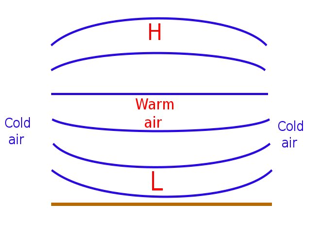



When the sun heats the Earth by way of short-wave radiation, the air immediately above the surface of the Earth is also heated through conduction. Air is a poor conductor of heat, and therefore with increasing solar radiation a temperature difference at various altitudes can be observed, initially with warmer air below colder air. This leads to instability, as warm air is less dense than cold air, and therefore the warm air rises, resulting in lower pressure near the surface. This results in a thermal depression: low pressure at the surface resulting from warm air. At higher altitude, because isobaric surfaces are spaced further apart in warm air than in cold air, the rising warm air will result in a relative high pressure aloft, as shown below.