



Third party (on the ground) risk
Description
This article discusses the risks posed to third parties on the ground by aviation operations. The article does not discuss ground handling accidents or the wider environmental impacts of aviation operations such as pollution or noise.

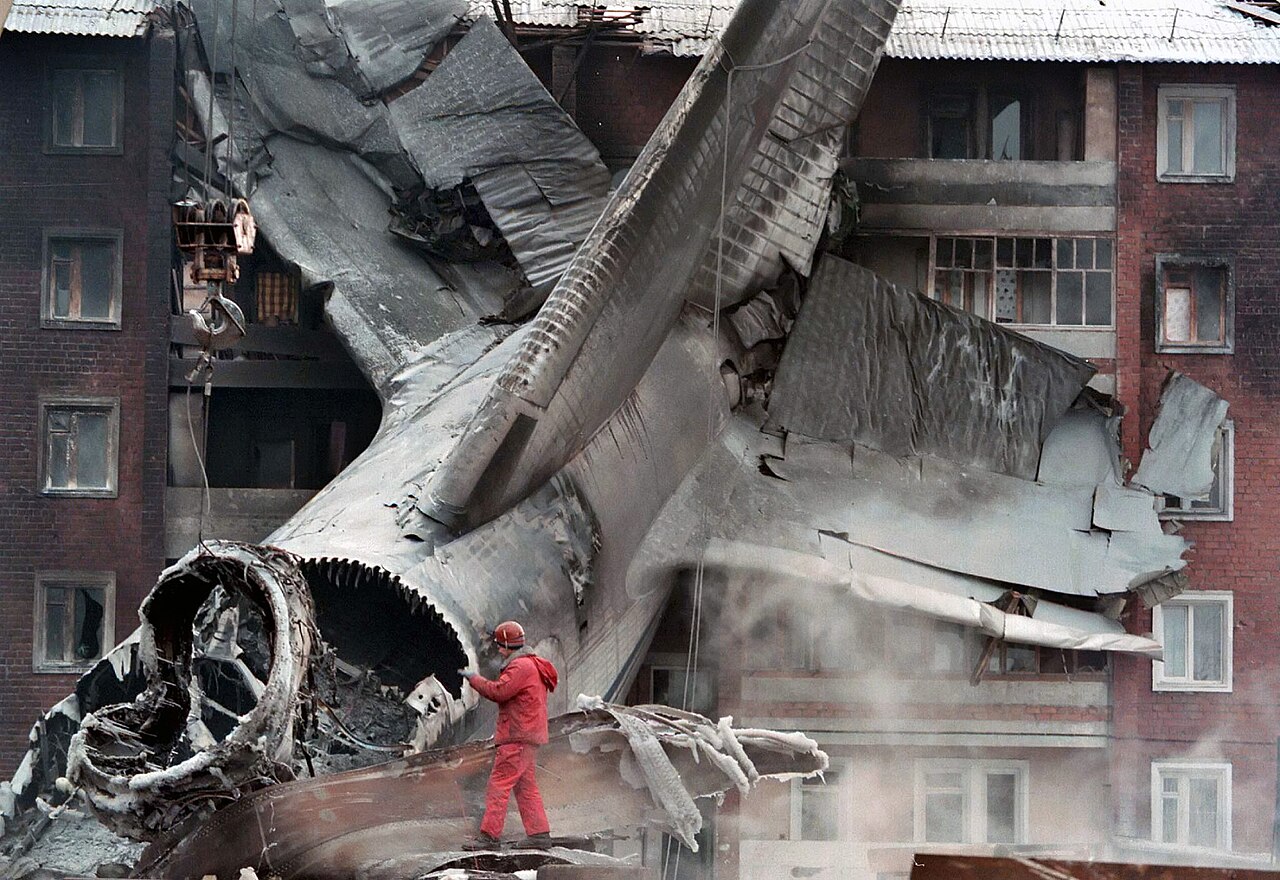
On 6 December 1997 an AN124 crashed into a residential area shorty after takeoff from Irkutsk [Source: Wikicommons/Mchs.gov.ru]
Overview
Third party risk in aviation accidents refers to the risk posed by aircraft accidents to people and property on the ground, including those who have no connection with flying. This is particularly high near airports and accidents which occur during the takeoff and landing phases of flight but extends to any accident which involves aircraft in flight.
Events involving aviation related objects hitting third parties or their property include:
- Icefalls - where ice from an aircraft has struck or ended up on third party property. This can include ice accumulations which have detached from the aircraft exterior as in entered warmer air or as a result of de-icing measures. It can also be the result of leakage from aircraft systems which has frozen at higher altitude and subsequently broken off, Blue Ice for example.
- Falling aircraft parts.
- Falling aircraft - where a whole aircraft has struck or ended up on third party property.
Managing third party risk
- Risk assessment and mapping: Methods are used to calculate and visualise risk levels around airports, often shown as "iso-risk contours" to guide planning decisions.
- Land use planning: Local authorities create restrictions such as public safety zones (PSZs) to limit housing and development in high-risk areas near airports.
Public Safety Zones (PSZs)
In the UK, public safety zones (PSZs) are defined as end of runway areas where development is restricted so as to control the number of people on the ground at risk of death or injury should an aircraft accident occur during takeoff or landing. The policy objective is to ensure that there is no increase (and over time a decrease) in the numbers of people living, working or congregating in the PSZ.
Implementation of PSZ policy is based on the level of risk to people on the ground around airports and the extent of the zone contours is based on aircraft accident data. The areas of the PSZs essentially correspond to the concentration of accident location, based on relevant data. The resultant shape of a PSZ is that of an elongated isosceles triangle. In all cases and airport's PSZs are based on the landing threshold for each end of the runway and taper away from the runway centreline.
PSZ policy is based predominantly on individual risk, while extending beyond it in relation to particular types of developments for example transport infrastructure and temporary uses.
An airport's PSZs will need to be redefined if the runway is extended or the landing threshold moved or if there is an increase in use of the runway concerned by commercial air transport.
Further reading
- Control of development in airport public safety zones - UK Department for Transport, updated 8 October 2021.
- Feasibility study on the integration of third party risk near airports into IMPACT (EUROCONTROL's environmental impact assessment platform) - June 2015
Categories