


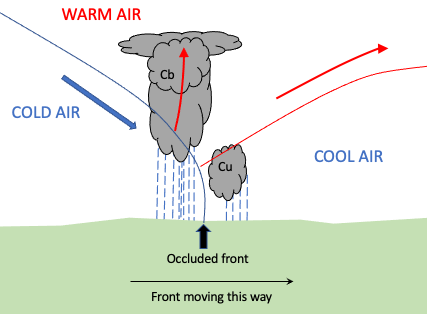



When large masses of warm air and cold air meet, they do not mix because of density differences. Instead, they form a front, usually hundreds of miles long. An Occluded Front forms when a warm air mass gets caught between two cold air masses. The warm air mass rises as the cool air masses push and meet in the middle. The temperature drops as the warm air mass is occluded, or “cut off,” from the ground and pushed upward. Such fronts can bring strong winds and heavy precipitation.
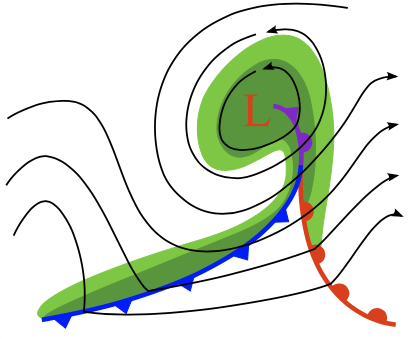
Occluded fronts usually form around mature low pressure areas.
Figure 1: An extra-tropical cyclone in the early stages of occlusion in the Northern Hemisphere
There are two types of occlusion, warm and cold:
Cold occlusion
In a cold occlusion, the cold air mass overtaking the warm front is colder than the cool air ahead of the warm front, and plows under both air masses.