


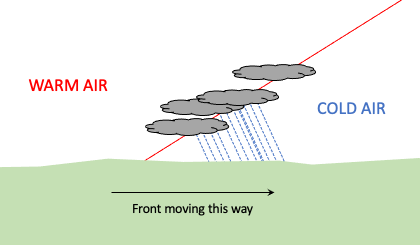



When large masses of warm air and cold air meet, they do not mix because of density differences. Instead, they form a front, usually hundreds of miles long. A Warm Front forms when a relatively moist, warm air mass slides up and over a cold air mass. As the warm air mass rises, it often condenses into a broad area of clouds. The warm air at the surface, behind the warm front, advances slowly, replacing the cold air at the surface. Depending on the amount of moisture available and the intensity of lifting being produced, light to heavy amounts of rain or snow can occur ahead of the surface warm front. Convective showers and thunderstorms are even possible if the warm air mass is unstable. Severe weather, however. is unlikely with colder air near the surface. Following warm frontal passage, temperatures will rise.