A320 / B788, vicinity Delhi, India, 2023
A320 / B788, vicinity Delhi, India, 2023
Summary
On 10 November 2023, an Airbus A320 inbound to Delhi going around from an approach to runway 29L came into lost required separation with a Boeing 787-8 that had just taken off from the closely spaced parallel runway 29R. The aircraft were on two different radio frequencies. Two successive TCAS RAs occurred and were followed, which prevented a collision. Prior to that point, both aircraft had been flown in accordance with their clearances. The conflict occurred because the aircraft flight paths as cleared created a collision risk. Inadequacies in related air traffic control procedures and practices and in controller performance and support were assessed as causal.
Flight Details
Aircraft
Type of Flight
Public Transport (Passenger)
Flight Origin
Intended Destination
Take-off Commenced
Yes
Flight Airborne
Yes
Flight Completed
Yes
Phase of Flight
Missed Approach
Flight Details
Aircraft
Operator
Type of Flight
Public Transport (Passenger)
Flight Origin
Intended Destination
Take-off Commenced
Yes
Flight Airborne
Yes
Flight Completed
Yes
Phase of Flight
Climb
Location - Airport
Airport
General
Tag(s)
Aircraft-aircraft near miss,
Inadequate ATC Procedures
HF
Tag(s)
ATC clearance error,
ATC Unit Co-ordination,
Procedural non compliance,
Stress
LOS
Tag(s)
Required Separation not maintained,
ATC Error,
Near Miss,
Go Around Separation
Outcome
Damage or injury
No
Non-aircraft damage
No
Non-occupant Casualties
No
Off Airport Landing
No
Ditching
No
Causal Factor Group(s)
Group(s)
Air Traffic Management
Safety Recommendation(s)
Group(s)
Air Traffic Management
Airport Management
Investigation Type
Type
Independent
Description
On 10 November 2023, a Boeing 787-8 (ET-ATL) operated by Ethiopian Airlines on a scheduled international passenger flight from Delhi to Addis Ababa as ETH 689 began its standard instrument departure (SID) left turn in day visual conditions (VMC) as cleared. However, it then came into close proximity with an Airbus A320 (VT-TQL) operated by Vistara Airlines on a scheduled domestic passenger flight from Ahmedabad to Delhi as VTI946, which had commenced a go-around after encountering windshear. The two aircraft initially received coordinated resolution advisories (TCAS RAs) as they came into close proximity at around 2,500 feet. Less than two minutes after receiving ‘clear of conflict’, the two aircraft then received further RAs as a result of the 787 making a right turn away from the initially perceived conflict position which unintentionally resulted in much closer proximity: 0.2 nm laterally and 400 feet vertically. Required separation was then re-established.
Investigation
A serious incident (AIRPROX) Investigation was carried out by the Indian Aircraft Accident Investigation Bureau (AAIB). The flight data recorder (FDR) and the two-hour cockpit voice recorder (CVR) were removed from the A320 and all relevant radar and recorded air traffic control (ATC) communications data were also available.
The 59-year-old 787 captain had a total of 21,000 hours flying experience, of which 800 hours had been on type, all obtained in command. The 29-year-old first officer had a total of 4,500 hours flying experience, of which 3,200 hours had been on type. The 34-year-old A320 captain had a total of 7,397 hours flying experience, of which 4,655 hours had been on type which included 887 hours in command on type.
The 33-year-old South One controller responsible for runway 29L had held his Delhi Aerodrome Control Rating for 4 years, the 36-year-old South Two controller responsible for runway 29R had held his Delhi Aerodrome Control Rating for 5 months, and the 42-year-old Approach Departure (radar) controller had held his Approach Control Radar Rating for two-and-a-half years.
What Happened
The Ethiopian Airlines 787 was cleared to take off from runway 29R by the South Two controller. Once airborne, it was transferred to the approach/departure controller and began the left turn required in the assigned SID as it continued to climb to the initial stop altitude of 4,000 feet. As it neared the extended centreline of the designated arrivals runway 29L (controlled by the South One Controller), it began to lose separation against an A320 which was making a go-around due to an unexpected turbulence (wind shear) encounter. The A320 crew had immediately notified the South One controller of their go-around. The call was acknowledged but both the South Two controller and the approach/departure controller remained unaware of this change.
A few seconds after the 787 became airborne, the South Two controller transferred it to approach/departure control, and the South One controller advised the A320 that “an Ethiopian 787 now climbing to 1,800 feet on adjacent runway." Ten seconds after this, the 787 checked in with approach/departure and reported passing 2,200 feet for 4,000 feet and the controller responded by giving the flight an unrestricted climb. A “Current Conflict Alert” on the approach/departure controller’s situation display then alerted him to the convergence of the two aircraft in a position approximately three nm from the Delhi airport reference point (ARP). The South One Controller then called the approach/departure controller to advise him that the A320 was making a go-around and was told that it was at 2,400 feet.
The approach/departure controller instructed the 787 to stop climb at 2,600 feet (which it did not initially do as the crew “did not fully understand the instruction”) and then to also turn right. Shortly after this, both aircraft were at 2,600 feet on similar parallel tracks (see below) separated by only 1.4 nm laterally.
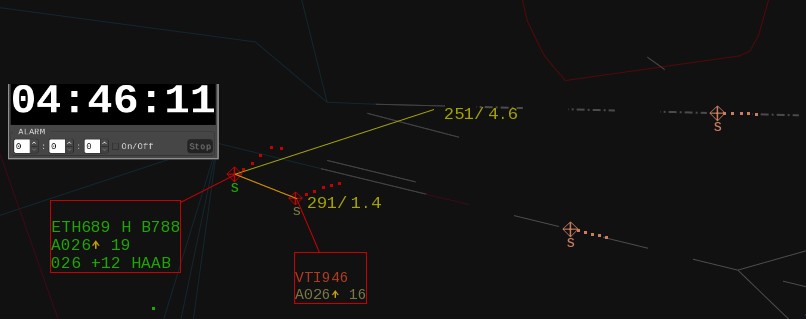
The Approach Departure Controller’s view of both aircraft at the same altitude. [Reproduced from the Official Report]
The 787 continued turning left, and 16 seconds later, coordinated TCAS RAs were received by both aircraft as their separation reduced. The A320 received a “Descend, Descend” RA and immediately began to do so until, at 2,250 feet, this changed to “Don't Climb." After the A320 RA had been terminated by a "clear of conflict" call, the South One controller instructed it to call the approach/departure controller. The 787 was told by the approach/departure controller to stop climbing, and then (in what was described as “a panicked voice”) the controller told it to “turn right on heading 270” and informed that traffic on go-around was at 2,200 feet. Since the 787 crew again “did not fully comprehend the message” they requested a repeat.
The A320 then checked in with approach/departure and the controller instructed it “maintain 2000 feet” and received the reply that it was “passing 2,300 feet and was clear of conflict." The 787 then called to say it was turning left to heading 270 and maintaining 3,000 feet, which the controller acknowledged. However, “according to the replay of the ATC surveillance system” it was actually turning right, as had been instructed. Almost immediately, the controller’s traffic display showed that the A320 (only) had received another TCAS RA against the 787, which had reached 3,100 feet and was continuing its right turn as the A320 climbed through 2,600 feet towards a similar position. The A320 stopped its climb and once back at 2,600 feet its RA changed to “Don't Climb." The minimum separation in this second encounter was 0.2 nm laterally and 400 feet vertically (see the illustration below).
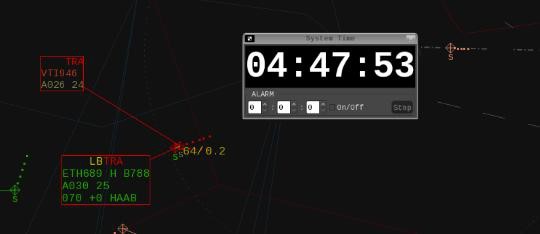
The Controller’s view of both aircraft in almost the same position but 400 feet apart. [Reproduced from the Official Report]
Fourteen seconds later, the applicable minimum separation between the two aircraft was restored and maintained and the controller’s ‘Current Conflict Alert’ ceased. The A320 was subsequently radar vectored for another ILS approach to runway 29L and completed its flight without further event.
Why It Happened
The two closely spaced southern runways at Delhi are each the responsibility of a dedicated controller, with the South One Controller responsible for runway 29L and the South Two Controller responsible for runway 29R. These two runway centrelines were only 380 metres apart and without controller intervention, the flight paths of the two aircraft were likely to cross at similar altitudes. According to the report, this “left little time for either controller to detect and resolve the (inevitable) conflict."
Essentially, the South Two Controller set up a potential conflict by not complying with a standard operating procedure (SOP) not to clear any aircraft to take off from runway 29R if there is an inbound aircraft within 90 seconds of touchdown on runway 29L. The South One Controller then did not transfer the arriving aircraft to the radar-equipped approach/departure controller quickly enough for them to be able to manage the impending loss of separation. Faced with a potential loss of separation, the approach/departure controller "issued inappropriate resolution instructions."
The Probable Causes of the AIRPROX serious incident were formally recorded as due to:
- The loss of situational awareness of the South Two tower controller who allowed the 787 take off from runway 29R even though minimum ‘Time-to-Threshold’ (TTT) of the arriving A320 to land on the parallel runway 29L was inside the minimum time of 90 seconds.
- When the inbound A320 discontinued its approach after becoming unstabilised and initiated a go-around from Runway 29L as the 787 became airborne from runway 29R, without coordination between the two controllers, an intersection of their projected flight paths occurred.
Five Contributory Factors were identified as follows:
- Operational Interdependency and Complexity:
The South Two Controller’s dependency, while issuing take-off clearance to aircraft under their jurisdiction, on the position of arriving aircraft on Runway 29L and concurrent operations on Runway 27 under adverse weather conditions created a complex and high-stress environment, increasing susceptibility to human error and compromising decision making. - Cognitive Overload on the South Two Controller:
The South Two Controller was required to manage multiple simultaneous safety-critical tasks at a very busy airport which resulted in cognitive overload. This impaired the controller’s ability to effectively prioritise actions and respond to critical situations in a timely manner. - Delayed Transfer of Communication During Missed Approach:
The South One Controller’s delayed transfer of communication to the Approach Departure Controller regarding execution of a missed approach, impeded efficient conflict resolution and limited the controller’s ability to manage the situation effectively. - Ineffective Conflict Resolution Instructions:
The Approach Departure Controller issued inappropriate resolution instructions to the aircraft involved in the conflict (which) potentially resulted (in reduced) separation between both aircraft and escalated the risk of (an) AIRPROX. - Inadequate Separation Assurance in SID Design:
The design of the Standard Instrument Departure (DUDUM6C) did not adequately ensure positive separation between (a) departing aircraft from Runway 29R and (an) aircraft executing a missed approach from Runway 29L, (which) increased the risk of loss of separation.
A total of 20 Safety Recommendations were issued at the conclusion of the Investigation based on its Findings as follows:
- that the Airports Authority of India (AAI) take appropriate action to review and redesign Standard Instrument Departures (SIDs) and missed approach procedures at Delhi (so that they) have initial positive separation assurance. The design should provide controllers with adequate time to intervene and resolve any potential conflicts between aircraft conducting missed approaches and departing aircraft from closely spaced runways.
- that the Airports Authority of India (AAI) consider and implement procedures enabling automatic transfer of communication from aerodrome controllers to approach/departure controllers at Delhi. This would allow departing aircraft, under normal conditions, to directly contact the approach/departure controller without requiring explicit manual instructions from the aerodrome controller. A safety assessment should be conducted prior to implementation to ensure the procedure is safe and effective, with contingency measures in place for special circumstances.
- that the Airports Authority of India (AAI) develop and implement training programs on Team Resource Management (TRM), emphasising its benefits in reducing teamwork-related incidents and enhancing communication and coordination among ATC personnel.
- that the Airports Authority of India (AAI) ensure air traffic controllers coordinate via intercom and communicate exclusively in aviation English. Using the intercom enhances communication efficiency by providing a clear, direct, and reliable means of coordination between controllers. This minimises background noise and potential distractions, ensuring that critical information is accurately conveyed. Communicating in aviation English, the global standard, further reduces the risk of miscommunication, especially in high-pressure situations, promoting safer and more consistent operations.
- that the Airports Authority of India (AAI) implement the recommendation from a previous investigation report to ensure that ATC units are equipped with devices to record background communications and the aural environment at controller workstations as a priority.
- that the Airports Authority of India (AAI) implement an automated self-briefing system for meteorological conditions to ensure that all air traffic controllers receive and complete their required briefings. This system would allow controllers to access up-to-date weather information independently, log their briefing completion and generate summary reports for management oversight. Implementing this system will standardise the briefing process, reduce the risk of missed or incomplete briefings, and enhance operational safety, particularly in managing weather-related events like wind shear.
- that the Airports Authority of India (AAI) review the “Standard Operating Procedures for Four Runways” and incorporate explicit contingency plans for scenarios where one or more runways are unavailable. These procedures should ensure that operations remain safe and efficient during any adverse weather conditions or disruptions.
- that the Airports Authority of India (AAI) ensure strict adherence to SOPs by controllers and implement periodic and effective monitoring of compliance with established procedures to maintain operational consistency and safety.
- that the Airports Authority of India (AAI) ensure air traffic controllers undergo periodic refresher training on automation functions that are infrequently used. This will help controllers maintain proficiency in all aspects of their role and reduce the likelihood of errors due to forgetting less frequently used functions over time. Regular training updates and simulated exercises should be implemented to reinforce their knowledge and skills in effectively using these automation tools.
- that the Airports Authority of India (AAI) develop effective implementation of windshear reporting procedures to ensure timely and accurate dissemination of information, enhancing the safety of flight operations during adverse weather conditions.
- that the Airports Authority of India (AAI) review and enhance the simulator training of surveillance controllers, focusing on conflict resolution techniques for handling unusual situations. Regular training will ensure that controllers are well-prepared to manage unexpected events safely and efficiently.
- that the Airports Authority of India (AAI) ensure inclusion of provision of preservation of automatic terminal information service (ATIS) recording, particularly if any safety occurrence happens in terminal airspace or at an aerodrome.
- that the Airports Authority of India (AAI) ensures that Tower Electronics Flight Strips (TEFS) movements are consistently recorded whenever such systems are introduced in any ATM Automation System. This will facilitate thorough safety investigations in the event of incidents or accidents by providing a comprehensive record of flight data and controller actions.
- that the Airports Authority of India (AAI) should have a comprehensive SOP for a situation when any of communication channel recorder becomes unserviceable.
- that the Airports Authority of India (AAI) should effectively implement procedures to promptly relieve air traffic controllers from duty after a critical incident to mitigate stress effects. Timely relief will help prevent impaired decision-making and reduced performance due to heightened stress levels.
- that the Airports Authority of India (AAI) implement a Critical Incident Stress Management (CISM) program for controllers to provide immediate and effective psychological support following traumatic or stressful incidents. The program should include timely debriefings, peer support, and access to professional counselling services. By addressing stress in a structured and supportive manner, AAI can help controllers recover quickly, maintain performance, and reduce the risk of stress-related errors, ultimately enhancing operational safety.
- that the Airports Authority of India (AAI) ensure all safety-critical positions are consistently manned including (the) Alpha Controller position and (that) controllers take over watch in accordance with established procedures. This will contribute to the safe and efficient management of Air Traffic Services and support effective safety investigations in the event of incidents or accidents.
- that the Airports Authority of India (AAI) may verify the safety management system (SMS) manual issued by Delhi Airport ANS to ensure that regulations, guidelines and procedures outlined in the manual are in line with the existing regulations.
- that the Airports Authority of India (AAI) ensure that ATM Automation System should be developed for alerting the controllers when the Time-To-Threshold (TTT) reaches the pre-defined value to attract their attention and (ensure that) no departure breaches the TTT the limit.
- that the India Meteorological Department (IMD) implement wind shear warning systems at all busy airports. These systems will provide real-time wind shear alerts to both aircraft and air traffic control, significantly enhancing safety during takeoff and landing. By enabling timely and accurate warnings, this system will allow pilots and controllers to take proactive measures, reducing the risk of incidents (arising from) sudden wind shear conditions.
The Final Report was completed on 9 September 2025 and published online a few days later.