B773, en-route, central Iceland, 2023
B773, en-route, central Iceland, 2023
Summary
On 13 February 2023 a Boeing 777-300 encountered unforecast severe mountain wave turbulence at FL350. The PF was an inexperienced first officer undergoing line training. A line captain was in the cockpit whilst the training captain-in-command was taking crew rest. Although the line captain responded with control inputs, he did not announce this and the trainee continued his own inputs. As a consequence of competing pitch commands, the aircraft lost 8,000 feet of altitude in approximately one minute at up to 17,100 fpm before stabilised flight was regained and a recovery climb initiated. The flight continued to Istanbul where the injured crew and passengers were hospitalised.
Flight Details
Aircraft
Operator
Type of Flight
Public Transport (Passenger)
Flight Origin
Intended Destination
Take-off Commenced
Yes
Flight Airborne
Yes
Flight Completed
Yes
Phase of Flight
Cruise
Location
General
Tag(s)
Copilot less than 500 hours on Type,
Flight Crew Training,
CVR overwritten
HF
Tag(s)
Inappropriate crew response - skills deficiency,
Procedural non compliance
LB
Tag(s)
Accepted ATC Clearance not followed
LOC
Tag(s)
Uncommanded AP disconnect,
AP Status Awareness,
Aircraft Flight Path Control Error,
Environmental Factors,
Temporary Control Loss,
Incorrect Aircraft Configuration
WX
Tag(s)
Mountain Wave/Rotor Conditions
CS
Tag(s)
Turbulence Injury - Cabin Crew,
Pax Turbulence Injury - Seat Belt Signs on
Outcome
Damage or injury
Yes
Aircraft damage
Minor
Non-aircraft damage
No
Non-occupant Casualties
No
Occupant Injuries
Few occupants
Off Airport Landing
No
Ditching
No
Causal Factor Group(s)
Group(s)
Aircraft Operation
Safety Recommendation(s)
Group(s)
Aircraft Operation
Air Traffic Management
Investigation Type
Type
Independent
Description
On 13 February 2023 a Boeing 777-300 (TC-JJJ) operated by Turkish Airlines on a scheduled overnight international passenger flight from Toronto to Istanbul as TK0018 was in cruise at FL350 when severe turbulence was encountered without warning. A trainee first officer acting as pilot flying (PF) was being overseen by a line captain whilst the training captain and aircraft commander was taking scheduled crew rest. The pilot monitoring (PM) captain responded to the turbulence by making control column inputs without announcing he was taking over, and the trainee continued his own inputs. The combination of simultaneous and uncoordinated actions resulted in the aircraft descending almost 8,000 feet at up to 17,100 fpm with multiple stick shaker activations and the airspeed exceeding maximum operating speed (Vmo). Two passengers and five cabin crew sustained minor injuries, and the airline said minor damage had occurred to the aircraft interior. The line captain was eventually able to gain control and a recovery climb was initiated. Five minutes after the upset had begun, the training captain returned to the flight deck and took charge - initially from a supernumerary crew seat before replacing the line captain and taking over as PF. He declared a PAN and in the presence of “light to moderate turbulence” accepted an offer of a track change which would avoid a just-advised area of potential further turbulence. The remainder of the flight was completed to destination without further event.
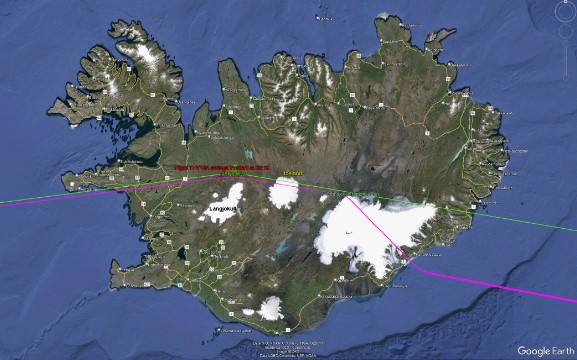
The location of the investigated serious incident just ahead of the slight right turn on the flight plan route (in green). The actual route (in magenta) was subsequently changed for unrelated reasons. [Reproduced from the Official Report]
Investigation
On the basis that none of the injuries were ‘serious’ as defined in ICAO Annex 13, the Icelandic Transportation Safety Board (ITSB) commenced a serious incident Investigation (as opposed to an accident investigation) based on downloaded flight data recorder (FDR) data and recorded air traffic control (ATC) radar and communications data. Relevant data on the cockpit voice recorder (CVR) had been overwritten due to the decision to complete the flight to its intended destination. It was noted that:
- The training captain in command had a total of 20,174 hours flying experience, including 7,253 hours on type, of which 5,473 hours were in command on type and was in the crew rest area when the turbulence was first encountered.
- The PM operating captain had a total of 10,986 hours flying experience, including 2,154 hours on type, of which 2,112 hours were in command on type.
- The PF first officer was undergoing line training on type and had a total of 1,128 flying hours, which included 38 hours on type. His training prior to commencing line flying had included mandatory upset and recovery (UPRT) training.
What Happened
The flight was level at FL 350 at M 0.83 with the autopilot (AP) and autothrust (A/T) engaged, the latter set to speed mode, when the aircraft suddenly encountered unforecast severe turbulence. The possibility of less significant turbulence had been recognised earlier, and the seat belt signs had already been illuminated for approximately ten minutes. Initially, a downdraft occurred and the A/T responded by increasing thrust. But within 30 seconds, following recorded oscillations in acceleration and angle of attack, the airspeed began to increase when a short updraft was followed by a rapid downdraft. Despite the AP still being engaged, the first officer responded by “applying control column force” to pitch up. As the speed approached 300 KCAS/M0.88, the speed brakes were deployed. The thrust levers were moved to idle but the speedbrakes remained deployed and the A/T began to increase thrust. Further manual thrust reductions to idle were partly countered by A/T thrust increases, but airspeed began to fall. The flight management computer (FMC) airspeed target was only very briefly maintained before a slow descent and loss of airspeed began.
The stick shaker activated in response to “brief, sharp, increases in angle of attack" and the first officer “responded with a strong push on his control column" which “probably reached the 27kg maximum override force required to disconnect the AP." The PF continued to push on his control column. The nose-down aircraft attitude began to increase, and a second stick shaker activation occurred with the rate of descent recorded as 1,360 fpm (point 9 on the illustration below). A third followed fourteen seconds later (point 15 on the illustration) at a 9,008 fpm rate of descent.
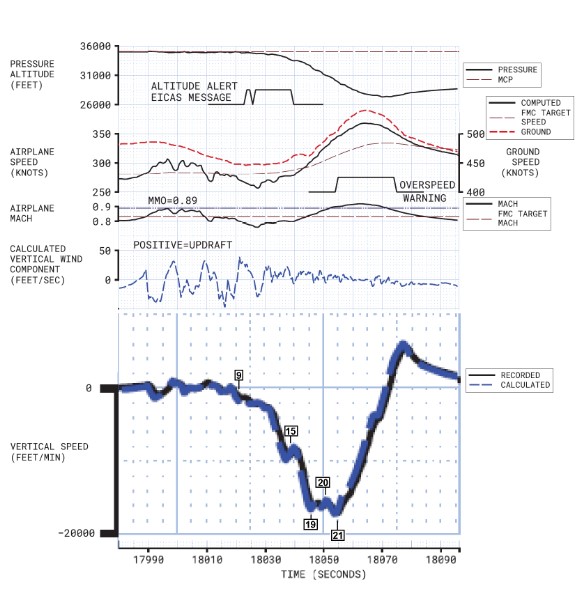
A summary of key FDR parameters during the upset. [Reproduced from the Official Report]
The captain then began to make simultaneous opposing pitch-up control column inputs in response to the first officer’s pitch down. The descent rate increased and three seconds later, the lowest airspeed during the descent (256 KCAS) was recorded and maximum forward thrust was commanded. It was evident from the flight data that “a force‐fight between the two pilots had ensued, with the first officer pushing on the control column and the captain pulling on it” with almost equal forces of close to 45 kg. This action (point 19 on the illustration) led to the first of a number of control column breakouts as the aircraft descended through 32,000 feet at over 300 KCAS with a recorded rate of descent of 15,920 fpm and the opposing control column inputs reaching almost 45kg. Five seconds later, Vmo/Mmo was exceeded (point 20 on the illustration). As the captain made a further control column aft movement of almost 60 kg (point 21 on the illustration), the maximum rate of descent of 17,100 fpm was reached as the overspeed warning continued, eventually ceasing after being active for 20 seconds. Nine seconds later, the airspeed peaked at 368 KCAS (Vmo + 18, equivalent to Mmo + 0.03) as the altitude was approaching 27,500 feet. Opposing control column forces were still occurring but with their positions now similar at around neutral, and six seconds later, the minimum recoded altitude of 27,295 feet was reached.
It was then a further 6 seconds before the overspeed condition ceased and a call from ATC was made. The crew was busy re-engaging the AP and retracting the speed brakes and did not respond until the call was repeated. Then, one of the pilots “noticeably out of breath” replied, advising that severe turbulence had been experienced and that they were now climbing back to FL350. At FL315, “another period of prolonged turbulence, evident by additional oscillations in acceleration and air data” was encountered and the AP was disconnected and a descent to FL280 was commenced. Shortly after this, the training captain in command returned to the flight deck and took charge, according to information supplied by the airline.
The senior cabin crew member (SCCM) was contacted and provided a report on damage and injuries in the passenger cabin. They advised that a medical doctor had identified himself and was assisting injured passengers. Minor damage to the aircraft interior included to two passenger oxygen units, an armrest and the fore and aft galley lighting and some passenger cabin wall panels were also reported to have been damaged.
After discussing the possibility of a diversion to either Glasgow or Copenhagen and consulting the company operations control centre (OCC), it was decided to continue to the intended destination, which was achieved without further event. Nearer the destination, a request was made for ambulances to take some of the injured to hospital.
A full illustrated description of the episode is provided in Appendix II of the investigation report.
Why It Happened
The initial encounter with unforecast severe turbulence had led to a situation that justified a serious incident investigation, and the flight crew had not been given weather information that could have alerted them. This issue was subject to a detailed review.
The prevailing meteorological situation was reviewed using all available data. The applicable significant weather chart issued by WAFC (World Area Forecast Centre) London had been provided in the crew’s flight documents and was valid for 0600 UTC (just over 2 hours prior to the turbulence encounter). This indicated that “moderate and occasionally severe” turbulence was expected north and northwest of Iceland between FL280 and FL390 but there was no forecast of significant high-level turbulence over Iceland, even after the flight had departed. The only forecast severe turbulence (of mountain wave origin) over or in the immediate vicinity of Iceland was the subject of a SIGMET issued by the Icelandic Meteorological Office advising of turbulence up to FL100 during a period prior to the flight passing over Iceland. This was included in the flight weather package handed to the crew. This was subsequently re-issued initially with an extended duration but with no change in the maximum height. It was then issued for a third time just before the investigated event occurred for a slightly larger area but still with no large increase in the vertical limit, which was changed only from FL100 to FL120.
However, immediately after the third version of the mountain wave SIGMET had been issued, the Icelandic Meteorological Office duty forecaster prepared and issued another SIGMET with immediate validity. This SIGMET advised of severe mountain waves over part of eastern Iceland between FL300 and FL440 slightly to the east of the Boeing 777s current position, but which would affect its flight planned track. This new SIGMET was issued just as the aircraft, having recovered from the loss of control, had climbed to just below FL300. The crew were advised by ATC and accepted the suggested slightly more southerly route, which would avoid the new SIGMET airspace. Only 15 minutes later did ATC advise the duty forecaster of the severe turbulence encounter which had preceded the 777 upset. This then led to the issue of a revised version of the just-issued SIGMET to extend it to include more westerly area airspace.
At the request of the ITSB, the Icelandic Meteorological Office subsequently prepared a technical report on meteorological aspects relevant to the incident. This noted that although they had procedures for the issue of SIGMETs for low altitudes, there were no similar procedures in the case of mountain waves and there was scope for improvement. It was, however, noted that no cross-section forecasts over areas for vertical wind speed were issued.
The report stated that calculated vertical wind and headwind data from the FDR aligned with the airspeed deviations leading up to the turbulence encounter. It also found that FDR wind data also indicated that at the onset of turbulence, the headwind/tailwind component relative to the crosswind component had transitioned from a right crosswind of 40 knots to an alternating left and right crosswind.
It was also noted that at the time of the incident, the on-duty forecaster had access only to a single high‐resolution model. It was also noted that when the high‐resolution model forecast data was analysed, there were indications of the formation of mountain waves at the location where they were encountered.
Finally, it was accepted that “as the WAFCs do not forecast mountain waves”, it is important that local MWOs (Meteorological Watch Offices) monitor such weather conditions and issue SIGMETs for them.
The formally documented Causes of the upset were as follows:
- An encounter with severe turbulence.
- A breakdown in Crew Resource Management.
- A loss of Crew Situational Awareness.
Four Contributory Factors were also identified:
- A SIGMET for high‐altitude severe mountain waves had not been issued prior to the
incident. - The captain (PM) did not follow procedure by using the phrase “I have control” in accordance with the airline’s operating procedures when he tried to take over the controls.
- Inappropriate control inputs occurred during the aircraft upset.
- The autothrottle remained engaged and speedbrakes remained deployed during the aircraft upset.
Four Safety Recommendations were made as a result of the investigation as follows:
- that the Icelandic Meteorological Office improves the use of automation when analysing weather phenomena (such as turbulence, icing, mountain waves, thunderstorms etc.) for high resolution weather forecasts. [23‐016F005‐T1]
- that the Icelandic Meteorological Office presents SIGMET areas in graphical form on charts. [23‐016F005‐T2]
- that Turkish Airlines re‐evaluates their pilot CRM training to re-emphasise the importance of each pilot’s role in flying the aircraft. [23‐016F005‐T3]
- that Isavia Air Navigation Services (ANSP) ensures that pilot reports to the Icelandic Meteorological Office include all weather-related information. [23‐016F005‐T4]
The Final Report was approved on 8 May 2025 and subsequently released online.